

Global enterprises across various industries continuously rely on platforms that have been in place for 10 to 20 years. These platforms support core workflows and functions driven by connected systems, SCM mechanisms, manufacturing software, ERP/CRM systems, and banking dashboards.
While these legacy platforms have delivered measurable value for decades, they now limit capabilities to scale with modern business requirements, address evolving pain points, and resolve emerging complex challenges. This calls for rethinking legacy investments to modernize operations with strategic modernization.
But why is modernizing legacy systems a non-negotiable business imperative for today’s enterprises?
There are four main reasons for this shift – cloud adoption, data and AI readiness, system integration, and compliance.
Organizations are rapidly moving toward cloud platforms (Azure, AWS, GCP) to ensure scalability and cost-efficiency across digital-first operations. They are leveraging systems with capabilities to accommodate advanced data-driven analytics and AI-based input-to-decision patterns. Many companies are prioritizing integration with the latest tools while recognizing core security and compliance requirements.
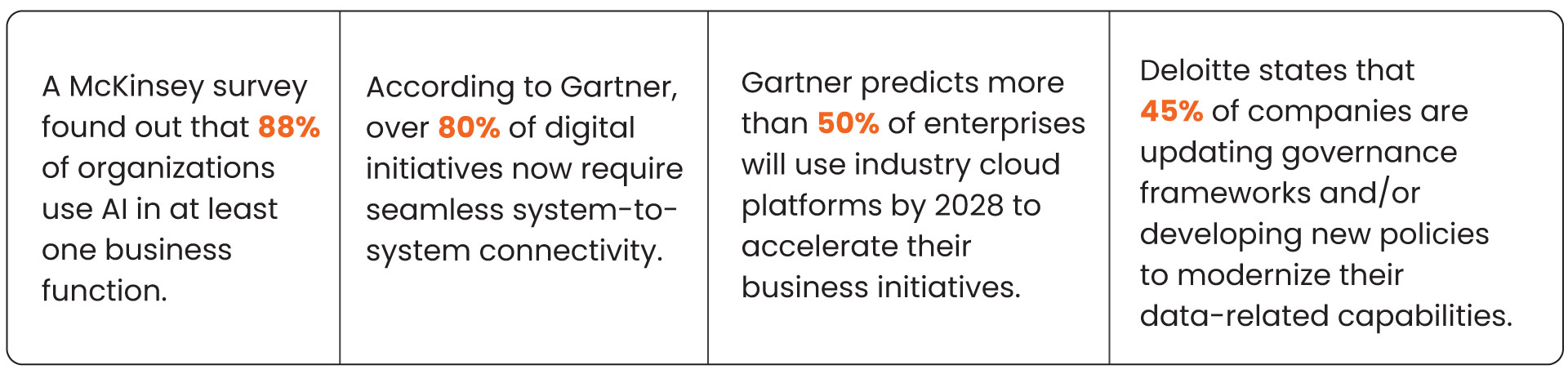
Despite these trends and expanding digital footprints, enterprise leaders continue to grapple with key questions about business impact and execution. Will modernization cause disruption and downtime? Will newly integrated systems perform or break existing ones? Will AI-led transformation deliver measurable business outcomes?
This is where a clear and strategic approach to modernization is essential, ensuring a seamless connection between strategy and execution for sustainable, high-performance outcomes.
Why Legacy Systems Limit Business Agility
Over time, systems that were once invaluable assets can become barriers to innovation, growth, and competitive advantage. Here’s why these systems restrict organizations from adapting, scaling, and competing.
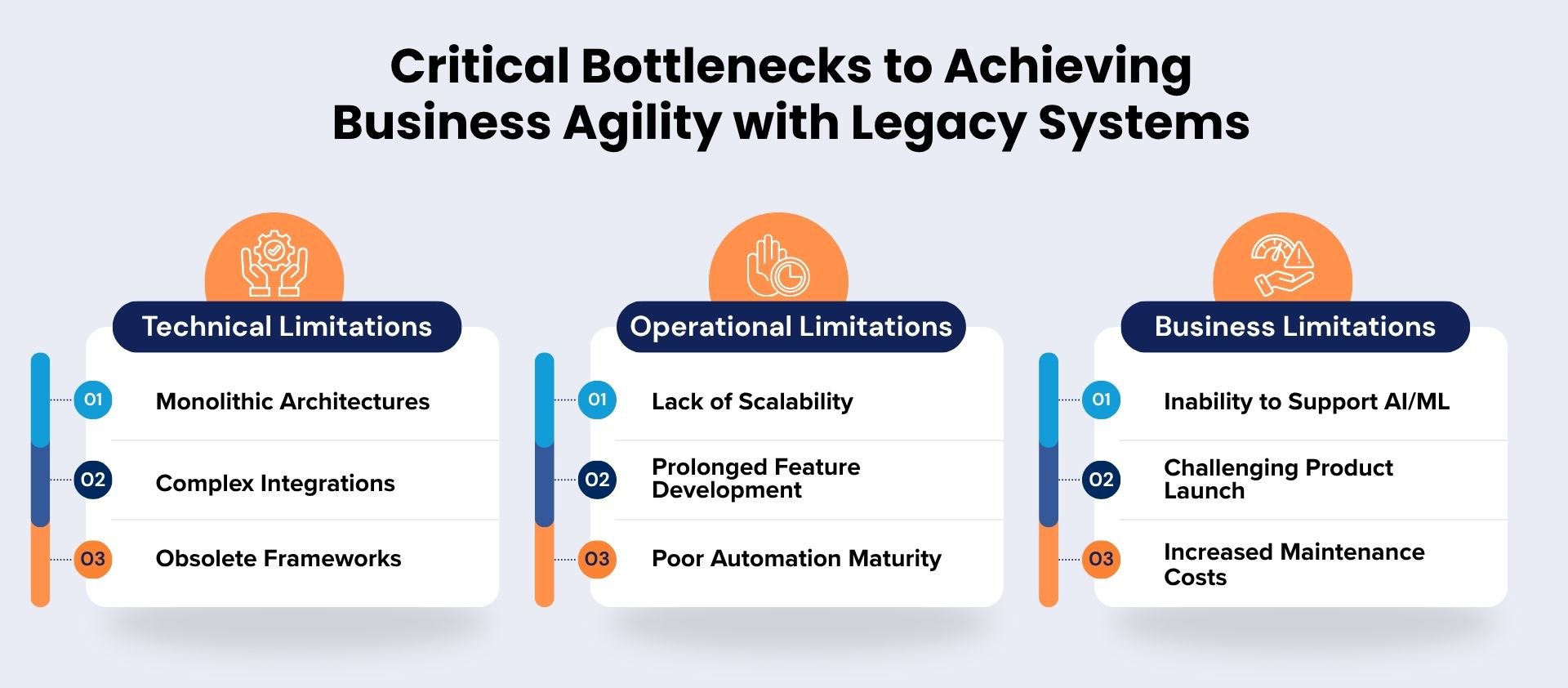
#1 Technical Limitations
-
Monolithic Architectures
According to IDC, 70% of companies are still using apps that rely on monolithic legacy architectures.
These architectures are rigid and hard to scale. With tightly coupled components in place, the system lacks the required flexibility for considerable expansion without affecting the entire environment. This restricts organizations from quickly adapting to changing business scenarios.
-
Complex Integrations
Legacy systems were not designed for seamless integration with modern tools and technologies. They restrict the potential for smooth digital transformation with data silos, cross-functional limitations, and a lack of interoperability.
-
Obsolete Frameworks
Legacy applications often rely on outdated frameworks and code, creating significant challenges for maintenance and updates. With technology advancements taking the center stage, these frameworks become inefficient, low-performing, and cumbersome. This deficiency increases overhead costs and operational complexities.
Forrester states that enterprises spend 74 to 80% of their IT budgets on maintaining outdated infrastructure and apps.
#2 Operational Limitations
-
Lack of Scalability
Business expansion requires a well-structured foundation to accommodate changing customer preferences. While core legacy apps are capable of catering to regular requirements, they can cause permanent damage when greater workloads come in. This gap hinders the achievement of key business objectives and measurable outcomes.
-
Prolonged Feature Development
A 10x Banking report suggests that 55% of banks consider core systems as the biggest barrier to elevating their digital assets
Often built to meet the needs of the past, legacy systems cannot adapt to evolving market demands. Adding new features and functionalities to such systems can be cost-intensive and slow. It results in extended innovation cycles, slower time-to-market, and delayed feature advancements.
-
Poor Automation Maturity
Legacy systems are unable to prioritize automation. As such, many companies heavily rely on human-driven processes and manual tasks that are time-consuming and vulnerable to discrepancies. They neglect automation opportunities that increase the scope of human errors.
#3 Business Limitations
-
Inability to Support AI/ML
An MIT study states that 95% of AI projects fail to deliver measurable value. A key contributor to this underperformance is the inability of legacy systems to integrate with AI.
Advanced technologies, such as AI, ML, and NLP, need immense computing power and flexibility to operate and generate desired results. Decade-old software systems are unable to provide such capabilities and restrict AI solutions from supporting data-based automation and decision-making.
-
Challenging Product Launch
In today’s digital-first business landscape, faster time-to-market and time-to-value are crucial for the success of your new product. However, legacy frameworks struggle to align with iterative and agile deliveries. This undermines your company’s potential to enable innovative breakthroughs, market relevance, and competitive growth.
-
Increased Maintenance Costs
ServiceNow identified that companies invest $40K each year and spend 17 hours per week on average to maintain legacy systems. They also found out that more than 33 percent of organizations experience a negative impact of obsolete platforms on the industry due to increased maintenance costs.
Age-old systems need frequent repairs, patching, and upgrades. Your team needs to spend excessive time, effort, and resources on optimizing and maintaining such systems and platforms. This increases maintenance costs and reduces the scope of innovation and business growth.
See how a phased modernization approach helped reduce maintenance costs, improve system reliability, and support more efficient operations. Read the case study.
Why Enterprises Contemplate Legacy Modernization?
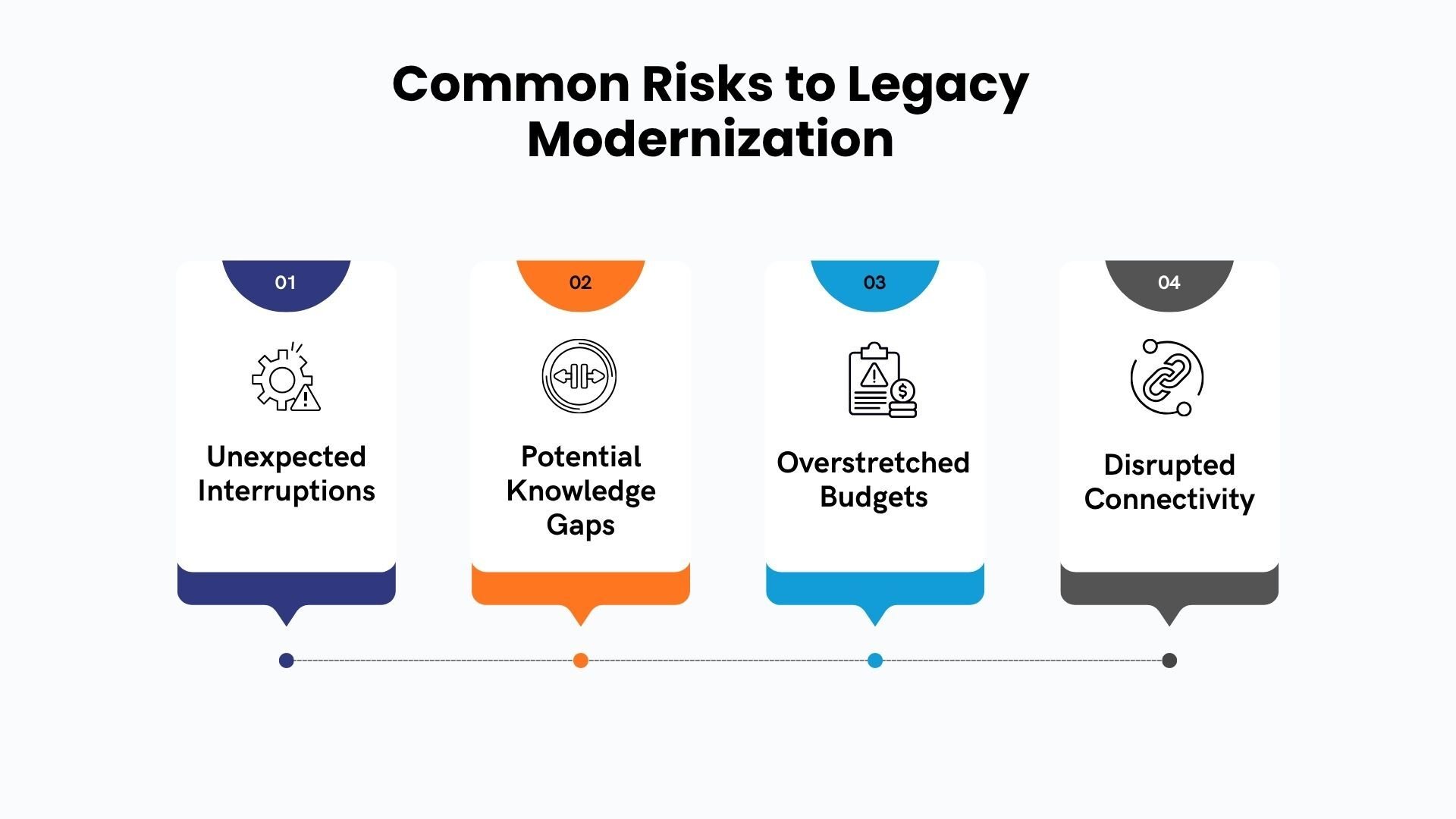
Creating a strategy that can positively disrupt core operations can be challenging. That’s why many enterprise leaders approach legacy application modernization with caution. Here are some common risks that worry them the most.
-
Unexpected Interruptions
A small breakdown in a system can cause downtime. It can result in long-term reputational damage, loss of revenue, and customer dissatisfaction. Critical systems going offline during migration can put the business in jeopardy.
-
Potential Knowledge Gaps
Organizations often depend on employees with long-standing contributions to business success. These professionals are well-aware of how legacy systems, platforms, and frameworks operate. However, when they leave or retire from their positions, it creates a knowledge gap that can stall the modernization process.
-
Overstretched Budgets
One of the most important concerns for enterprises looking to modernize their legacy systems is budget overruns. Predefined expenses can easily elevate when dealing with multi-year transformation initiatives. Hence, many organizations avoid a protracted initiative with no clarity on closure or outcomes.
-
Disrupted Connectivity
Many enterprises are driven by systems that underline solid connectivity with internal and external platforms. They believe that unwinding such tightly coupled systems during transition can disturb critical business processes and service delivery.
Legacy Modernization: The Disruption-Free Enterprise Blueprint
The key to a successful transformation project is risk-free and continuous operations throughout the migration process. Let’s check out some practical strategies that most large-scale enterprises apply to modernize without disruption.
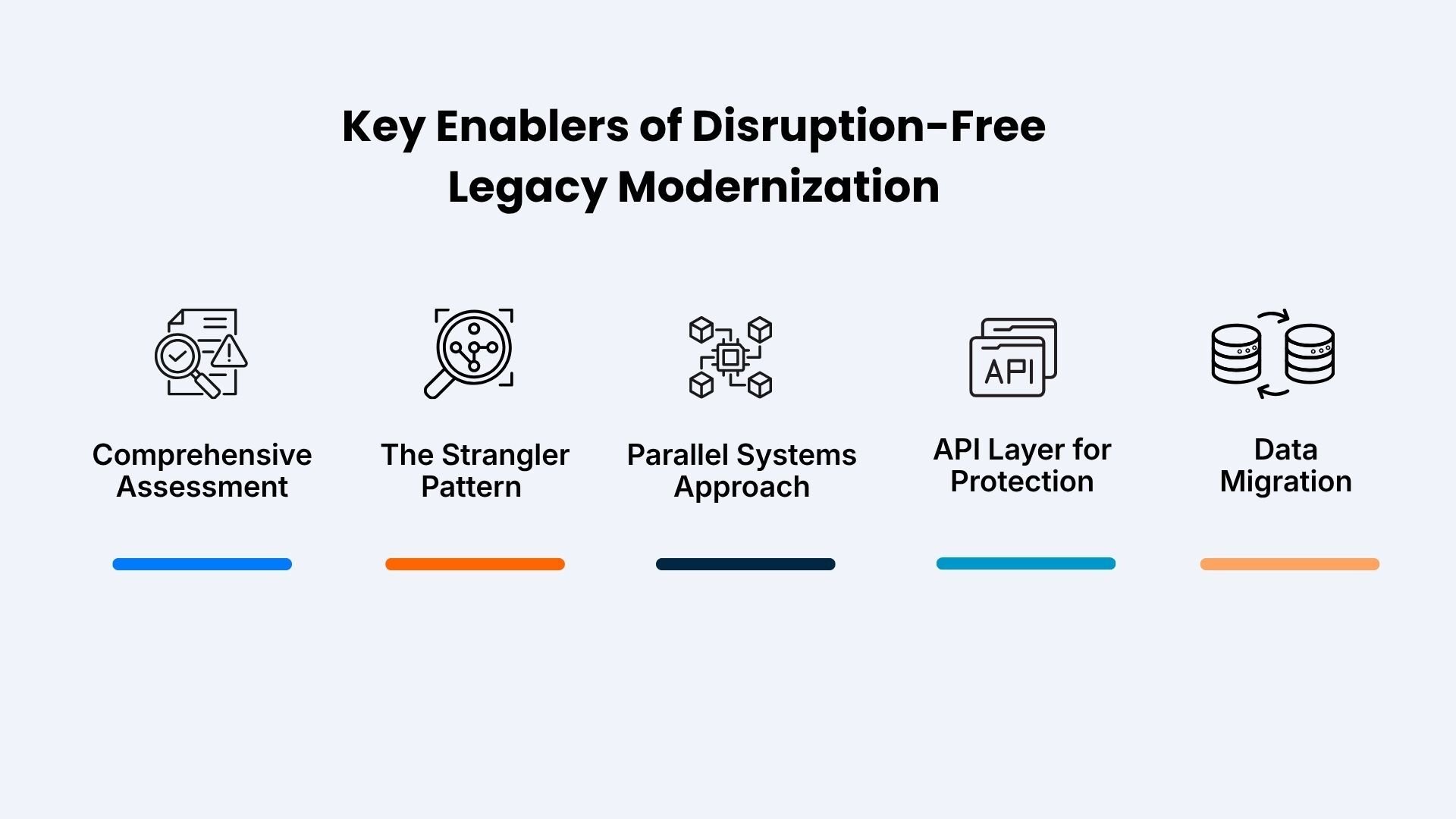
#1 Comprehensive Assessment
It’s crucial to gain a deeper understanding of your existing system before approaching enterprise-grade modernization. A full-scale assessment backed by an initial discovery phase is essential to ensure that there are no disruptions over time. It helps recognize potential risks, integration pain points, and dependencies that can hinder the transition.
Key Activities that Play a Vital Role
-
Evaluating system architecture to analyze how various elements work together as a combination.
-
Creating visual diagrams to outline the system architecture and recognize critical bottlenecks.
-
Identifying essential dependencies across apps, systems, and processes for smooth functioning.
-
Highlighting key components that can directly impact business operations during migration.
-
Understanding legacy system integrations with other platforms to ensure interoperability.
-
Reviewing the codebase for technical debt or areas that demand dedicated support on priority.
-
Measuring system performance to set benchmarks that help validate modernization success.
#2 The Strangler Pattern
Large enterprises take full advantage of the strangler pattern to modernize their legacy systems. This approach enables incremental advancements and supports a gradual transition. It ensures new and old systems can coexist without complexities.
In an analysis, HashiCorp’s experts identified that implementing domain-driven design principles with the strangler pattern to gradually replace monolithic functionalities with microservices helped achieve 55% more effective service decomposition results.
Key Activities that Play a Vital Role
-
Replacing modules gradually via reengineering or integrating modern apps into the existing architecture.
-
Designing new software systems around old ones to run in parallel until migration is complete.
-
Strategizing system modernization in a way that each component phases out one by one.
-
Avoiding broad migration and focusing on gradual updates to eliminate irreversible damage.
-
Following a continuous delivery approach for the consecutive integration of features/modules.
-
Creating a controlled rollout environment to test and manage every step of the transition process.
#3 Parallel Systems Approach
Another proven technique to modernize outdated systems is running systems in parallel. This technique enables the new platform to run alongside the older one, shifting traffic gradually to the new one over time. It helps enterprise leaders test the new platform in a real, controlled environment while ensuring that the existing system is stable (as a fallback) if complexities arise.
Which Industry Sectors Can Benefit the Most
Banking & Finance – CFOs can ensure continuity and uptime with systems running in parallel.
Telecom – Organizations can modernize legacy systems while keeping services operational.
Manufacturing – Companies with a complex supply chain can avoid downtime during upgrades.
#4 API Layer for Protection
Large enterprises integrate the latest technologies with existing systems without disturbing the foundational matrix by using an API abstraction layer. This strategy decouples new systems from the old, ensuring seamless communication between the two.
Major Advantages of Deploying an API Layer
-
Enables smooth integration with advanced tools, cloud platforms, and third-party services.
-
Allows modernization at a pace that supports the incremental introduction of new functionalities.
-
Acts as an ally that ensures core legacy systems are not replaced or altered immediately.
#5 Data Migration
When it comes to legacy modernization, enterprises heavily rely on accurate and real-time data. Any issues in data migration can lead to adverse effects. That’s why business leaders practice well-defined data migration that can streamline operations, create value, and avoid sudden exposure to complexities.
Key Activities that Play a Vital Role
-
Deploying a real-time data synchronization environment to keep legacy and modern systems up and running.
-
Migrating required data in planned phases to ensure top-notch quality and integrity.
-
Implementing data validation frameworks to verify whether data is consistent and accurate across systems.
-
Embedding data reconciliation tools that provide a secure alignment of new system data with existing system data.
Technology-Led Modernization: Driving Secure System Evolutions
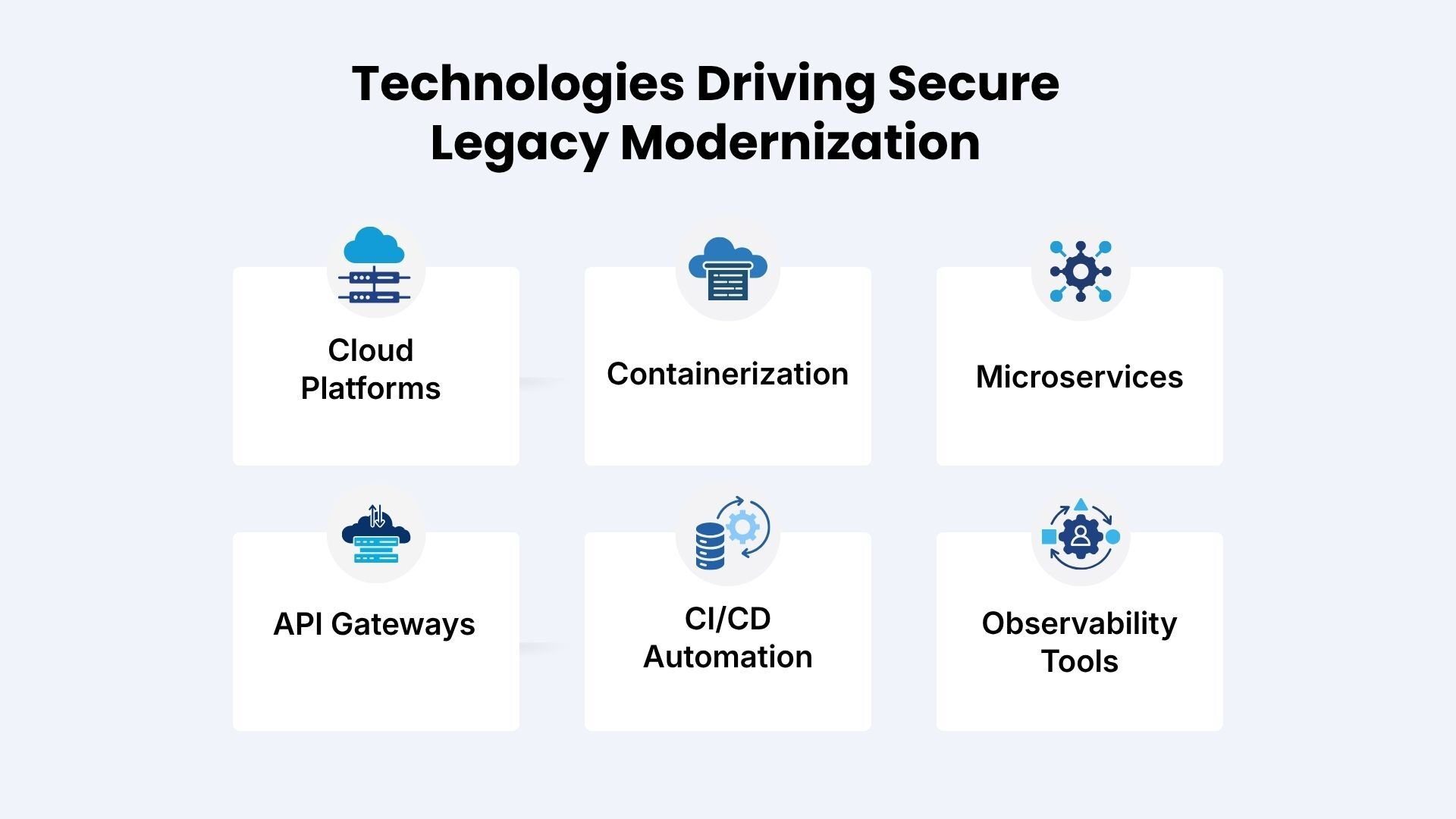
With the right tools and technologies at the helm, an enterprise can not only embrace rapid market shifts but also reduce risks and innovate at scale. Here are some technologies that can make your modernization journey safe and secure like never before.
-
Cloud Platforms
With cloud platforms, enterprises can easily scale their operations on demand. They can help them access resources without making large up-front investments in physical infrastructure. They provide enough flexibility for modern system integrations and new technology adoptions (AI, ML, data analytics).
-
Containerization
With containerization tools, enterprise leaders can run apps in isolated environments and ensure smooth & more predictable migration. These tools provide consistency across the entire lifecycle (development, testing, production) to keep apps operable irrespective of wherever they are deployed.
-
Microservices
For business leaders looking to modernize legacy systems without a complete overhaul, microservices architecture proves to be a game-changer. It facilitates incremental upgrades that reduce operational risk and the scale of each upgrade. Each microservice can be designed, implemented, and scaled individually to enable agile transformation.
-
API Gateways
During the transition, API gateways can abstract the complexities of legacy platforms. This helps enterprises introduce modern systems without making frequent iterations to the core infrastructure. Moreover, their operations remain secure and efficient during migration by leveraging powerful functionalities like rate limiting and load balancing.
-
CI/CD Automation
For large-scale enterprises, CI/CD automation is of utmost significance to seamlessly integrate and deploy code changes to production. With this automation, the application of the latest advanced components becomes easier and risk-free. It ensures every new update or functionality is thoroughly tested and verified before rollout.
-
Observability Tools
These tools provide real-time visibility into performance to monitor system health during the transition phase. As a business leader, you will be able to analyze data from multiple sources, such as traces, metrics, and logs, and detect issues & potential failures before they escalate into a no-recovery path.
Practical Example of Legacy System Modernization
Critical Business Challenges
A global oil & gas enterprise faced significant barriers to efficiency and innovation due to legacy systems in place. Their internal teams were struggling to overcome critical challenges:
-
Inability to support modern business processes
-
Unexpected downtime and system failures
-
Poor integration with advanced technologies
-
Ongoing platform maintenance expenses
As such, the company approached Clarion Technologies to modernize its aging operational platform without disrupting production systems.
Clarion’s Strategic Solution
Clarion guided the client through a phased transition to a cloud-enabled platform, integrating AI-powered monitoring and advanced data processing to enhance performance. Our experts enhanced manageability and scalability for newly developed systems with microservices architecture, API tools, CI/CD automation, and containerization.
Measurable Business Outcomes
-
50% reduction in maintenance costs
-
40% improvement in system reliability
-
Faster product innovation cycles
-
Efficient & high-performance operations
Legacy System Modernization: Critical Mistakes Enterprise Must Avoid
As an enterprise leader driving a modernization initiative, you need to avoid recurring challenges and risk-prone decisions. Avoiding these pitfalls ensures a seamless transition and uninterrupted service delivery to your customers.
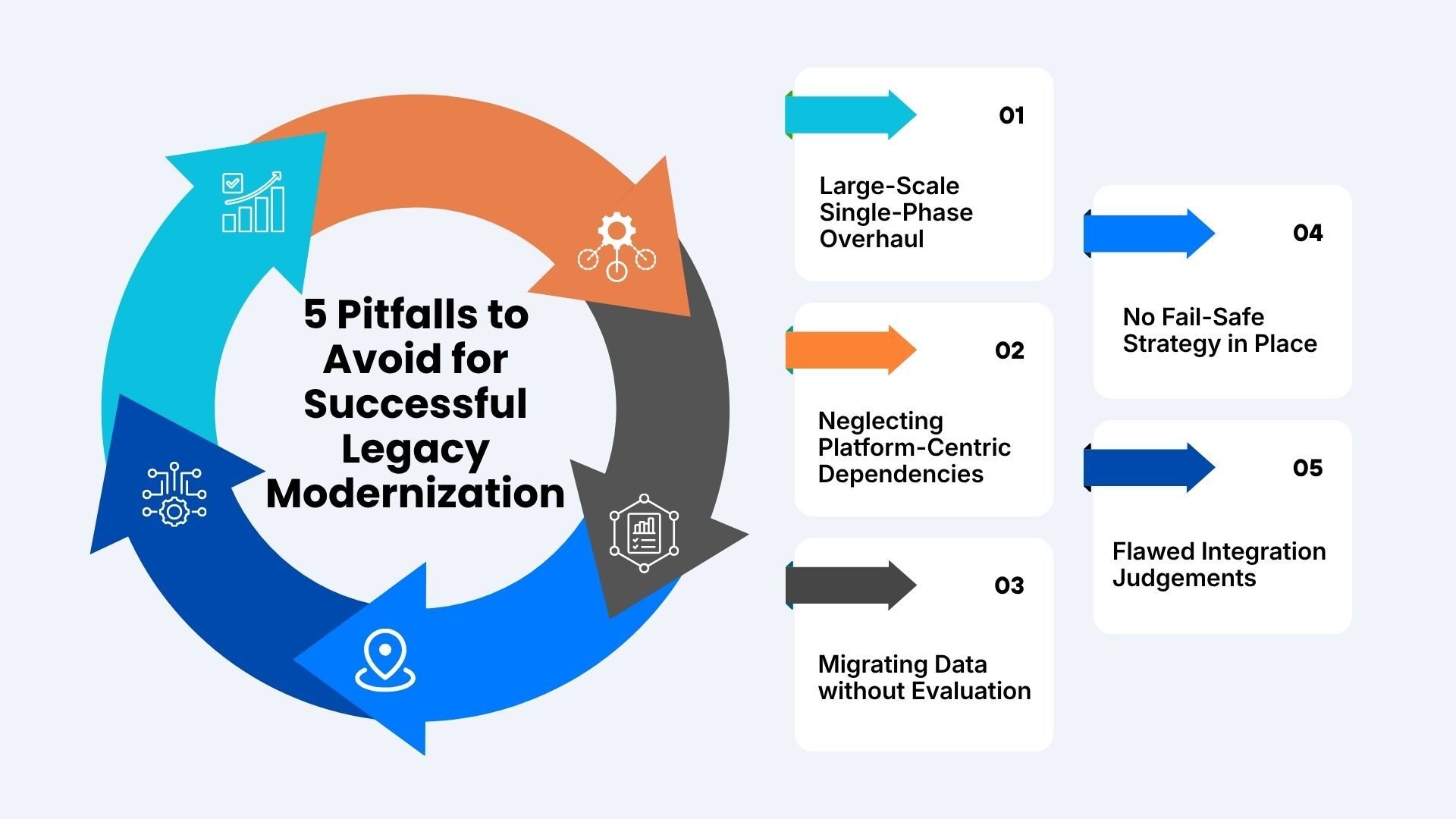
#1 Large-Scale Single-Phase Overhaul
A complete system can cause major disruption, leading to high-risk scenarios, compatibility issues, downtime, and other technical challenges. Instead, you can opt for an incremental approach like the strangler pattern that ensures controlled replacement of key elements.
#2 Neglecting Platform-Centric Dependencies
Legacy systems often have hidden connections and dependencies; if missed, they can result in broken workflows and integration issues. You need to perform a rigorous dependency mapping to discover and optimize essential touchpoints across systems.
#3 Migrating Data without Evaluation
Migrating your system data without proper validation can corrupt your foundation and negatively impact reporting mechanisms. That’s where implementing reconciliation tools and data validation frameworks can help you enable data integrity throughout the migration process.
#4 No Fail-Safe Strategy in Place
Without a well-defined fallback plan, your systems may face operational disturbances and extended downtime. Therefore, it’s imperative to have a clear rollback strategy backed by a detailed contingency blueprint and data backup patterns.
#5 Flawed Integration Judgements
Underestimating the connectivity across legacy systems and related platforms can limit integration capabilities and force delays. To ensure all-round compatibility, you need to assess integration requirements beforehand by adopting middleware and API gateways.
How to Choose the Right Legacy Modernization Partner
Selecting the right partner for legacy system modernization is crucial for ensuring a smooth, successful transition. Here are key qualities to look for in a partner:
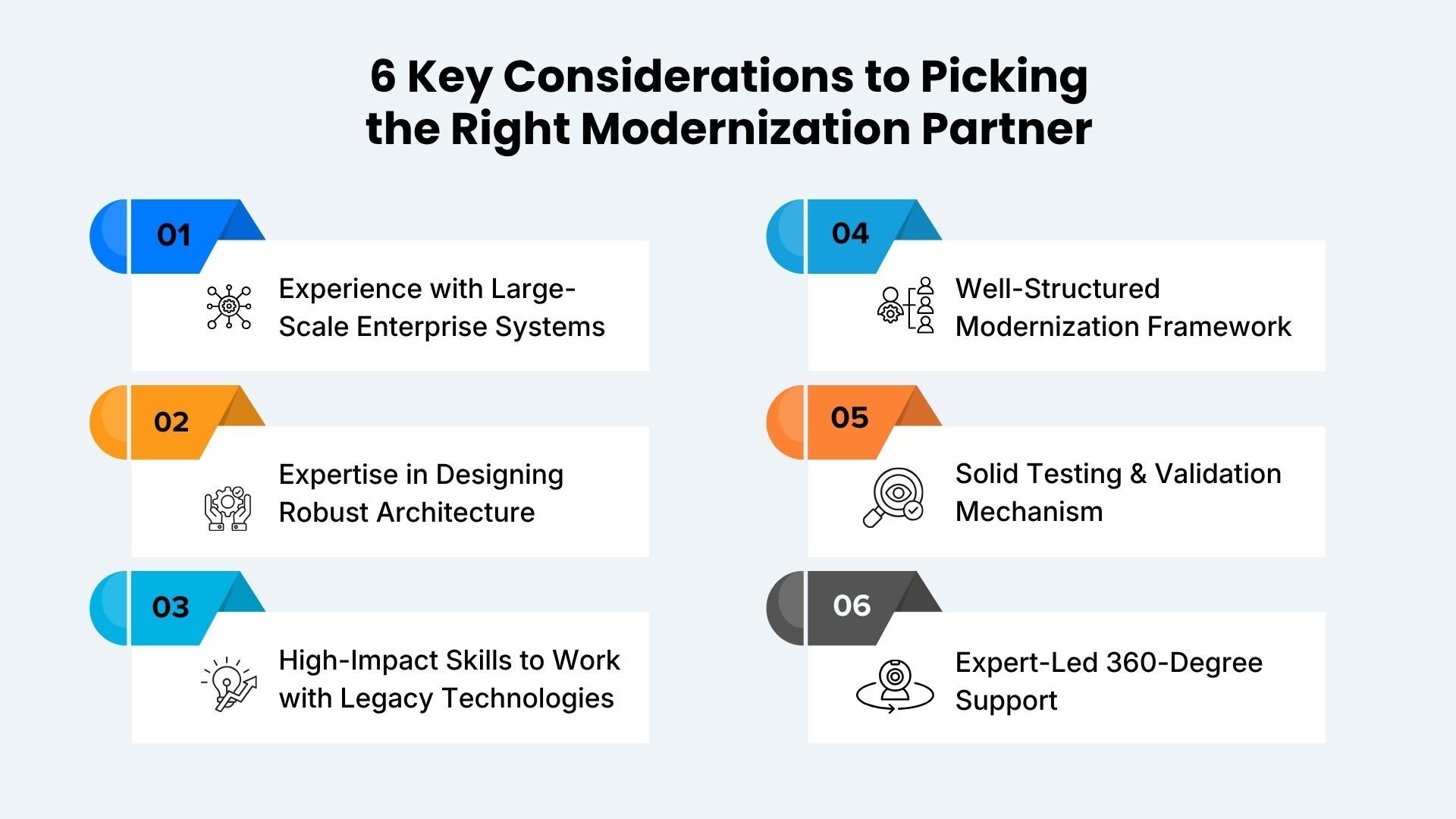
#1 Experience with Large-Scale Enterprise Systems
The first thing you need to consider is proven experience working with complex, large-scale systems. Executing enterprise-grade modernization requires deep know-how of how massive infrastructures operate, and an outcome-driven partner will surely be familiar with the hiccups of optimizing core enterprise platforms with high-volume workflows.
#2 Expertise in Designing Robust Architecture
As a decision-maker for your company, you need to look for a capability-first partner well-versed in charting out scalable frameworks. The collaboration should be focused on defining a future-proof architecture that perfectly aligns with your current and future business needs.
#3 High-Impact Skills to Work with Legacy Technologies
You should look for a partner that not only understands how aging platforms work but is also familiar with end-of-life technologies. This kind of expertise is necessary to avoid downtime and enable a smooth migration process.
#4 Well-Structured Modernization Framework
Another key consideration while choosing a legacy modernization partner is a structured agile methodology. Your chosen company should build on a disciplined execution model that prioritizes maximum growth and minimal risks. This will keep your project on track with effective management of available resources, budgets, and timelines.
#5 Solid Testing & Validation Mechanism
In-depth testing environments play a vital role in delivering a result-oriented software or application that meets business-specific requirements head-on. Therefore, you need to partner with a company that prioritizes robust testing and validation processes to identify and remediate risk-inducing and vulnerability triggers.
#6 Expert-Led 360-Degree Support
Last but not least, the right partner should provide dedicated maintenance and support services post-modernization. They should provide expert assistance for bug fixing, performance optimization, security patching, compliance updates, and feature enhancements over time.
How Clarion Technologies Can Help
Clarion modernizes legacy systems for businesses where uptime, compliance exposure, and scalability cannot be compromised. Our legacy application modernization services help global organizations maximize system security through ROI-driven development, high-level governance (HIPAA, GDPR), modular architecture, and risk profile mapping.
At Clarion, every engagement follows a ‘maximum security, minimal risk’ approach to ensure operational resilience, reliable uptime, and lower total cost of ownership. With experience across 1,500+ engagements, our focus remains consistent: reduce operational risk, tech-next partnership, accelerate secure delivery, and align engineering outcomes to measurable SLAs.
Our stand-up agile product-oriented deliveries (PODs) blend the vEmployee model (where engineers work as an extension of your internal team – easy ramp-up/down) with lead engineers to help leadership teams with data security, product migration, third-party integration, and ethical AI adoption.
Request a 30-minute consultation to evaluate your legacy modernization strategy and receive expert guidance on mitigating risks for a seamless transition.

Author

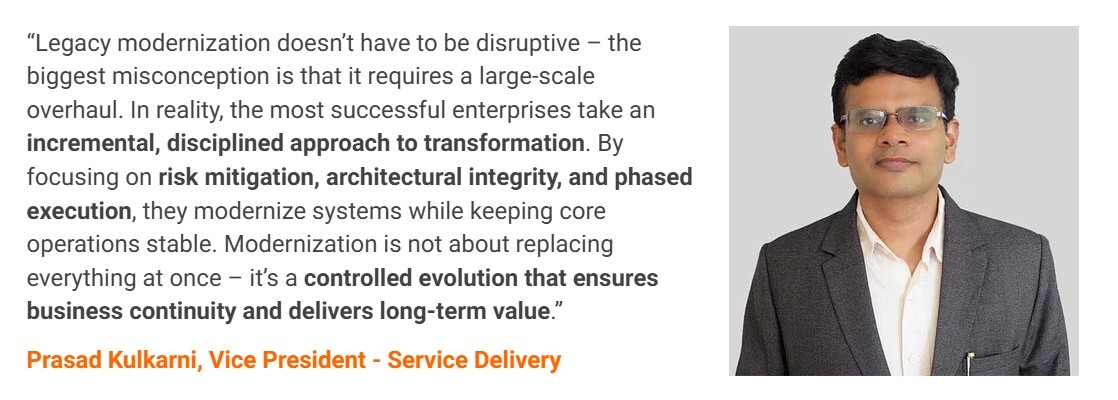
Prasad Kulkarni - Vice President Service Delivery
Prasad Kulkarni is the Vice President of Service Delivery at Clarion Technologies, renowned for his expertise in QA, JavaScript, MySQL, jQuery, Ajax, and E-commerce. His proficiency in Web Application and Development, coupled with a strong background in Business Intelligence (BI) and Business Development (BD), has propelled him to the forefront of technological innovation. Prasad's dynamic approach and deep technical knowledge make him a pivotal leader in the tech industry.