



“Global AI adoption is reshaping assumptions about how businesses will operate in the future. However, elusive returns are pushing leaders to contemplate the value it brings to the table. They need proof of ROI.”
Artificial intelligence is no longer a boardroom concept — it is now embedded in enterprise operations. Organizations across multiple industries are leveraging ML models, NLP-based agents, AI-backed tools, automated systems, and advanced data architecture to drive various functions. From healthcare and fintech to manufacturing and eCommerce, these variables are playing a vital role in accelerating digital transformation.
IDC states that the global AI spending is about to reach a whopping $632 billion by 2028.
The scale of investment signals that AI is no longer experimental — it is becoming a core business capability. On the other hand, most AI discussions are centered around ‘technology’ – frameworks, models, and tools.
But heavy spending and techno-optimism don’t guarantee returns. Many business and technology leaders still seek answers to critical questions, such as:
-
What measurable outcomes will AI deliver in the long-term?
-
Can it improve customer engagement and experience?
-
Will it enhance business productivity and decision-making?
-
Will AI-powered models help reduce operational costs?
-
How quickly will investments translate into tangible results?
That’s where evaluating AI ROI becomes more critical. Understanding how and where returns materialize helps business leaders make better decisions, reskill workforces, streamline core operations, avoid experimentation overheads, and prioritize initiatives that generate real value.
Measuring AI ROI: The Rising Complexity for Enterprise Leaders
Unlike traditional IT investments, AI rarely produces value in a single measurable metric — its impact spreads across productivity, operational efficiency, and decision quality.
According to Deloitte, out of 57 percent of organizations using Agentic AI, only 10 percent state that they have realized considerable ROI.
The reason why many organizations struggle to measure ROI is how AI initiatives are introduced and implemented.
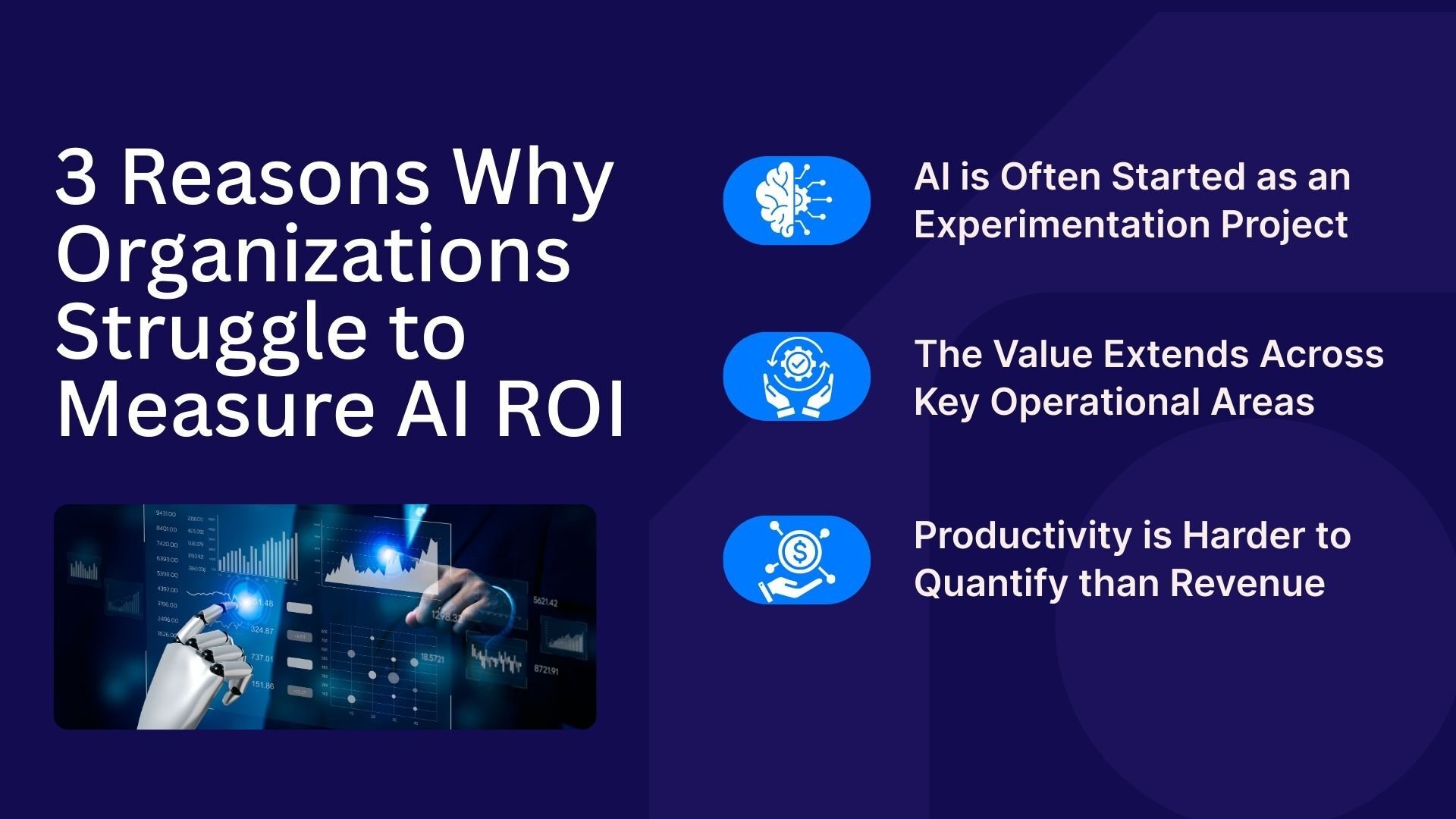
AI is Often Started as an Experimentation Project
In many organizations, AI begins as an experimentation initiative rather than a structured transformation program with clearly defined success metrics. Engineering teams identify automation opportunities, pilot custom solutions, and develop prototypes/MVPs without defining how success will be evaluated. As such, the pathway from AI project ballparks to tangible outcomes lacks clarity.
The Value Extends Across Key Operational Areas
Another critical pain point to consider is that the value generated by AI is scattered across multiple operational areas. For instance:
-
Increased team efficiency with AI-first copilots.
-
Improved planning precision with ML-based forecasting algorithms.
-
Minimized operational workload with automated document verification.
All these developments directly influence AI ROI. However, the impact is witnessed across various departments and metrics.
Productivity is Harder to Quantify than Revenue
For particular business scenarios, AI can deliver substantial value through productivity gains, leading to revenue growth.
McKinsey analyzed 63 use cases across four different areas – R&D, customer operations, software engineering, and sales & marketing to measure the impact of Generative AI. They discovered that Generative AI can add $2.6 to $4.4 trillion in global economy, with a major share of that value coming from productivity improvements driven by knowledge work.
Here, revenue growth can be easily quantified. But productivity gains are operational, not transactional, which makes them even more difficult to track and measure. This calls for rethinking how AI ROI is measured through more strategic approaches.
Primary Sources of Value Creation Using AI
For multiple industry sectors, ROI driven by AI commonly outlines five essential components, which include:
-
Increased Revenue – businesses witness a surge in sales, profits, and lead closures.
-
Reduced Risks – better governance, security, and fraud detection & remediation.
-
Decreased Costs – automation leads to minimized overheads and operational expenses.
-
Efficient Operations – Less manual work and streamlines business workflows.
-
Improved Productivity – teams achieve more in less time and with higher accuracy.
Deeper know-how of these components will help business and technology leaders evaluate the ROI of AI projects more effectively.
But where exactly is artificial intelligence delivering measurable impact for today’s enterprises? Let’s understand.
AI ROI Benchmarks: Exploring Top Business Functions
With AI use cases expanding continuously, clear and repeatable ROI benchmarks are emerging across various business functions. These benchmarks provide dedicated assistance to business leaders looking to evaluate AI investments with utmost accuracy.
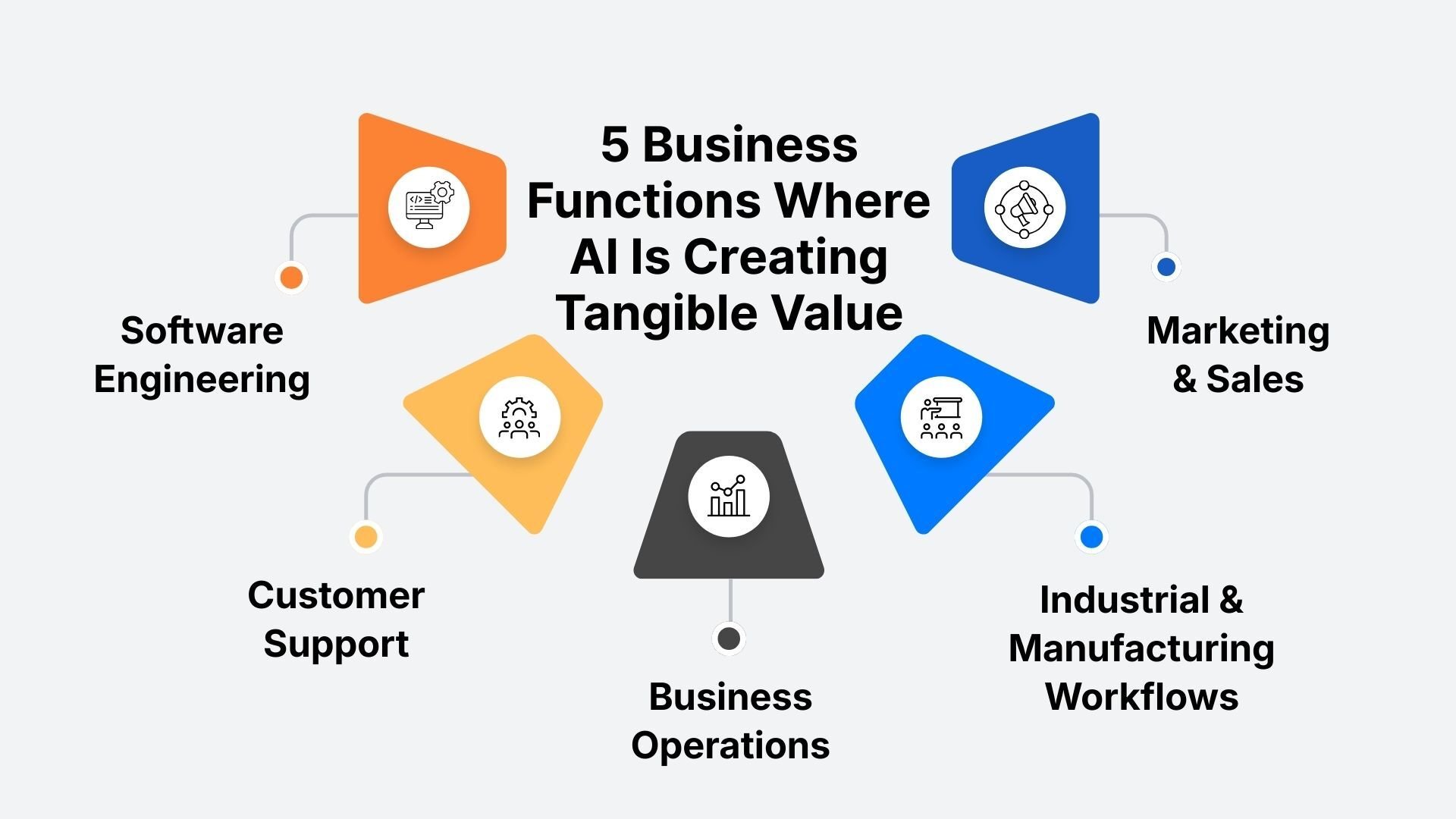
#1 Software Engineering
It’s one of the most significant areas where the impact of AI is clearly visible in the form of long-term productivity improvements. AI-guided software development tools are transforming how engineers ideate, code (from development and testing to ongoing maintenance), and even manage CI/CD pipelines.
Some common applications of AI in software engineering are as follows:
-
Coding assistance and custom suggestions
-
CI/CD automation (build, test, and deploy stages)
-
Product-specific test case generation
-
Software audit and review automation
-
Error discovery and debugging support
-
Documentation process automation
With effective deployment, these capabilities can not only reduce the manual effort and time spent on development tasks but also allow engineers to focus on core problem-solving.
As per GitHub, developers who use AI-powered coding assistants can complete development tasks 55 percent faster compared to the traditional process. Another research by McKinsey states that GenAI can accelerate documentation by 50 percent, increase developer productivity by 35 - 40 percent, and code refactoring by 20 - 30 percent.
Here are some examples of ROI benchmarks in software engineering to give you a better idea.
-
Fast-tracked testing cycles by 35 - 50 percent
-
Improved developer productivity by 20 - 45 percent
-
Reduced development time by 25 - 40 percent
You can easily achieve and even surpass these benchmarks by partnering with a proven, high-performance software engineering partner. This will help you implement productivity optimization frameworks, and AI-driven development practices can help your enterprise tech teams deliver measurable business outcomes.
#2 Customer Support
Another important area where AI is creating a lasting impact is customer support and service operations. Business leaders are progressively embracing advanced AI tools to create automated customer service workflows and decrease relevant response times.
Here are some common applications of AI in customer support for better understanding.
-
AI-based chatbots and virtual assistants
-
Call centers backed by AI calling agents
-
Ticket classification automation
-
Knowledge agents for support professionals
With these tools at the helm, organizations can easily handle a huge volume of interactions, deliver top-notch quality service, enhance customer experience, and enable 24/7 availability.
Gartner states that customer conversations driven by AI-based chatbots can accelerate response times and minimize support expenses by 30 percent.
Some examples of ROI benchmarks for this area are:
-
Reduced support workload by 40 - 60 percent
-
Faster customer response times by 30 - 50 percent
-
Increased support cost savings by 20 - 30 percent
#3 Business Operations
Many enterprise workflows still depend on fragmented systems, manual approvals, and repetitive operational tasks that create hidden inefficiencies. AI models modernize and automate such workflows to create intelligent decision-making environments.
Essential applications of AI in typical business operations include:
-
AI-powered workflow automation
-
Insights-to-decision support models
-
Document processing and verification
-
ML-enabled demand prediction
According to Deloitte, intelligent business automation has helped organizations reduce costs by up to 70 percent in a targeted area while enhancing accuracy and speed.
For enterprise leaders, some AI ROI benchmarks to consider across business operations are as follows:
-
Minimized manual processing time by 30 - 60 percent
-
Improved internal team efficiency by 25 - 40 percent
-
Refined forecasting accuracy by 15 - 20 percent
#4 Industrial & Manufacturing Workflows
AI is rapidly adopted across complex industrial ecosystems to detect fraud, forecast failures, maintain equipment, and streamline the production process. Industrial analytics systems built on top of AI monitor sensor data, production variables, and machinery performance to identify, report, and minimize potential risks before they cause costly disruption.
In industrial environments, practical use cases of AI reflect:
-
Factory and warehouse analytics
-
Equipment monitoring models
-
Predictive maintenance systems
-
Fraud detection automation tools
As per PwC, AI-backed predictive maintenance can reduce sudden downtime by 45 percent and maintenance overheads by 30 percent.
Here are some benchmarks for manufacturing systems that can help you better evaluate the ROI of your AI project.
-
Decreased downtime by 30 - 50 percent
-
Reduced maintenance costs by 20 - 30 percent
-
Elevated production efficiency by 15 - 20 percent
#5 Marketing & Sales
Teams driving marketing and sales functions are also witnessing quantifiable results with AI-assisted automation and insights. They are using custom AI frameworks across various digital channels to analyze behavioral patterns, monitor customer intent, and deliver hyper-personalized experiences.
Some significant use cases of AI in these areas include:
-
Lead validation and scoring automation
-
Sales and deal suggestion assistance
-
Product marketing personalization
-
Content creation automation
Super AGI states that organization leveraging AI-centric sales systems have experienced a significant increase in business productivity. Some companies report a 30 percent increase in conversion rates with 25 percent faster sales cycles.
AI ROI benchmarks specific to sales and marketing include:
-
Accelerated campaign execution by 30 - 50 percent
-
Maximized conversion rates by 20 - 30 percent
-
Improved sales productivity by 10 - 20 percent
Planning to outsource your AI project? Provide a quick overview to instantly evaluate the potential ROI.

Real-World Example of Proven AI ROI Delivery
Business Requirement & Key Challenges
One of the top long-term care pharmacy providers in the U.S. was facing difficulties in generating drug price quotations for different healthcare facilities. Their teams evaluated multiple pricing inputs and drug costs for required facilities to manually formulate the quotations – where 4 - 5 days were spent on a particular quotation.
This setup was highly resource-intensive with prolonged customer responses, restricting the company’s ability to cater to large pricing requirements head-on. As such, the company struggled with critical hiccups, such as:
-
Consistent errors
-
Loss of business deals
-
Departmental dependencies
-
Poor client satisfaction
Clarion’s AI-Powered Price Quote Solution to the Rescue
To meet key business objectives and overcome such complex challenges, Clarion partnered with the client to build a custom AI-based solution that automated the quotation workflow and pricing calculations. The solution helped the client analyze pricing inputs and produce quotations quickly and accurately.
Outcomes Achieved After Solution Deployment
✅ 90 percent increase in price quotation speed
✅ 20-minute reduction in quotation TAT
✅ Better accommodation of larger deals
✅ Seamless improvement in process efficiency
✅ Uninterrupted operational visibility
✅ Substantial decrease in manual effort
✅ Lightning-fast response to customer inquiries
Why Many AI Projects Struggle to Produce Expected ROI
Many technically successful AI initiatives still fail to generate meaningful business value. The reason – lack of a clear roadmap and alignment with measurable business results. It isn’t a technology problem that limits success, rather it’s an execution and strategy challenge that you need to overcome.
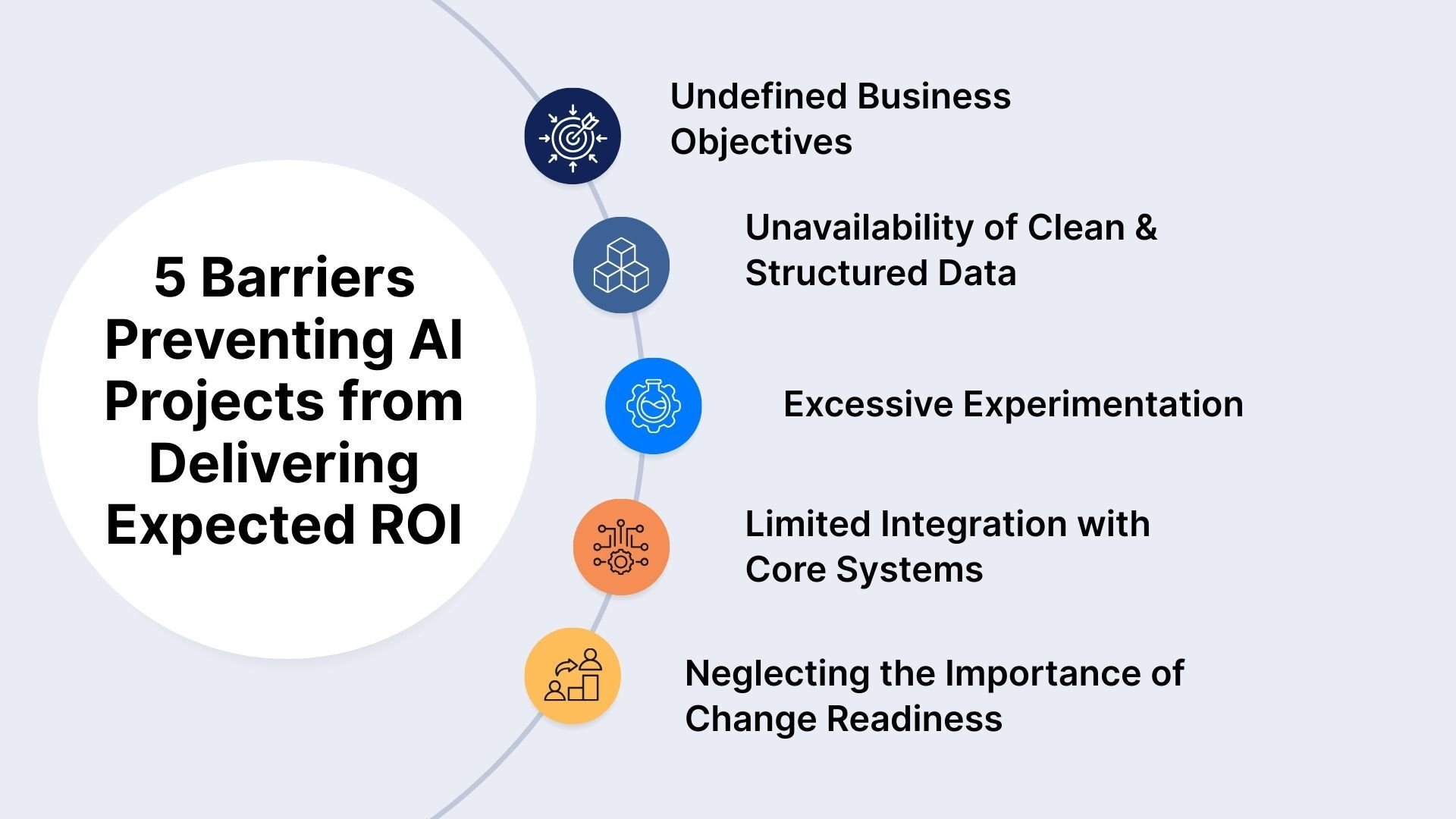
#1 Undefined Business Objectives
AI projects often start with a typical question – Where can AI be used? Instead, the focus should be on identifying the objectives to achieve and the critical problems to solve. Absence of unclear goals and a problem statement leads to unstructured experiments that are unable to deliver tangible results despite heavy investments.
#2 Unavailability of Clean & Structured Data
AI solutions have a high dependency on data and its quality. If your project outlines unstructured datasets, disparate systems, and poor governance, achieving AI maturity will be more challenging.
#3 Excessive Experimentation
Many enterprises pour extensive time, effort, and investment into highly complex AI projects. They underestimate the significance of addressing small and simple operational challenges that can help them create a long-term impact faster.
#4 Limited Integration with Core Systems
Indeed, AI solutions are capable of generating actionable insights for strategic decision-making. However, these insights only become valuable when rightly integrated with existing workflows and core platforms. Failures in integration disconnect AI from daily tasks, putting the entire system in jeopardy.
#5 Neglecting the Importance of Change Readiness
Effective AI adoption and deployment demands high adaptability to critical workflows, processes, and decision models. Organizations that underestimate the organizational change required for AI adoption often struggle to realize its full value.
How Enterprises Can Realize AI ROI Faster
Concretely, AI initiatives require an even mix of five major capabilities to succeed, move beyond experimentation, and produce quantitative business results.
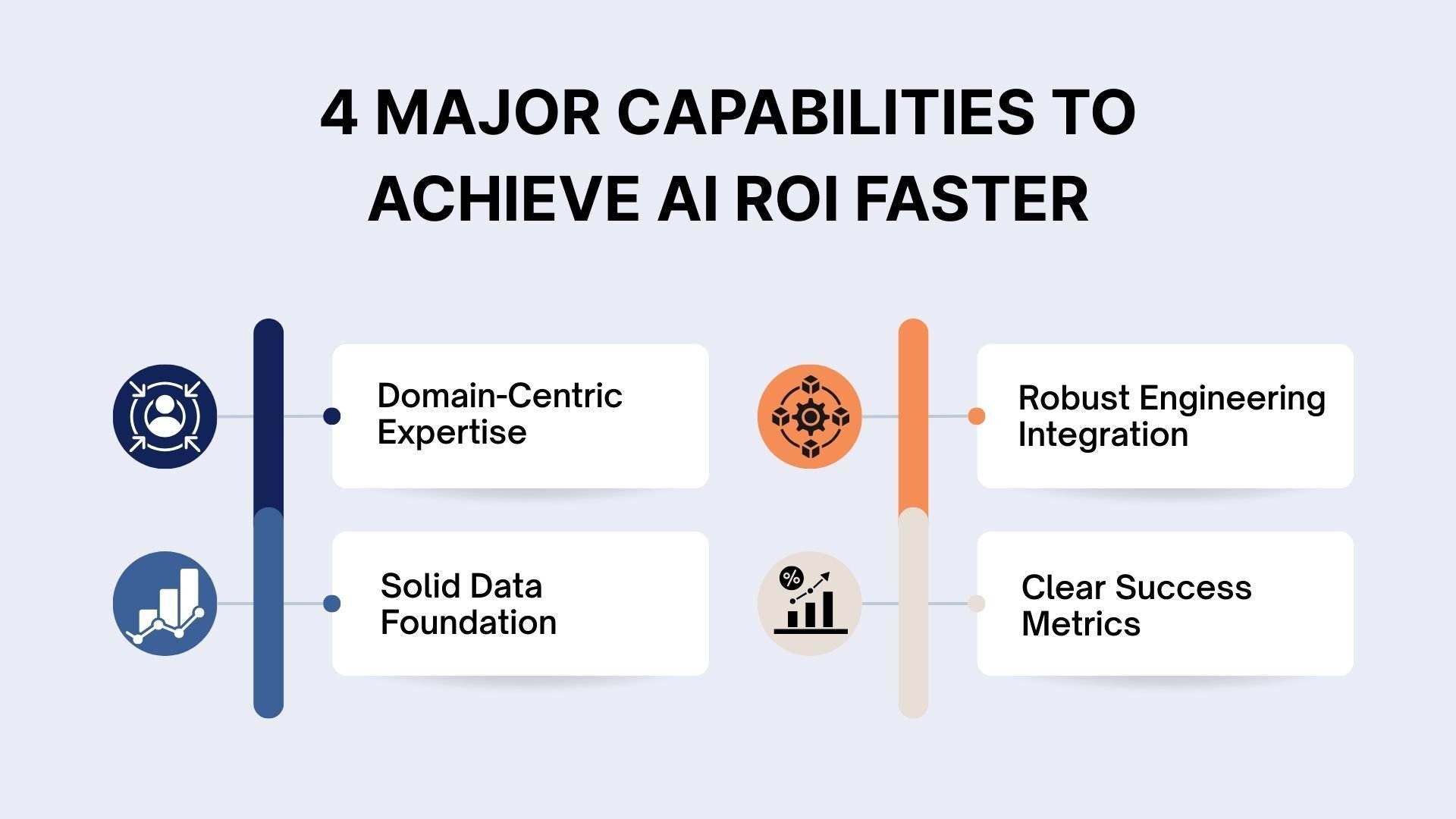
#1 Domain-Centric Expertise
You need dedicated assistance from experts who can ensure AI models resolve niche challenges, cater to business-specific scenarios, and address critical pain points. They should understand that effective AI projects focus on complexities related to data availability, strong operational alignment, and evidence-based impact.
#2 Solid Data Foundation
The performance of custom AI solutions is directly connected to data infrastructure (accessibility, interoperability, and quality). That’s why you need to have a stringent data foundation in place that provides a clean, structured, and scalable environment for training AI models. It should be driven by cloud-based platforms, advanced enterprise analytics, and scalable data pipelines.
#3 Robust Engineering Integration
AI models operating in isolation limit business success. You need to prioritize integrating them with engineering workflows, operational systems, and enterprise platforms seamlessly. This approach enables valuable insights to simplify decision-making for business leaders.
#4 Clear Success Metrics
Before launching your AI projects, you need to define measurable success indicators. For instance, increased efficiency, reduced manual efforts, faster cycle time, improved productivity, decreased costs, and elevated revenue. These metrics can help you better evaluate ROI and determine the success of your AI implementation initiative.
How Clarion Can Help
Clarion designs enterprise AI systems for businesses where uptime, compliance exposure, and scalability cannot be compromised. Our AI development services help global organizations maximize system security through ROI-driven development, high-level governance (HIPAA, GDPR), modular architecture, and risk profile mapping.
At Clarion, every engagement follows a ‘maximum security, minimal risk’ approach to ensure operational resilience, reliable uptime, and lower total cost of ownership. With experience across 1,500+ engagements, our focus remains consistent: reduce operational risk, tech-next partnership, accelerate secure delivery, and align engineering outcomes to measurable SLAs.
Our stand-up agile product-oriented deliveries (PODs) blend the vEmployee model (where engineers work as an extension of your internal team – easy ramp-up/down) with lead engineers to help leadership teams with data security, product modernization, third-party integration, and ethical AI adoption.
Request a 30-minute consultation to evaluate your AI use case and receive benchmark insights that help you estimate realistic business returns.

Author

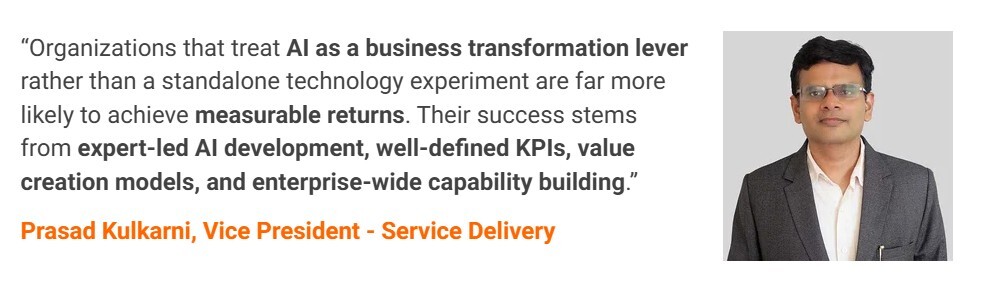
Prasad Kulkarni - Vice President Service Delivery
Prasad Kulkarni is the Vice President of Service Delivery at Clarion Technologies, renowned for his expertise in QA, JavaScript, MySQL, jQuery, Ajax, and E-commerce. His proficiency in Web Application and Development, coupled with a strong background in Business Intelligence (BI) and Business Development (BD), has propelled him to the forefront of technological innovation. Prasad's dynamic approach and deep technical knowledge make him a pivotal leader in the tech industry.