



In many modern-day enterprises worldwide, the rapidly increasing adoption of AI solutions is driven by innovation teams, CTOs, CEOs, CAIOs, VPs, technology heads, project managers, and other external consultants. The narrative mostly reflects an even mix of experimentation, speed, technology, and competitive advantage.
However, for CFOs, the conversation around AI unfolds quite differently.
Financial leaders and decision-makers operate in an environment where – accuracy matters more than speed, experimentation is secondary to auditability, ‘technology vs cost’ bifurcation is significant, and compliance failures are subjected to monetary, material, and reputational penalties.
For instance, an AI-based prediction model improves accuracy by 15 percent. But if this model cannot explain how it achieved the number, it may not withstand audit committee evaluations.
That’s why many CFOs approach AI projects with prudent skepticism. For them, the question isn’t, “Can AI automate financial workflows?” What really matters is identifying financial operations for secure automation without compromising fiscal or regulatory compliance.
This distinction is a necessity as poorly governed AI-driven automation limits capabilities, restricts business growth, introduces long-term risks, and causes permanent operational damage.
Automation in Finance: A 20-Year Shift Now Accelerating with AI
Many enterprise CFOs believe that automation in finance is a new practice taking over the market. But that’s not true. For more than two decades, finance professionals have been automating business operations through various tools and technologies, such as:
-
Electronic invoicing systems
-
ERP, CRM, and CMS platforms
-
RPA-based transaction tools
-
Rule-enabled workflow engines
Deloitte states that 73 percent of organizations have implemented intelligent automation into their finance operations through RPA, AaaS, cloud, and enterprise-driven assets.
This means AI didn’t introduce the first wave of automation to finance. The difference lies in what AI can now automate to extend existing business capabilities. Here’s a brief overview of the comparison between traditional and AI-based automation in finance to give you a better idea.
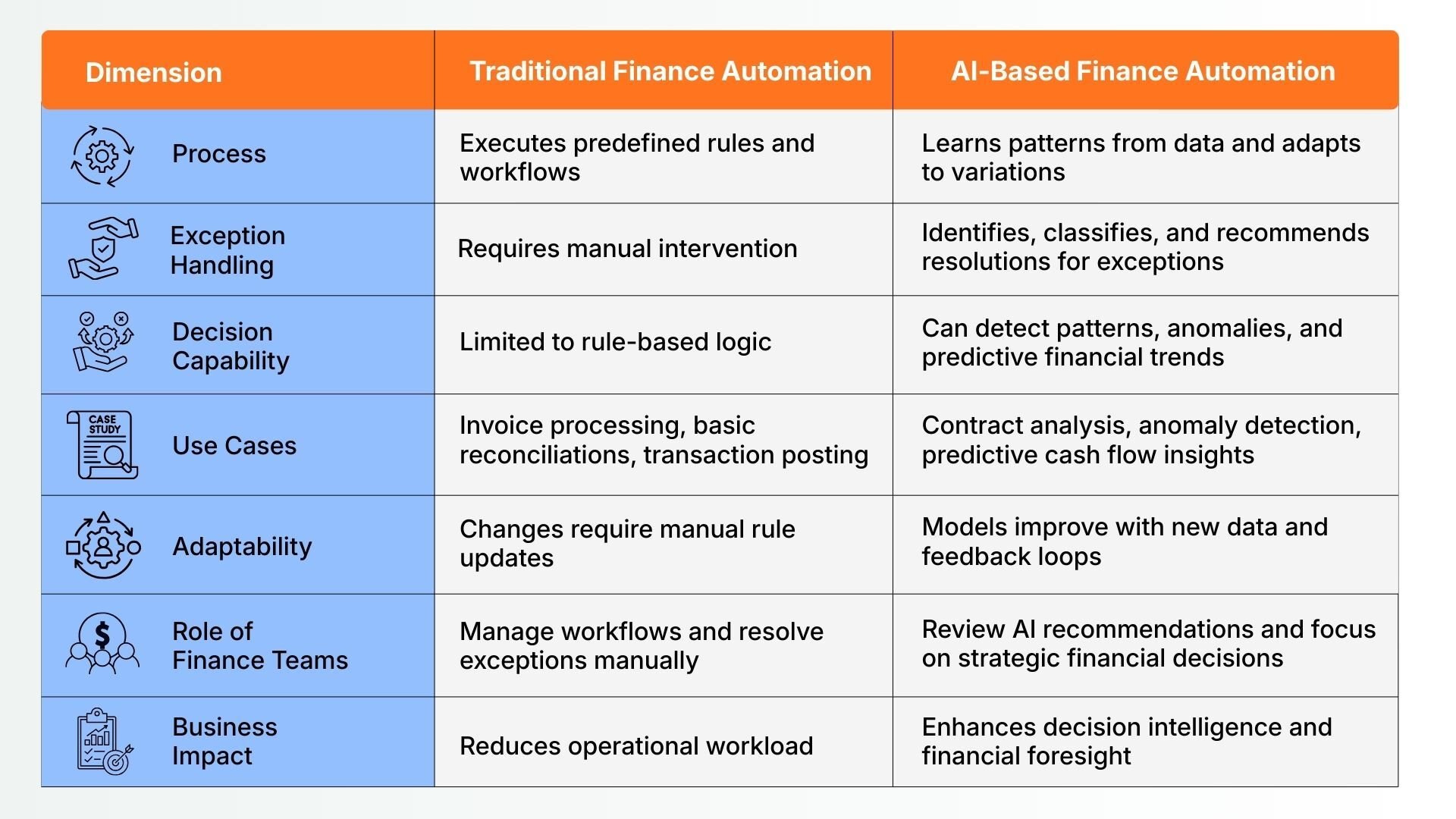
Traditional automation in finance works well for predictable rules, structured workflows, and standardized data. On the other hand, AI helps you address scenarios where conventional ways break down – predicting risks, extracting insights from unstructured data, and handling exceptions.
This is how AI accelerates and adds meaningful value to financial operations without rearchitecting or replacing existing systems entirely.
Unlocking Next-Gen Finance: What AI Brings to the Table
The most effective AI-powered finance projects prioritize operational consistency over attention-grabbing use cases. They focus on high-impact, high-performance operations that require the most time, effort, strategic thinking, and resources.
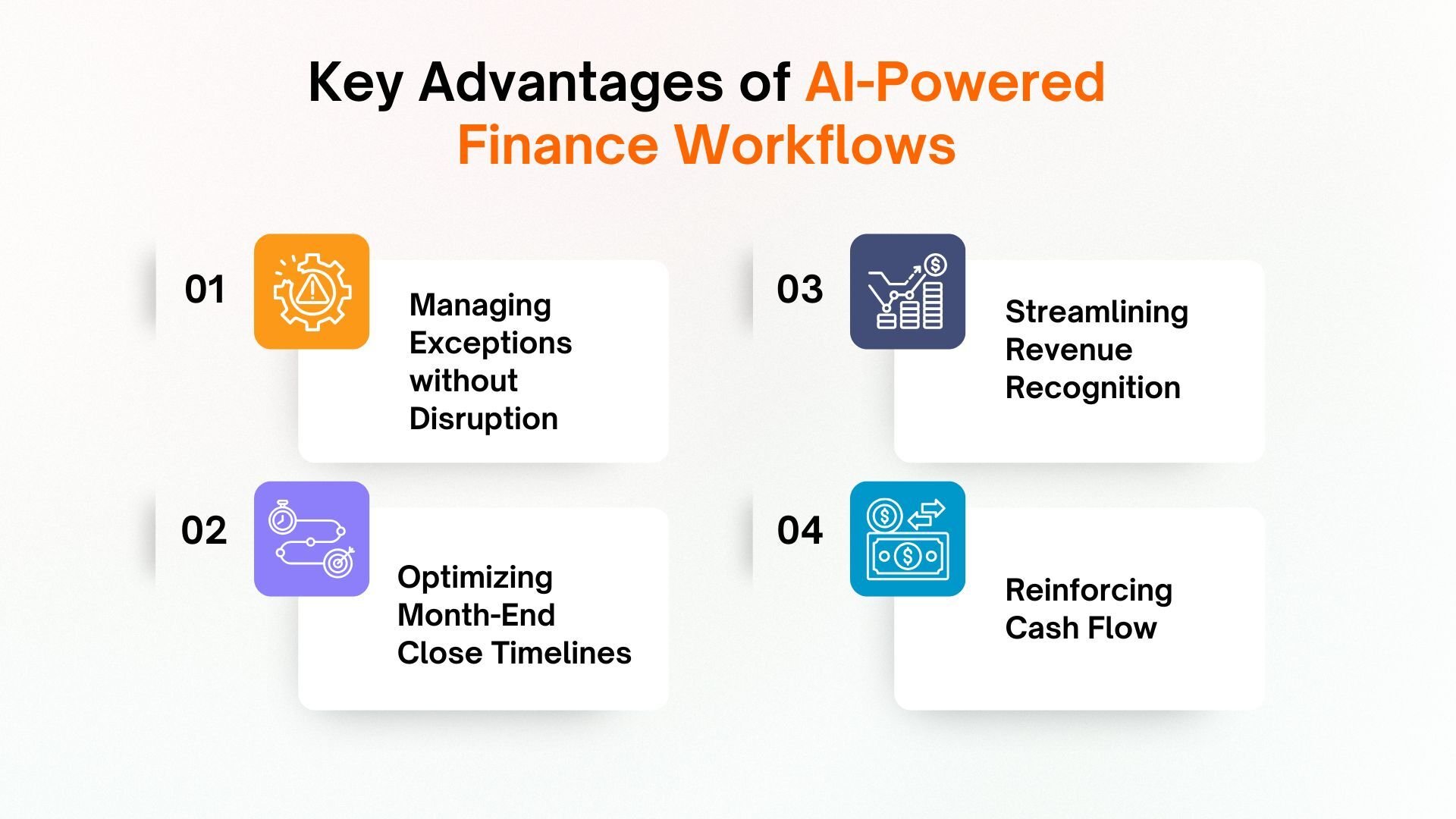
Managing Exceptions without Disruption
Many enterprises have automated finance workflows in place to save time. They are more concerned about handling exceptions at scale.
For instance, let’s consider an invoice automation workflow designed for smooth invoice processing. However, unexpected scenarios like changes in supplier format, missing order numbers, mismatched pricing, and duplicate invoices delay the process. It not only increases overhead costs but also leads to time-intensive manual investigation.
AI acts as an intelligent exception manager without replacing existing workflows. With custom AI solutions at the helm, you can easily avoid complex scenarios with:
-
Faster identification of critical exceptions
-
Easier classification of the type of scenarios
-
Effective routing of issues to concerned teams
-
Seamless recommendation of potential resolutions
Optimizing Month-End Close Timelines
For CFOs, the month-end close process is one of the most time, effort, and resource-intensive activities as it involves data verification across multiple systems, account reconciliations, variance analysis, and journal inputs.
According to CFO Magazine, 50 percent of finance professionals still take six or more business days to complete their close cycle, leading to delayed decisions, potential risks, and stalled forecasts.
With AI-assisted finance, you can easily reduce this cycle time up to 50 percent by:
-
Discovering inconsistent/missing transactions
-
Detecting discrepancies in data autonomously
-
Prioritizing critical reconciliation operations
-
Suggesting relevant explanations for variances
Streamlining Revenue Recognition
In financial reporting, revenue recognition is one of the most significant components as per IFRS 15 and ASC 606 standards. The terms of revenue are often embedded in unstructured contracts that make interpretations more difficult when dealing with large contract portfolios.
As per PwC, 40 percent of finance teams consider regulatory governance as a key priority to manage contract-driven revenue recognition.
With trained AI models, you can easily analyze contract language and comply with key revenue triggers, pricing structures, performance benchmarks, and renewal specifications. AI-driven contract intelligence can eliminate this burden by:
-
Quickly identifying inconsistencies across billing
-
Effortlessly highlighting misaligned revenue schedules
-
Proactively outlining crucial compliance issues
Reinforcing Cash Flow
Typical cash flow predictions heavily rely on spreadsheet-based modeling and historical patterns. But essential metrics that indicate financial risks are difficult to monitor manually. That’s where AI can shift the scenario from reactive reporting to financial risk management.
McKinsey states that organizations can decrease errors by 20 to 50 percent using AI-based forecasting.
With AI-powered financial forecasting systems, CFOs can easily identify vulnerable patterns and receive early warning alerts before any risks escalate. These systems can solidify the cash flow process by detecting:
-
Delays in customer payments
-
Instability across suppliers
-
Irregular expense patterns
-
Prolonged invoice settlement
High-Risk Areas CFOs Can’t Afford to Neglect
Indeed, AI-based automation introduces various advantages to the global finance landscape. But not every function requires an automated approach. You need to apply stringent guardrails to specific areas, such as:
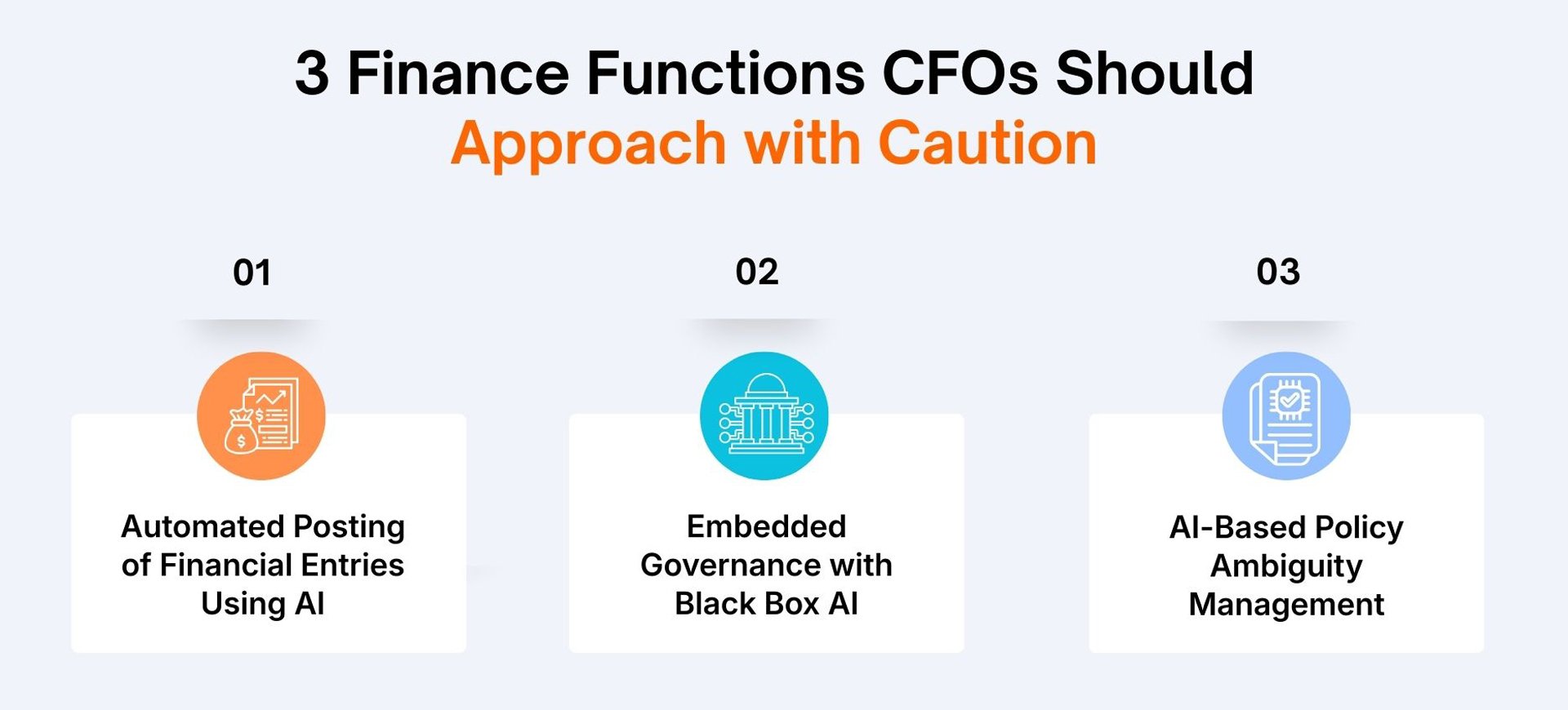
#1 Automated Posting of Financial Entries Using AI
CFOs can expose their organizations to critical risks if they enable AI models to post entries into the general ledger. It can result in inaccuracy in financial statements, violations of compliance, lack of traceability, and poor audit trails.
To avoid such scenarios, you need to keep your financial controls intact. AI can suggest entries, but they will only be posted after they are verified and approved by finance professionals.
#2 Embedded Governance with Black Box AI
Many AI models are considered black boxes. Why? Because they generate results without relevant reasoning. This can create complexities in a financial setup. For instance, if an AI tool highlights a transaction as suspicious, then finance teams should have end-to-end visibility into why it was flagged, the type of data used, and the pattern that triggered the decision.
If AI models are unable to provide this kind of transparency, they are bound to get rejected and blocked by auditors and compliance teams. As such, CFOs need to prioritize implementing explainable AI models that deliver complete decision transparency and traceability.
#3 AI-Based Policy Ambiguity Management
Many key policies in finance are outlined by areas lacking clear interpretations that require deeper judgment, context, and regulatory understanding. Some examples are:
-
Decisions related to tax treatment
-
Judgments on accounting classification & revenue recognition
-
Interpretations for expense policy
You can struggle with policy nuance while using AI systems. That’s why you need to build a human-led decision support system backed by AI insights rather than replacing it.
Implementing AI in Finance: Key Challenges Faced by CFOs
Many enterprise CFOs believe that the hardest part of introducing AI in financial operations is choosing AI models. But that’s not true. Instead, what makes it more challenging is fragmented data spread across ERP, CRM, banking, payroll, procurement, and financial planning systems.
As per an Accenture study, most finance teams lack a single source of data with restricted access to external diverse data. The research also discovered that 57 percent of finance executives consider a lack of availability and access to data as a major barrier to achieving continuous accounting in real time.
With a strong and centralized data foundation, AI amplifies existing data hiccups. Therefore, it’s necessary to establish a solid data architecture that is free from situations driven by:
-
Inconsistent data definitions
-
Different set of systems
-
Diverse financial metrics
-
Incomplete reconciliation
-
Poor quality historical data
A Practical Roadmap CFOs Should Follow for Successful AI Adoption
With AI redefining how finance teams operate, it’s essential to approach its implementation with caution. Instead of focusing on an outright transformation strategy, CFOs should layer AI in a way to achieve short-term requirements and long-term goals.
Let’s check out what these layers are all about.
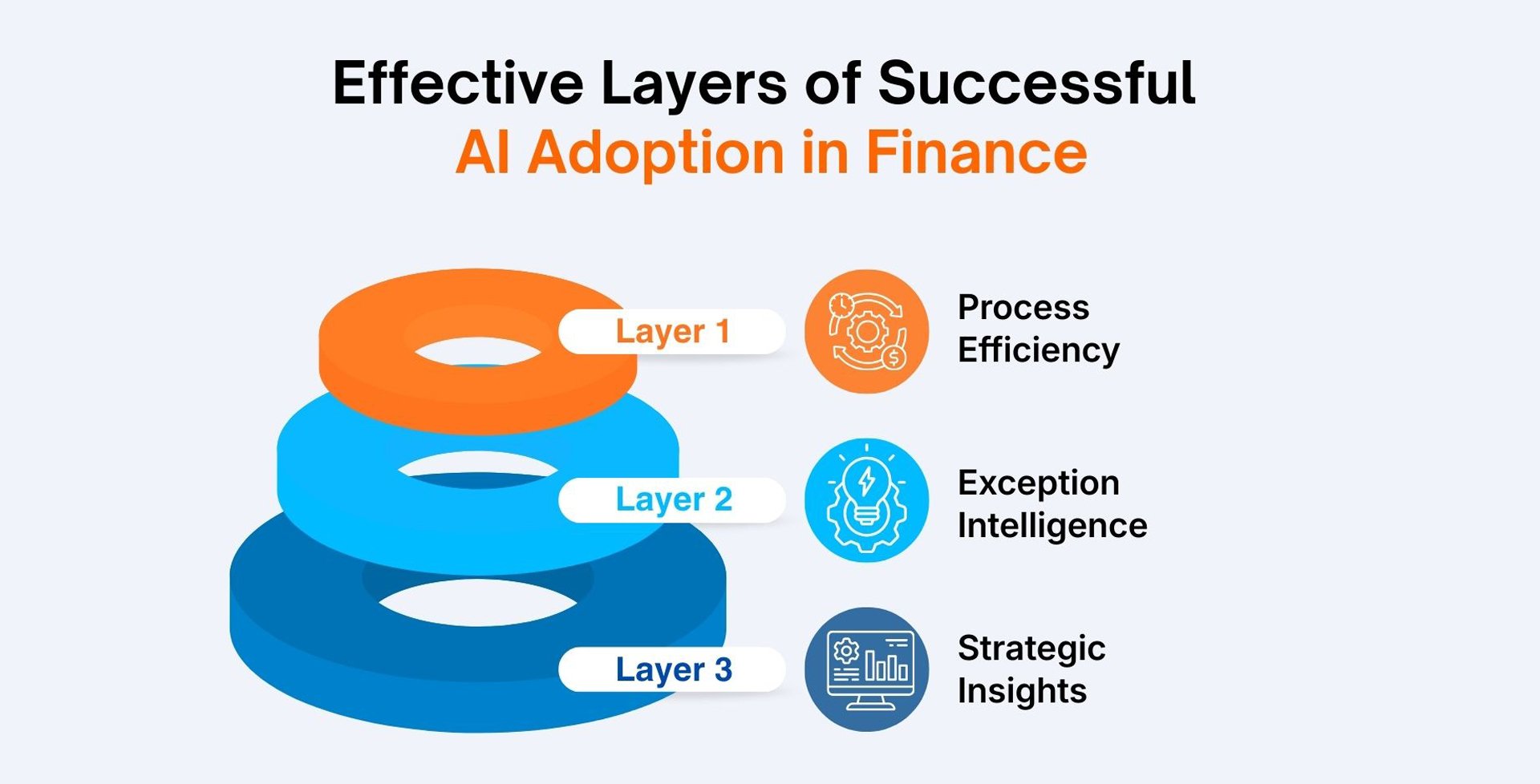
#1 Process Efficiency Layer
This layer reduces overhead costs and improves efficiency to help your teams prioritize high-value tasks. You need to start with automation of repetitive, low-complexity, and human-dependent tasks. Some of these include:
Invoice Processing – Using AI to automate data extraction from invoices, match it to purchase orders, and perform regular checks.
Reconciliation – Helping finance executives go beyond manual checks with sophisticated inspection to identify discrepancies by comparing data across various systems.
Financial Reporting – Automating the process of creating reports, cash flow statements, and balance sheets with minimal human effort.
#2 Exception Intelligence Layer
This layer demands the deployment of trained AI models that can help your teams focus on problem-solving instead of routine checks. You can easily eliminate bottlenecks that slow down finance operations with AI-assisted:
Anomaly Detection – Discovering transactions that fail to conform excepted standards or marking invoices that don’t conform to predefined formats.
Suspicious Activity Alert – Notifying finance teams about potential issues, such as frequently fluctuating spending patterns, unapproved transactions, and cash flow discrepancies, quickly and effectively.
Compliance Tracking – Ensuring all processes comply with the latest standards, industry regulations, and technology advancements.
#3 Strategic Insights Layer
Last but not least, this layer translates number crunching into a forward-thinking function that rapidly adapts to changes and helps with futuristic decision-making. Here’s where AI solutions can create a lasting impact:
Budgeting & Forecasting – Analyzing historical trends/data to deliver more accurate predictions, drive data-based decisions, and accelerate financial planning.
Scenario Modeling – Simulating key financial scenarios like fresh investments and evolving market conditions to analyze measurable outcomes, ensuring long-term sustainability.
Invest Planning – Optimizing capital distribution based on market circumstances, performance metrics, and potential risks for effective use of available resources.
What Defines High-Impact AI: A Quick Checklist for CFOs
As a CFO assessing AI-backed transformation opportunities within your finance operations, it’s essential to think beyond tech-led advancements. You need to ensure high governance, robust security, and alignment with key objectives. Here are some significant aspects that you can consider for choosing the right AI solution for your finance team.

#1 Auditability
It’s one of the core aspects where finance professionals should be able to track, verify, and get explainable reasons for decisions driven by AI models. This not only ensures regulatory compliance but also enables secure decision-making.
As a CFO, you need to validate the reasoning when AI identifies an issue and provides actionable insights to resolve it. This avoids viewing an AI model as a black box, helps build a clear defense strategy during audits, and justifies financial outcomes.
#2 Control
Your chosen AI solutions should be backed by systematic and solid control mechanisms that offer complete transparency. This includes clear documentation for every transaction, segregation of key roles/responsibilities, and approval workflows.
CFOs need to ensure that AI models are built on tight financial controls. This helps with structured assessments, 360-degree compliance, error-free financial statements, and the elimination of potential fraud.
#3 Data Security
Financial data is highly confidential and sensitive for your enterprise. It demands solid protection from malicious activities, leakages, breaches, and unauthorized access. It should comply with essential data protection standards like CCPA and GDPR.
As such, you need to ensure comprehensive security comes in handy with AI systems. The systems should be loaded with features that provide role-based access, stringent integrations with proprietary platforms, and end-to-end encryption.
#4 ERP Integration
Another significant aspect to consider for successful AI implementation is seamless integration with the ERP system (NetSuite, SAP, Oracle). Why? If an AI solution is based on isolated data sources, it can introduce silos that can negatively impact your broader financial architecture.
Integration allows secure access to required financial data in real time, provides data-centric recommendations, and ensures every engagement is free from disturbance. That’s why you need to adopt AI solutions that can easily integrate with your ERP, proprietary, and other financial systems.
Kickstart Automation in Finance with Clarion’s AI Expertise
Clarion designs enterprise AI systems for businesses where uptime, compliance exposure, and scalability cannot be compromised. Our AI development services help global organizations maximize system security through outcome-driven development, high-level governance (HIPAA, GDPR), modular architecture, and risk profile mapping.
At Clarion, every engagement follows a ‘maximum security, minimal risk’ approach to ensure operational resilience, reliable uptime, and lower total cost of ownership. With experience across 1,500+ engagements, our focus remains consistent: reduce operational risk, tech-next partnership, accelerate secure delivery, and align engineering outcomes to measurable SLAs.
Our stand-up agile product-oriented deliveries (PODs) blend the vEmployee model (where engineers work as an extension of your internal team – easy ramp-up/down) with lead engineers to help leadership teams with data security, product modernization, ERP integration, and ethical AI adoption.
Schedule a 30-minute consultation to discuss how your organization can streamline finance processes, enhance decision-making, and mitigate risk with AI.

Author

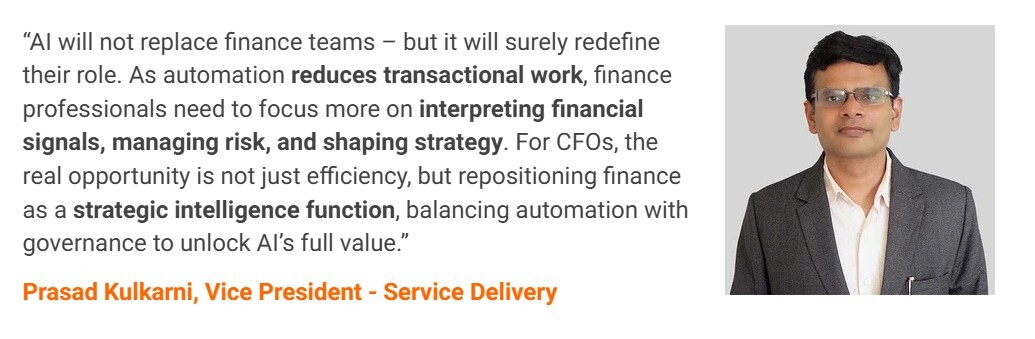
Prasad Kulkarni - Vice President Service Delivery
Prasad Kulkarni is the Vice President of Service Delivery at Clarion Technologies, renowned for his expertise in QA, JavaScript, MySQL, jQuery, Ajax, and E-commerce. His proficiency in Web Application and Development, coupled with a strong background in Business Intelligence (BI) and Business Development (BD), has propelled him to the forefront of technological innovation. Prasad's dynamic approach and deep technical knowledge make him a pivotal leader in the tech industry.