



As a business or technology leader, you must have already come across this situation when embarking on AI-driven initiatives – the entire process feels different and overwhelming compared to typical software development projects.
Traditional projects are often defined by a clear roadmap from ideation to completion. On the other hand, an AI project is a continuously evolving journey with an unclear scope. This uncertainty makes it challenging to predict related costs and timelines.
Let’s understand why AI projects are so unique and why their scope remains fuzzy. This blog post takes a deep dive into how you can approach cost and timeline estimation for faster decision-making, precise planning, and foolproof deliveries.
How Traditional Software Projects Differ from AI Projects
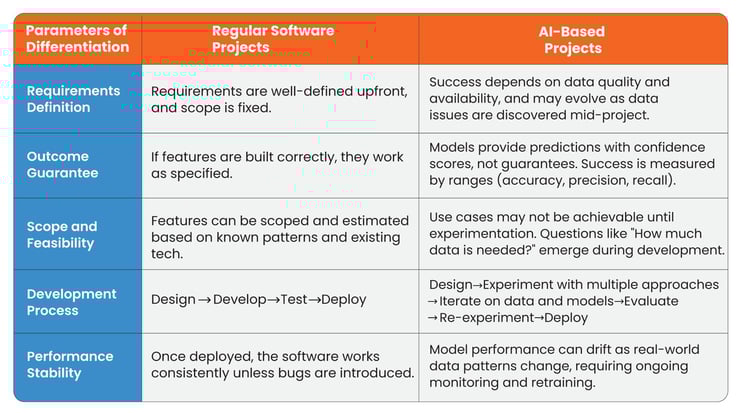
When it comes to traditional projects, the objective is simple – you have a properly articulated set of requirements. Once those are met, achieving success becomes much easier. However, in AI projects, success not only depends on specifications but is also defined by data quality. Here’s a clear picture of why AI-led initiatives operate differently.
Data Availability & Quality is the Necessity
In traditional software projects, technology leaders develop features and functionalities based on clearly defined priorities and business needs. In AI projects, the success of the initiative heavily depends on the quality, representativeness, and availability of data.
You might encounter complex challenges such as data bias, fragmentation, inaccuracy, and misaligned patterns that hinder your business goals.
For instance, an American multinational strategy and management consulting firm, McKinsey, states that 70 percent of AI projects fail due to data-related issues. This explains the impact of challenges while handling data in AI initiatives.
Accuracy Demands Stringent Evaluation
Traditional software projects yield clear, measurable outcomes, typically with a straightforward pass/fail criterion. If your code is rightly written and implemented, it will work as expected. However, when dealing with AI, embedded models deliver predictions with confidence scores.
"This suggests even 95 percent accuracy means there are 5 percent chances of failure."
To be precise, parameters of success in AI projects go beyond the pass/fail definition. Instead, they are defined by a gamut of precision and recall (not guaranteed). They require strict validation to achieve maximum accuracy.
Experimentation is Essential for Clarity
The scope for designing features is a straight line in regular projects. Moreover, by focusing on known patterns, you can easily estimate the required efforts and resources. However, when AI comes into the picture, enterprise leaders need to experiment to discover whether a particular use case is achievable.
Can a 92 percent accurate AI model resolve current challenges? Will the model require 1K to 100K labeled data points? These variations can only be revealed when you have enough room for experiments with AI models at hand.
Continuous Iteration is a Must
Traditional projects follow a straightforward path for designing, developing, testing, and deploying software systems. AI initiatives, on the flip side, require continuous iteration, training, and fine-tuning of AI models, algorithms, and patterns.
Business leaders must iterate through various models, experiment, continuously monitor data, evaluate outcomes, and adjust before deploying. This progress-driven process proves to be effort-intensive when it comes to forecasting timelines.
Consistent Maintenance & Monitoring
Linear software development models, once deployed, work systematically until discrepancies escalate over time. Comparatively, AI projects demand a different modus operandi. You need to monitor them constantly, analyze the performance of AI models, and retrain them as data patterns evolve with business expansion.
Why the Scope of AI Projects is Fuzzy: Hidden Blind Spots
After knowing the difference between traditional and AI projects, it’s time to understand why AI initiatives often have a fuzzy scope. This will help you set realistic expectations and define a structured path to budgeting and planning.
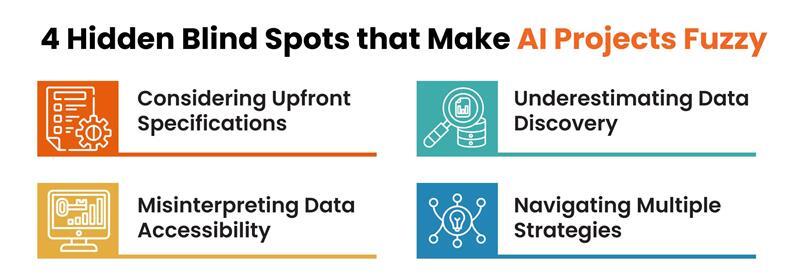
Considering Upfront Specifications
Decision-makers are often unaware of the required accuracy until they analyze outcomes. However, the criteria for project success don’t depend on upfront specifications. It evolves as your teams work on the project and continuously iterate.
Underestimating Data Discovery
Enterprise leaders may know what to automate or predict (for instance, churn rate). But they may not realize whether their data can support such functionalities. Many times, the triggering point isn’t seen in the data. It is only exposed through exploratory data analysis. Let’s consider data quality issues, such as inconsistencies, outdated records, and missing values. They only emerge when you start monitoring.
Misinterpreting Data Accessibility
When decision-makers say, “Our systems possess the required data,” they mean data is present in a particular environment. But it might not be readily available, usable, clean, and accessible. Addressing such a scenario can be tough and time-consuming.
Navigating Multiple Strategies
Unlike classic development initiatives, which are driven by a standard technology stack and approach, AI projects often require juggling multiple potential approaches. You can either opt for typical ML or deep learning. You can build your custom model from scratch or modify an off-the-shelf model. However, the result for these approaches can only be observed as the engagement moves forward.
Evaluating Cost & Timeline for AI Projects: Key Variables to Consider
For business and technology leaders, timeline and cost evaluation play a vital role in finalizing the AI project roadmap. However, a realistic and practical assessment requires considering a list of components. Let’s take a look at them.
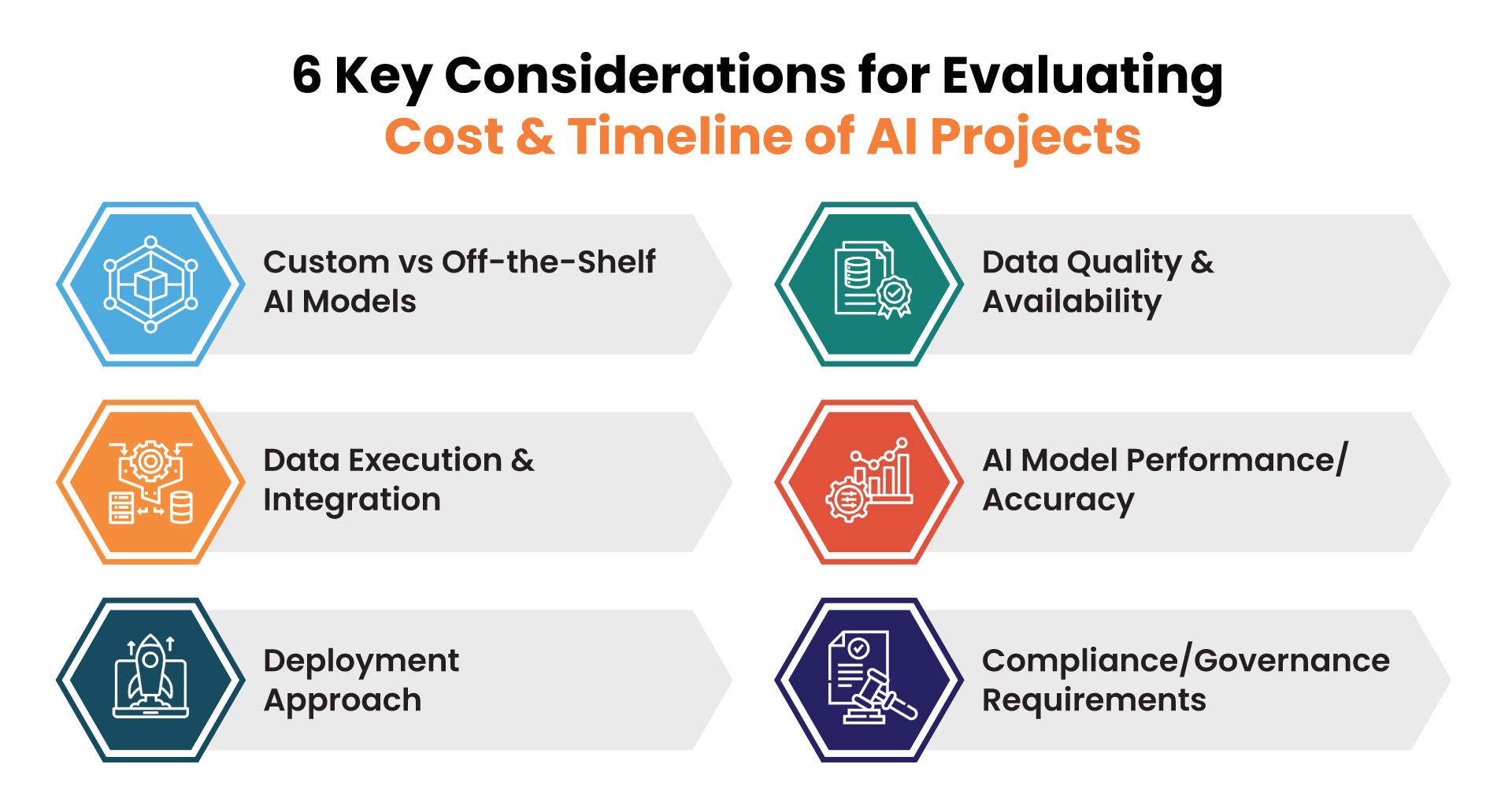
#1 Custom vs Off-the-Shelf AI Models
Pre-built or plug-and-play AI models, such as Google Vision and OpenAI, are faster to implement. However, they may have limited capabilities to address your business-centric use case. On the contrary, designing AI models from scratch may feel time-intensive at the start, but it may result in a comprehensive solution that perfectly meets your business requirements.
#2 Data Quality & Availability
The quality of data, its availability, and the ease to integrate it with the model directly impact project time and cost. If you need to onboard resources or invest time in data cleaning/labeling, this may increase costs to a certain extent.
#3 Data Execution & Integration
For most AI projects, executing and integrating fragmented data from isolated sources can be time-intensive and challenging compared to typical software development projects. The situation can become more complex if your project requires handling large sets of unstructured data.
#4 AI Model Performance/Accuracy
One of the most important considerations for estimating the cost and timeline is the overall performance of your AI model. You need to pre-define acceptable accuracy levels, recall, and related metrics at the start of the project. In some cases, you may need higher accuracy, which requires adopting complex models and data-heavy environments.
#5 Deployment Approach
Your selected deployment approach will surely influence the cost and timeline. That’s why you need to cautiously make a choice – whether to go for a cloud, on-premise, or hybrid ecosystem. Cloud-based approach often proves scalable and cost-effective, while on-premise and hybrid models may be necessary for certain data security and regulatory requirements.
#6 Compliance/Governance Requirements
You need to definitely think about governance if your project demands complying with essential frameworks like HIPAA and GDPR and rests on complex, sensitive data. This will provide clearer insight into both cost and timeline as your project evolves.
How to Approach AI Project Ballpark, Cost & Timeline When the Scope is Fuzzy
When the project scope is uncertain, you need to follow a strategic approach to get accurate estimates and eliminate unwanted risks. Here are some best practices that can help you achieve measurable business outcomes and maximize business growth.
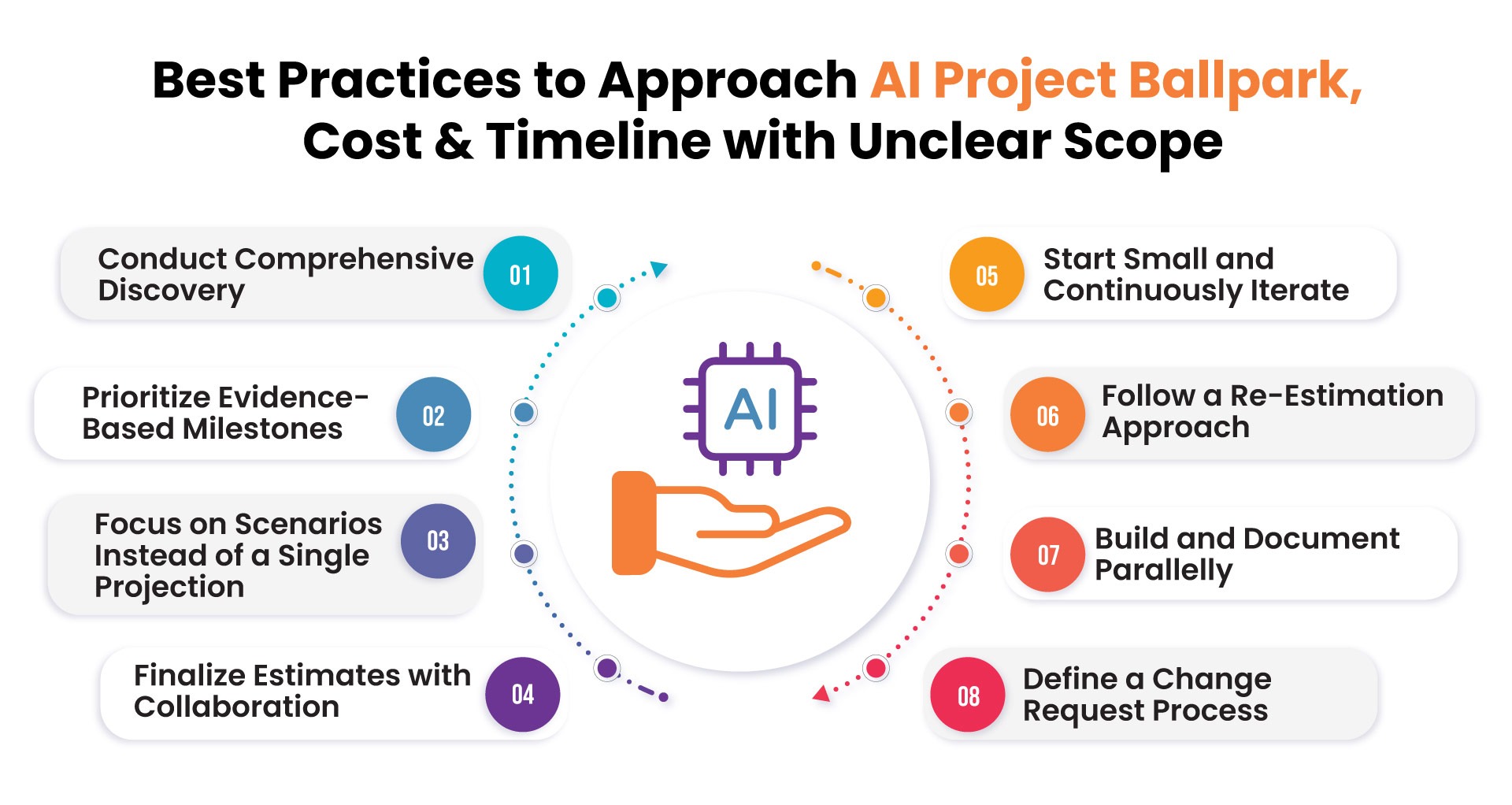
#1 Conduct Comprehensive Discovery
You need to carry out a thorough discovery phase backed by the 4 key facets given below:
Data Audit – Analyze what kind of data is available, locate its exact position within the system, and evaluate its quality.
Use Case Verification – Verify whether your specific use case aligns with currently available data.
Success Criteria – Define what outcomes you want to achieve and the AI capabilities to integrate at the start of the project.
Architecture Evaluation – Assess the existing architecture to identify what to build and adapt in the long run.
#2 Prioritize Evidence-Based Milestones
You need to follow the ‘Proof over Promise’ approach with a 3-step implementation setup driven by:
Proof of Concept – Evaluate the feasibility of the use case and initial performance of your AI model.
MVP Development – Begin by designing an MVP and incorporating the feedback from step 1.
Controlled Production – Prepare for deployment with a major focus on active monitoring.
#3 Focus on Scenarios Instead of a Single Projection
You need to avoid an individual estimate for your AI project by determining three specific scenarios, including:
Positive – Underlines clean data, fewer integration issues, and a standard approach that will work.
Practical – Creates a balance between data hiccups, model iterations, and other complexities.
Classic – Enables data collation/labeling along with complex integration and governance needs.
#4 Finalize Estimates with Collaboration
You need to prioritize the involvement of key stakeholders for your AI project. You need to maximize transparency across cross-functional departments. This ensures expectations are appropriately set and assumptions are properly aligned with core business objectives.
#5 Start Small and Continuously Iterate
Technology and business leaders should start by developing a foundational AI model. After development, they need to test its capabilities by validating performance. This practice will help iterate and scale as per a realistic final output.
#6 Follow a Re-Estimation Approach
You need to specifically compare the actual progress of your AI project with the projected effort. However, this is only possible when you have a weekly or bi-weekly check-in setup in place. This helps make critical modifications at the right time.
#7 Build and Document in Parallel
Enterprise leaders need to adopt a symmetric model – where equal weightage should be given to development and documentation. You can eliminate all possible misunderstandings by documenting various dependencies, assumptions, exceptions, and exclusions.
#8 Define a Change Request Process
Last but not least, it’s important to have a well-defined change request process in place. This will help align advancements to fundamental estimates as the scope of your AI project evolves.
How Clarion Technologies Can Help

Clarion designs enterprise AI systems for businesses where uptime, compliance exposure, and scalability cannot be compromised. Our AI development services help global organizations maximize system security through outcome-driven development, high-level governance (HIPAA, GDPR), modular architecture, and risk profile mapping.
At Clarion, every engagement follows a ‘maximum security, minimal risk’ approach to ensure operational resilience, reliable uptime, and lower total cost of ownership. With experience across 1,500+ engagements, our focus remains consistent: reduce operational risk, tech-next partnership, accelerate secure delivery, and align engineering outcomes to measurable SLAs.
Our stand-up agile product-oriented deliveries (PODs) blend the vEmployee model (where engineers work as an extension of your internal team – easy ramp-up/down) with lead engineers to help leadership teams with data security, product modernization, third-party integration, and ethical AI adoption.
Request a 30-minute consultation for your AI project and receive a high-level risk assessment tailored to your enterprise environment.

Author

Prasad Kulkarni - Vice President Service Delivery
Prasad Kulkarni is the Vice President of Service Delivery at Clarion Technologies, renowned for his expertise in QA, JavaScript, MySQL, jQuery, Ajax, and E-commerce. His proficiency in Web Application and Development, coupled with a strong background in Business Intelligence (BI) and Business Development (BD), has propelled him to the forefront of technological innovation. Prasad's dynamic approach and deep technical knowledge make him a pivotal leader in the tech industry.