


Blog Overview
Businesses are under constant pressure to innovate without losing control of the budget and certainty. If you’ve been in charge of a software project, you’ve most likely been asked for a fixed number upfront. The difficulty? Evolving products don’t act in predictable ways. The requirements change over time, integrations get complex, and priorities change when real users engage with the product.
According to McKinsey, large IT projects go 45% over budget and 7% over time, while generating 56% less value than expected.
So, what’s really going wrong? In most cases, it’s an early estimation based on assumptions. Locking cost and scope too early doesn’t remove uncertainty. It simply hides it. That’s why at Clarion, we estimate evolving software projects using budget ranges, phased scope, and open assumptions. Let’s dive into how we do it for your software projects.
The Limitations of Fixed Scope & Budget
According to the Standish Group CHAOS Report, about 31% of software projects are delivered on time, on budget, and with full scope.
The rest of the projects failed due to unrealistic early promises on scope and cost. At the beginning, fixed scope and fixed budget models may look secure, but they often provide rigidity where flexibility is required for an evolving software project management.
The key limitations of having a fixed scope and budget are:
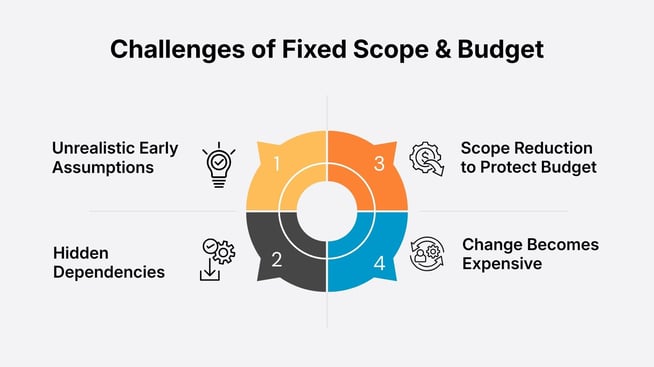
1. Unrealistic Early Assumptions
At the beginning of most software project management, requirements are still changing. However, a fixed number is locked in.
According to the PMI Pulse of the Profession Report, poor requirements management is one of the main reasons why projects fail. About 37% of projects fail due to poor management.
When early assumptions are assumed to be final truths, estimates become unreliable.
2. Scope Reduction to Protect Budget
When complexity surpasses original projections, something has to adjust. In many fixed-budget engagements, scope is sometimes reduced to preserve the agreed cost.
It leads to:
-
Deferred features
-
Compromised scalability
-
Technical shortcuts
At the end, the project may remain within budget, but strategic results suffer.
3. Hidden Dependencies
Gartner predicts that almost 80% of IT project overruns are tied to dependency risks and underestimated complexity.
Fixed estimates are based on assumptions. However, these assumptions aren’t always clear. Common hidden variables include:
-
Third-party integration complexity
-
Data quality inconsistencies
-
Internal decision delays
-
Regulatory requirements
-
Security constraints
4. Change Becomes Expensive
As per McKinsey, software initiatives go 45% over budget due to strict planning assumptions.
In evolving software systems, learning happens during execution. Customer input, compliance needs, architecture realities, and integration challenges reshape priorities. But under fixed models, each change often results in:
-
Change requests
-
Budget renegotiations
-
Timeline escalations
The contract structure penalizes adaptation instead of promoting innovation.
Our Agile Approach to Estimating Evolving Projects
When software projects evolve, estimating them requires discipline rather than rigid numbers. We use a structured Agile approach that preserves flexibility while maintaining financial clarity, rather than locking scope and budget too soon. Here’s how we project changing projects without creating any surprises:
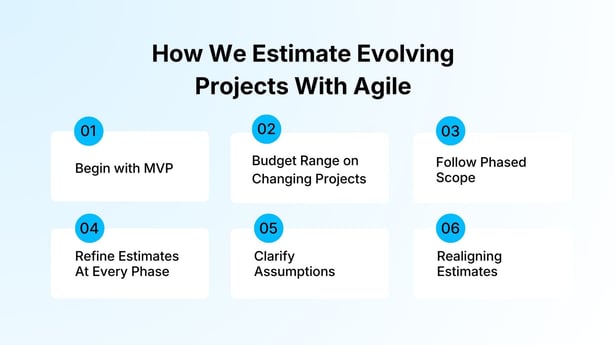
1. Begin with MVP
One of the most common mistakes in early-stage estimation is trying to price the entire future of the software projects at one go. At first, it may look like a strategic approach, but in reality, it’s only guesswork.
On the other hand, Clarion starts with MVP. First, we focus on delivering what truly matters first. It involves asking questions like:
-
What capabilities are essential for launch?
-
What features unlock business value fastest?
-
What can wait until validation?
These conversations help to analyze prioritization at the top level. By focusing only on the MVP, you reduce early investment risk, speed up time to value, and avoid locking budget into assumptions that may change. Instead of estimating a full 12-month roadmap all at once, we estimate what matters now.
2. Budget Range on Changing Projects
We don’t have a budget range for changing projects. Instead, we offer a budget range based on what we currently understand. Why? Because early-stage clarity is directional rather than precise. A single number creates artificial certainty.
This range shows known scope, complexity assumptions, integration dependencies, and business responsiveness.
3. Follow Phased Scope
We divide our work into phases, starting with an initial phase designed to increase clarity. The first phase may confirm:
-
Architecture direction
-
Integration feasibility
-
Performance constraints
-
Workflow realities
When you work in phases, it surfaces risks early, tests assumptions, and the plan becomes more realistic.
4. Refine Estimates At Every Phase
After each sprint or phase, estimates are refined based on what is learned and delivered. So, once a phase is completed, velocity, complexity, assumptions, and scope alignment are taken into consideration.
Estimation becomes increasingly more accurate as it is more performance-based rather than just theoretical. Over time, uncertainty reduces and forecast confidence rises.
5. Clarify Assumptions
All estimates are shared with clear dependencies and assumptions. It includes transparency regarding:
-
Third-party integrations
-
Data availability
-
Stakeholder responsiveness
-
Technical constraints
-
Compliance considerations
The largest source of budget surprises is hidden assumptions. By making them clear, risk is apparent, accountability is shared, and executive oversight is easier.
6. Realigning Estimates
Software changes, so do priorities related to it. We rapidly review and realign the estimate to avoid surprises whenever scope or assumptions change. We do not:
-
Absorb scope silently
-
Delay difficult budget conversations
-
Hide complexity behind optimism
Instead, our software development company recalibrates in real time by ensuring financial visibility is intact, decision-making stays informed, and trust is maintained.
Why Choose Clarion for Your Software Projects
Clarion partners with companies that understand developing software systems is not something that can be estimated on day one. So, trying to lock everything upfront usually increases risk rather than reducing it.
We assist companies in building clarity rather than forcing fixed numbers. Through sprint-based planning, phased execution, and clear budget ranges, we give you financial visibility without false certainty. In short, we don’t sell certainty that doesn’t exist in software development services.
At Clarion, we create predictability as your product develops. Our strategy is based on proof over promise. We don’t just commit, but demonstrate how we deliver value at every stage of your project.
Our stand-up agile product-oriented deliveries (PODs) blend the vEmployee model (where engineers work as an extension of your internal team – easy ramp-up/down) with lead engineers to help leadership teams with data security, product modernization, third-party integration, and ethical AI adoption.
If you’re still unsure how Clarion can be the right choice for your next project, schedule a free consultation with our software development company to understand how we execute your project’s discovery phase for long-term success.
Author

Devki Nair - Service Delivery Manager
Devki Nair, a seasoned professional with over 17 years of experience in the IT industry, boasts a multifaceted skill set encompassing 3 years in Service Delivery Management, 8+ years in Project Management, and 6+ years in programming. In her current role, Devki excels in managing multiple accounts across geographies, leading project managers, and overseeing diverse teams of over 50 people. As a dynamic leader, she actively participates in various organizational-level leadership initiatives, contributing to the strategic success of her team and the broader company.


-1.png?width=375&height=240&name=MicrosoftTeams-image%20(9)-1.png)