



Blog Overview
A large portion of software and technology projects struggle to deliver the desired results for businesses. According to industry research, only about 31% of projects are deemed successful, delivered on time, on budget, and with full scope, while the rest are challenged or completely failed.
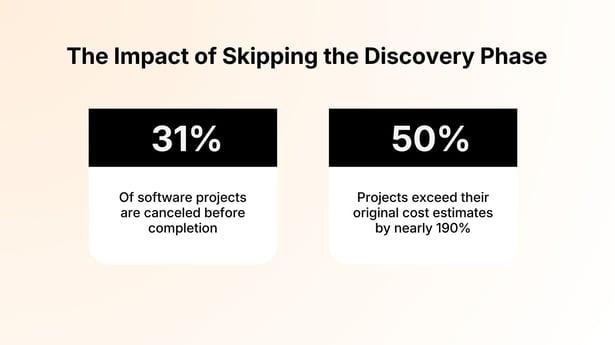
Most business owners assume that failures during development occur due to technical problems. However, the root cause often lies much earlier, before a single line of code is written.
The real issue? Skipping or rushing the software development discovery phase. It is a crucial phase when teams align on strategy, scope, success measures, risks, communication plans, and resources. It’s similar to beginning construction without blueprints because building something fast doesn’t always mean building it right.
Here, we’ll dive into what a discovery stage should deliver before development starts and why this determines whether your project launches with a clear approach or uncertainty.
What Happens Before Development Begins?
Before development begins, you should have clarity on key aspects to ensure seamless execution:
-
Are commercial terms aligned?
-
Is the right team in place?
-
Is the scope defined and prioritized?
-
Are risks identified and mitigated?
-
Is success measurable?
-
Is communication structured?
- Are tools and environments ready?
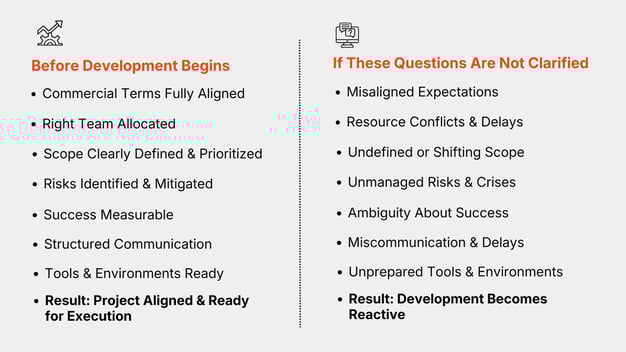
If these questions aren’t addressed before execution, the development process will be affected. Having a methodical discovery phase can reduce execution risks and set the foundation for a successful project by ensuring alignment across business, technology, and operations.
Key Deliverables in the Discovery Phase
Now, let’s explore what we actually deliver in the discovery phase of software development. These steps are designed to provide clarity, ensure alignment, and set the project up for success. Here’s what we take care of before development starts in projects:
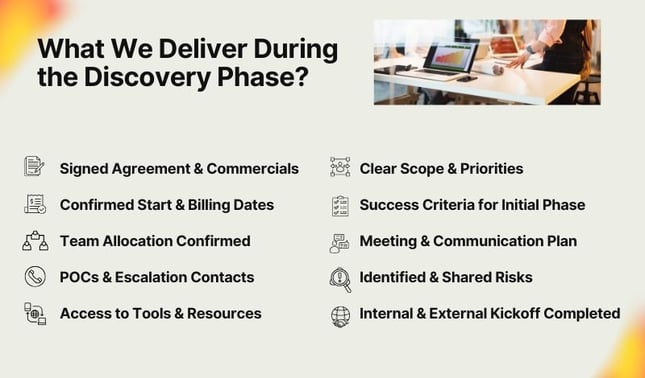
1. Signed Agreement & Commercials
Before any work begins, it’s essential to finalize the commercial agreement. This stage ensures that both parties, your business and the software developers, are clear on all conditions, including project scope, costs, timelines, and deliverables. Consider it as a contract that establishes the project’s terms of engagement. Begin by asking questions like:
-
Are the scope, timeline, and costs agreed upon?
-
Are payment terms and milestones set?
-
Are deliverables expectations aligned?
2. Confirmed Start & Billing Dates
When the agreement is signed, confirm the start date and billing start date. These dates are crucial for project planning and budget management. If you don’t have clear dates, you risk unnecessary misunderstanding and misalignment with financial predictions. You can clarify more on this by asking:
-
When does the project start?
-
When does billing begin?
-
What’s the timeline for milestones?
3. Team Allocation Confirmed
The next step is making sure the right team is allocated to the project and available from the start. If you do not have the right resources, team allocation is crucial so your project doesn’t experience delays or resource bottlenecks. Key questions to ask during this phase:
-
Does the team have the required skills?
-
Who are the main contacts and project managers?
-
Who will be the main point of contact?
4. POCs & Escalation Contacts
The discovery phase begins by building clear Points of Contact (POC) and escalation contacts. It ensures that communication flows smoothly throughout the project. It’s important to have clarity on who is responsible for what and how issues will be solved if they occur. It helps in avoiding delays caused by unclear communication channels. You can ask below questions to evaluate it better:
-
Who are the main POCs for both parties?
-
How will conflicts escalate?
-
What are the communication protocols and frequency?
5. Access to Tools & Resources
Before we start development, we ensure to get access to the required tools, repositories, and environments. This step prevents delays caused by access issues, which can be avoided during the early phase of a project. To understand it better, ask:
-
Do we have access to all necessary tools, systems, and environments?
-
Are security protocols or access restrictions addressed?
-
Is everything ready to use from day one?
6. Clear Scope & Priorities
The next steps in the discovery phase are to make sure the priorities and scope are clearly set. With no clear scope, the project risks going off-track, which leads to delays and high costs. We partner with stakeholders to define what needs to be done, what is out of scope, and the priorities for the first phase of the project. You can evaluate this by asking:
-
What’s included and excluded in the project scope?
-
What are the immediate priorities for the first phase?
-
How will scope changes be managed?
7. Success Criteria for Initial Phase
Another thing we do is define what success means for the initial stage of your project. This provides us with a clear set of objectives and measurable outcomes so we know when we’re on track. It all comes down to understanding what needs to be delivered first and ensuring that we have a solid baseline to track progress. However, ask questions below to understand their objectives:
-
What are the goals for the first phase?
-
How will success be measured (e.g., user adoption, performance)?
-
What does success look like in measurable terms?
8. Meeting & Communication Plan
During this step, we define how often we’ll meet, how we will report progress, and how we’ll manage daily communication. A well-defined communication strategy ensures that there’s no misunderstanding, making it easier to address problems and maintain focus. Top questions to consider before opting for software development services:
-
How often will we check in on progress?
-
Who is involved in key decisions?
-
What communication tools will we use (e.g., emails, Slack, meetings)?
9. Identified & Shared Risks
Risk management starts early in the discovery stage. We identify any potential threats to the projects, resources, or timeline risks. We create a plan to mitigate risks and avoid surprises during development. Some important questions you can ask:
-
What risks could impact the project?
-
What contingency plans are needed?
-
How will we address unexpected delays?
10. Internal & External Kickoff Completed
This stage ensures that both the internal team and any external stakeholders are prepared to start working together. It’s not just about starting but ensuring everyone understands the project’s goals, timeline, and expectations for each team member. The key questions you can ask here:
-
Are stakeholders aligned on goals and vision?
-
Do teams understand their roles and responsibilities?
-
How will we track progress and ensure transparency?
How These Deliverables Contribute to Project Success
By now, you understand that having established deliverables in place means your project will:
-
Be aligned across all teams (internal and external)
-
Have clear goals and priorities
-
Avoid unnecessary risks and surprises
-
Have defined success criteria that can be measured and tracked
For example, Clarion collaborated with an e-commerce company to implement a revenue cycle management (RCM) solution that was built on clear upfront planning, an aligned scope, and measurable success criteria. It resulted in 98% accurate payment predictions, 90% customer success, 40% faster payment processing, and 30% increase in transaction success. These outcomes are directly tied to the structured strategy of our software discovery phase.
Why Choose Clarion Experts for Your Projects
You are now aware of the importance of a structured discovery phase and the deliverables that guarantee smooth development. However, the real question is, who can ensure that your discovery phase is carried out with precision and foresight?
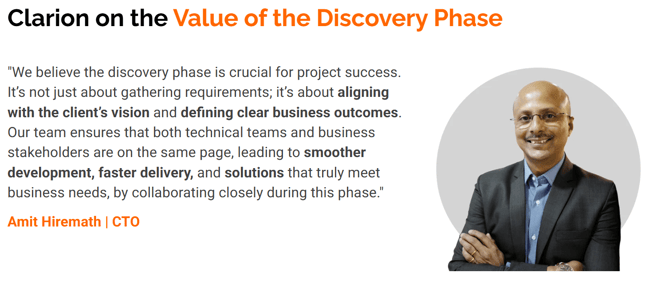
At Clarion, we have over 25 years of experience in initiating and managing complex projects from business software development to smooth integrations. We provide solutions that are tailored to meet your company's requirements and challenges. Here’s what we provide:
-
1,500+ clients globally
-
98% client satisfaction
-
Tailored models aligned with business goals
-
Proven discovery process that reduces risk
-
Certified experts in project management and development
Our strategy is based on proof over promise. We don’t just commit, but demonstrate how we deliver value at every stage of your project. Our agile product-oriented deliveries (PODs) work like an extension of your own team, with our flexible vEmployee model that lets you scale up or down as needed. With experienced lead engineers guiding the process, you see real progress, not endless discovery cycles.
If you’re still unsure how Clarion can be the right choice for your next project, schedule a free consultation with our software development company to understand how we execute your project’s discovery phase for long-term success.
Author

Devki Nair - Service Delivery Manager
Devki Nair, a seasoned professional with over 17 years of experience in the IT industry, boasts a multifaceted skill set encompassing 3 years in Service Delivery Management, 8+ years in Project Management, and 6+ years in programming. In her current role, Devki excels in managing multiple accounts across geographies, leading project managers, and overseeing diverse teams of over 50 people. As a dynamic leader, she actively participates in various organizational-level leadership initiatives, contributing to the strategic success of her team and the broader company.