



Product Acquisition: The Realities Most Business Leaders Overlook
“Most business leaders assume technology limitations are the primary risk to post-acquisition product continuity. In reality, execution credibility is the bigger failure point.” - Sashi Mohanty, Chief Marketing Officer
Organizational platforms, systems, and applications can be migrated. On the other hand, the internal workforce can also be restructured. However, once delivery confidence breaks, organizations face compounding execution risk that is difficult – and often impossible – to reverse post-acquisition. The scenarios become more challenging if your products directly influence customer experience, subscriptions, and business revenue.
This is why many post-acquisition product initiatives fail quietly – without a single visible failure event, but with steadily eroding delivery reliability.
This case illustrates a different and less discussed pathway to post-acquisition success. It outlines a long-term strategic partnership – where Clarion enables company-wide execution stability through transparent engineering practices, delivery governance, and a mature operating cadence.
Decoding Hidden Failures in Legacy Delivery Models
When collaborating with global enterprises governed by rigorous regulations and IP-backed products, SMEs at Clarion have consistently observed repeated patterns, such as:
-
Ad-hoc operational priorities disguised as ‘flexibility’
-
Excel-based planning without delivery predictability
-
Feature integration driven by urgency, not outcomes
-
Misaligned definitions of critical risk, speed, and value
These patterns often appear manageable in steady-state operations. However, under scale, regulatory pressure, or ownership change, these patterns reliably lead to unrecoverable delivery disruption. The same fragility surfaced as a strategic risk when the life sciences company’s IP services arm began scaling its platform.
Clarion’s ‘Execution Trust Diagnostic’ Framework to the Rescue
To help the client avoid such a vulnerable delivery pipeline, Clarion implemented its proprietary ‘Execution Trust Diagnostic’ framework – designed for long-running product ecosystems where continuity, predictability, and trust matter more than short-term delivery speed. This model is driven by four principles:
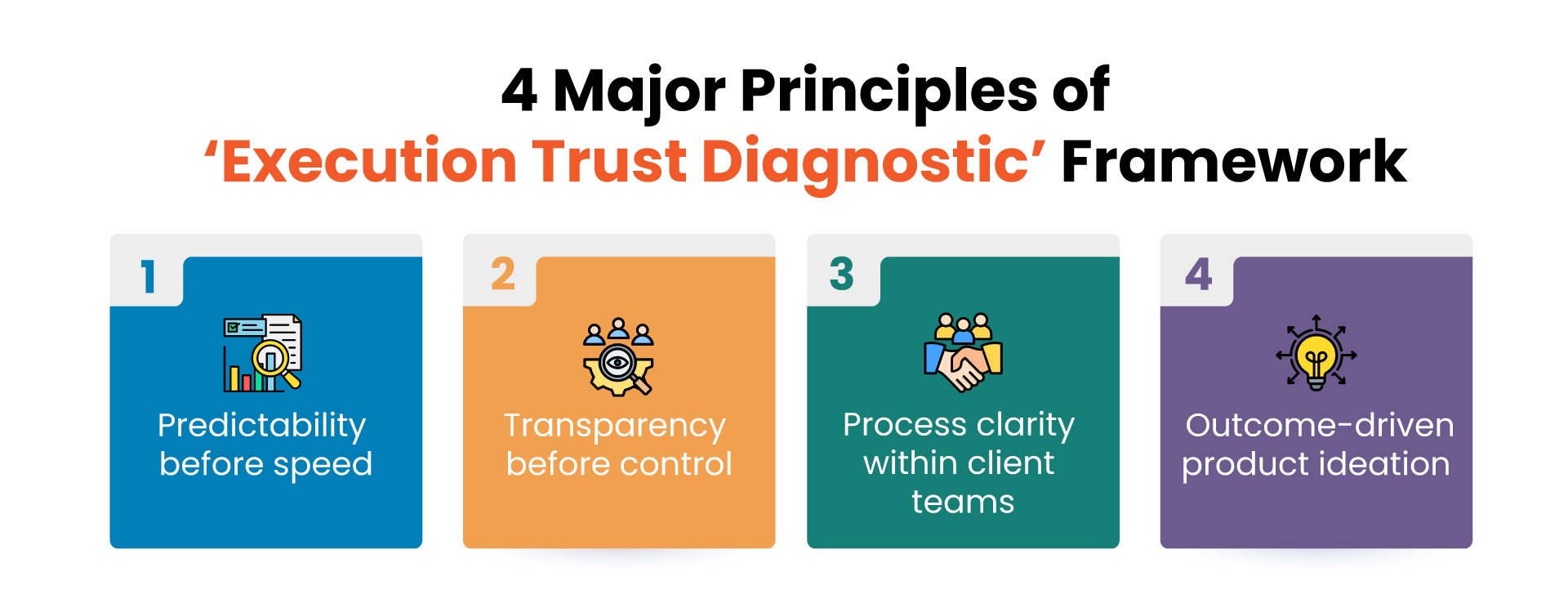
With the help of this framework, the client was able to cater to its product acquisition requirements without any disturbance. It became the governing mechanism for the execution of decisions across governance, onboarding, and delivery.
Enhancing Scalability and Transition Across Brands
The life sciences company’s IP services arm has a history of working with Clarion before getting acquired. The collaboration was centered around supporting and elevating internal platforms and workflows. The engagement focused on:
- Extending internal capability with certified .NET experts
- Building and enhancing high-impact revenue platforms
- Supplementing life sciences, patents, and IP workflows
Rather than establishing a staff-augmentation outsourcing relationship, the approach led to a business-centric delivery transformation for the client.
Therefore, at the time of acquisition, the IP services organization already had a process and engineering partner in place, enabling a seamless transition with uninterrupted execution momentum.
Elevating Engineering and Delivery Decisions
To ensure the right implementation of its ‘Execution Trust Diagnostic’ framework and support decision-making facets for the client, Clarion followed a step-by-step methodology.
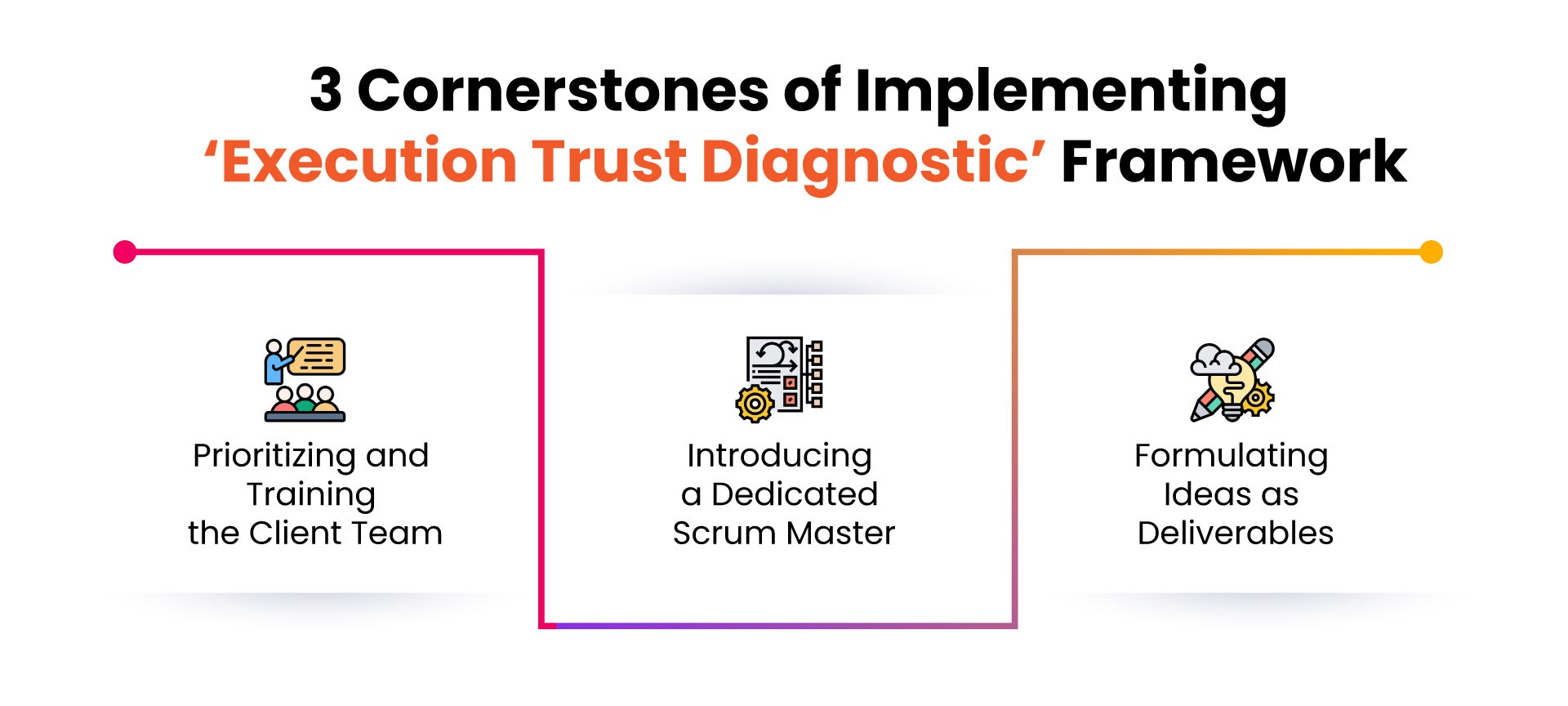
#1 Step: Prioritizing and Training the Client Team
Earlier, the IP services organization heavily depended on static estimates, priority lists, and minimal delivery ceremonies. Clarion focused on building internal decision confidence – not just enforcing process – so execution outcomes became predictable rather than reactive. This approach transformed task execution into collaboratively achieved outcomes through:
-
Agile and Scrum training for key client stakeholders
-
Sprint-driven strategy with shared velocity metrics
-
Full-scale Jira adoption for clear backlog management
-
Well-defined roadmap, huddles, retrospectives, and demos
#2 Step: Introducing a Dedicated Scrum Master
A highly skilled Scrum Master was deployed quickly to ensure continuity without negatively impacting development speed. The objective was to institutionalize predictable cadence, neutral scope negotiation, and execution discipline at scale.
#3 Step: Formulating Ideas as Deliverables
This step shifted execution from reactive ticket resolution to outcome-driven product decision-making. It institutionalized idea generation with expert-led, strategic assistance from Clarion, involving:
-
15 to 18 ideas for improvement per quarter
-
Pre-defined priorities and metrics for QBRs
-
First-hand input into roadmap discussions
Transforming Multiple Platforms with a Trusted Partnership
The partnership lifecycle between the life sciences company and Clarion has witnessed advancements and upliftment of various key systems and platforms.
IP Platform – A fully functional system enabling code & quote generation, third-party integration (for instance, Plunet), revenue-based transaction processing, and email workflows.
Life Sciences System – A platform ensuring continued post-acquisition for tiered service access, subscription-based revenue models, and alignment of feature gating and billing logic to product strategy.
The collaboration efforts also outlined:
-
Same-day remediation of key production discrepancies
-
Onboarding and knowledge transfer for new engineers
-
Consistent implementation/architectural fine-tuning
Business Outcomes that Matter
-
20 to 30% upsurge in delivery productivity
-
Faster resolution of critical vulnerabilities
-
Quick and predictable sprint-based releases
-
Sustained platform continuity via acquisition
-
Secure tech integration without disruption
-
Improved organizational scalability and ROI
2026 Demands a Mindset Shift
CIOs and product leaders worldwide face a strategic shift in 2026 where – “Delivery failure is no longer a tolerable growing pain; it’s a material business risk.”
Clarion’s partnership with the life sciences company highlights execution maturity as the real differentiator, not tools or resources. It explains that post-acquisition, platforms need to:
-
Scale without regression
-
Monetize without friction
-
Evolve without base reset
Success Demands Execution Trust
“Speed is not the only factor defining long-term product success. Execution trust – reinforced sprint after sprint – is a leading indicator of post-acquisition product success.”
That’s why Clarion doesn’t replace internal teams for its esteemed clients. It elevates their modus operandi to ensure consistent delivery confidence across evolving scenarios and complex environments.
Is Your Delivery Model Acquisition Ready?
Are you a technology or business leader seeking dedicated assistance for subscription monetization, platform consolidation, or post-merger product integration? Get a comprehensive assessment to evaluate delivery predictability, risk exposure during scale/transition, and process maturity with Clarion’s ‘Execution Trust Diagnostic’ framework.
Let’s move beyond sales conversations toward a clarity exercise – designed for leaders who can’t afford delivery failure.