



Blog Overview
Whenever organizations sit down to discuss and evaluate the decisions related to IT outsourcing, they almost always begin with a discussion on costs.
Hourly rates. Blended pricing. That whole onshore versus offshore math, which savings are better reflected in neat spreadsheets.
But that’s not 2026 anymore. Cost is no longer the biggest risk in outsourcing. Delivery failure is.
We have seen engagements where outsourcing has succeeded with high costs and failed spectacularly, even when there was aggressive cost optimization towards success. The differentiator is rarely price. Vendor governance-yes.
Cost Is Visible. Governance Is Not.
Cost is simple to determine. Governance is not.
You know the amount you pay your vendor per month. You cannot realize misalignment or soft accountability and slow decision loops in quantifiable terms until deliverables start slipping.
Most failures in outsourcing do not take place because vendors are incapable; they happen when governance frameworks are either weak or unclear, or completely missing.
This is what happens when governance is poor:
-
Timelines drift with no early warning
-
Quality collapses first gradually, then suddenly
-
Accountability becomes shared, therefore owned by no one
Escalations come in late, right when fixing things gets costly. By then, the leadership steps in, but the program
Why Low-Cost Vendors Often Create High Delivery Risk
There is a persistent assumption that lower cost equals better efficiency.
In reality, aggressively cost-driven vendor selection often introduces hidden fragility.
Low-cost engagements tend to compensate through:
-
Higher team churn
-
Overextended delivery managers
-
Minimal documentation
-
Reactive communication models
None of these show up in the contract. All of them show up in execution.
Strong IT outsourcing governance exists precisely to counterbalance these risks, not after problems arise, but before delivery begins.
Governance Is About Decision Flow, Not Control
Misconception about governance- it slows down the teams.
Lack of proper governance is exactly what creates friction.
Decision ownership, escalation paths, visibility into progress, and quality and delivery thresholds-all defined by good governance. None of this implies micromanagement within any government structure.
At Clarion, we firmly believe that governance accelerates delivery rather than acting as an overhead layer atop delivery. Because once expectations, authority and accountability are clearly articulated, there's no ambiguïty standing in the way for teams to address with momentum.
Delivery Risk Increases as Complexity Grows
Nowadays, outsourcing is not just a single-project initiative. It covers:
-
Distributed teams
-
Multi-vendor ecosystems
-
Cloud and legacy integrations
-
AI-driven workflows
-
Continuous release cycles
As complexity increases, informal coordination eventually breaks down.
This is where most organizations underestimate governance; what works for a small project fails at an enterprise scale.
Governance in successful IT outsourcing engagements evolves with complexity, from simple reporting to structured delivery assurance.
Governance Failures Rarely Announce Themselves
Delivery risk does not come as a crisis. It comes as silence.
Missed signals. Optimistic status updates. Minor issues repeated again and again. Technical debt accumulates quietly in the background.
By the time delivery metrics start showing visible signs of degradation, the window for inexpensive correction has already closed.
At Clarion Technologies, governance is designed such that it brings to notice any kind of risk much before it impacts customers, revenue, or leadership credibility.
Proactive review mechanisms form a part of it with measurable delivery indicators and shared accountability models that distribute surprises across the organization.
Why Governance Is a Leadership Responsibility
Vendor governance is pushed too far down in the organization. Procurement owns contracts. PMOs own reporting. Delivery teams own execution.
Governance failure is a leadership problem, not an operational one.
If governance does not have authority, then it becomes performative: reports with no consequences, meetings with no decisions,
There must be executive alignment to install strong governance on:
-
What success looks like
-
What failure looks like
-
Who intervenes when signals appear
-
How trade-offs are resolved
Without lining things up, money saved at first often disappears later because of delays, having to redo work, and damage to reputation
Cost Optimization Without Governance Is Short-Term Thinking
Organizations under margin pressure often optimize for immediate savings.
But cost-focused outsourcing without governance discipline creates long-term instability. We’ve seen cases where:
-
Savings achieved in year one were offset by rework in year two
-
Vendor transitions became unavoidable due to trust erosion
-
Internal teams were forced into firefighting mode
In contrast, organizations that prioritize governance build durable partnerships, where performance improves over time rather than degrades.
How Clarion Approaches Vendor Governance Differently
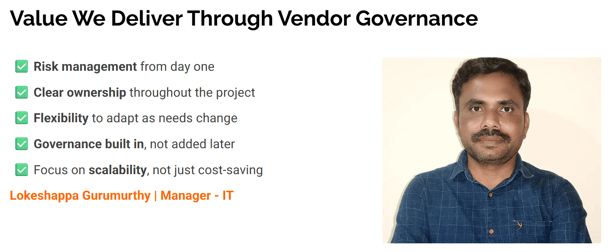
Governance is not a contractual formality at Clarion. Governance is the core delivery capability of Clarion. Our three engagement models ensure:
-
Defined outcome ownership
-
Integrated governance cadence with client leadership
-
Proactive risk visibility instead of waiting for escalation
-
Delivery accountability in business terms
That makes the outsourcing partnership resilient when priorities change or complexity increases.
We do not “add later” governance. It is there from day one. We combine governance with risk visibility, clear ownership, and outcome-based responsibility. Unlike cost-only approaches, we place a high priority on governance to control risk early and ensure smooth, scalable execution. Our Proof over Promise method is designed to create solutions that mitigate risks by focusing on intentional architecture, continuous ownership, and strategic flexibility.
Are you prepared to secure a successful outsourcing partnership? Collaborate with Clarion to ensure your governance is a key factor in long-term performance and business results.
Author

Dilip Kachot - Technical Architect Delivery
Dilip Kachot, a seasoned Technical Architect with over 7 years of experience in the Mobility domain, excels in driving successful delivery of cutting-edge solutions. His expertise lies in architecting and implementing innovative mobility solutions that align with the evolving technological landscape.