Case Study: Real-Time Shipment Tracking for Logistics Provider
A US-based logistics provider wanted to improve shipment visibility by offering customers accurate,...
25+ Years of Excellence Helping Businesses Succeed with Advanced Technology Solutions.
Top 1% Pre-Vetted Software Experts Committed to Maximize Business ROI.
Cutting-Edge Technology Stack for Building World-Class Software Solutions.
Thought Leadership to Decode Innovation & Accelerate Smart Business Decisions.
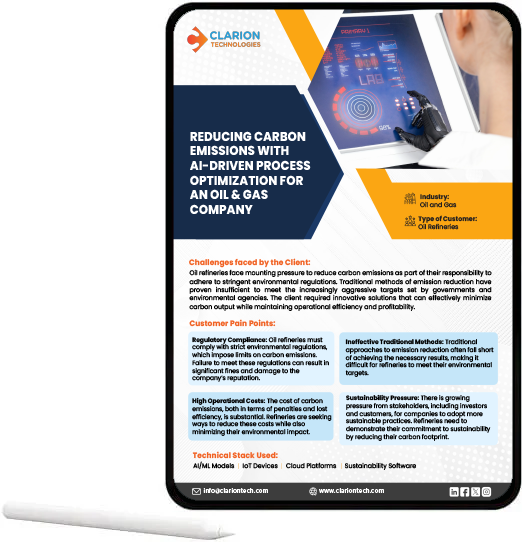
An oil refinery sought to reduce carbon emissions while maintaining operational efficiency and complying with increasingly stringent environmental regulations. Traditional emission reduction methods were no longer sufficient to meet sustainability targets, creating the need for an AI-driven optimization approach.
Legacy systems that could not achieve new emission targets without hurting output.
Meeting increasingly stringent environmental regulations and avoiding compliance risks.
High running costs due to energy loss and inefficient production process.
Increasing demand from stakeholders in terms of sustainability by reducing carbon footprints.
Clarion`s AI developers build an AI-driven process optimization solution using AI/ML models, IoT devices, cloud platforms, and sustainability software to reduce refinery carbon emissions.
Implemented AI/ML models to identify process inefficiencies and recommend optimization opportunities that reduce carbon output.
Deployed IoT devices for continuous, real-time monitoring of emissions, enabling immediate action when thresholds are exceeded.
Leveraged cloud platforms for scalable analytics, centralized reporting, and actionable operational insights while integrating sustainability software for carbon footprint tracking and regulatory reporting.
Up to 20% reduction in carbon emissions, helping refineries meet environmental targets.
Lower operational costs by reducing emissions-related penalties and process inefficiencies.
Improved regulatory compliance through continuous monitoring and accurate emissions reporting.
Enhanced sustainability through better carbon footprint management and data-driven operational decisions.
AI-powered process optimization enables refineries to analyze large volumes of operational data in real time, identify inefficiencies, and improve energy performance across plant operations. Key benefits are:
Identifying energy inefficiencies and operational bottlenecks across refinery units in real time.
Providing data-driven recommendations to optimize equipment performance and reduce fuel consumption.
Enhancing the efficiency of heating and processing systems to minimize energy waste.
Detecting potential equipment issues early, helping prevent operational disruptions and unexpected emissions increases.
IoT sensors installed throughout refinery operations collect critical emissions data, while cloud platforms aggregate, process, and analyze this information for improved visibility and decision-making. The combined benefits of using both are:
Providing a centralized, real-time view of emissions levels across the entire facility.
Generating instant alerts when emissions exceed regulatory thresholds or operational targets.
Processing large volumes of environmental data to identify trends and optimization opportunities.
Streamlining compliance reporting by automatically integrating accurate emissions data into reporting systems.
Real-time emissions monitoring helps organizations:
A US-based logistics provider wanted to improve shipment visibility by offering customers accurate,...
A large-scale oil refining and distribution company sought to improve supply chain efficiency amid...
A US-based healthcare solutions provider partners with federal agencies and the private sector to...