Thought Leadership to Decode Innovation & Accelerate Smart Business Decisions.

Choose Value with Competitive Costs through our IT Outsourcing ROI Calculator. Get Your Report
Hire Pre-Vetted Engineers with 2-weeks, Risk-Free Trial Get Started
Build your own Agentic AI. Book a Slot

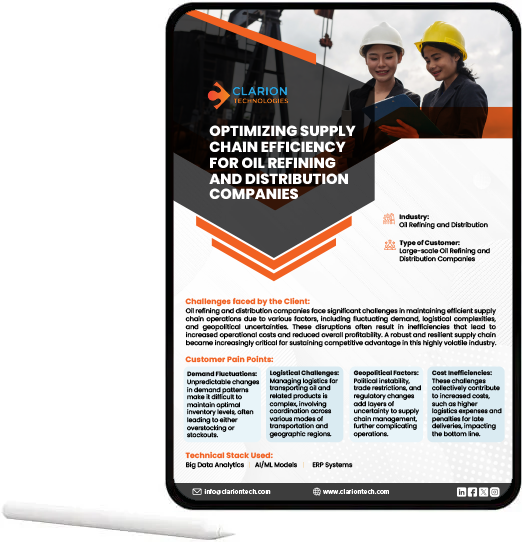
Case Study: Maximizing Oil Refining and Distribution Efficiency with Custom ERP, AI & Analytics

Case Study: Maximizing Oil Refining and Distribution Efficiency with Custom ERP, AI & Analytics
Oil & Gas Supply Chain Optimization with ERP & AI - Clarion Case Study

A large-scale oil refining and distribution company sought to improve supply chain efficiency amid fluctuating demand, complex logistics, and geopolitical uncertainties. These challenges increased operational costs, affected delivery performance, and made it difficult to maintain a resilient and responsive supply chain.

The Challenges:

  • Unpredictable demand fluctuations made it difficult to maintain optimal inventory levels, leading to overstocking or stockouts.

  • Complex logistics operations across multiple transportation modes and regions reduced supply chain efficiency.

  • Geopolitical uncertainties and regulatory changes disrupted planning and increased operational risk.

  • Rising logistics costs and penalties for delayed deliveries impacted profitability and operational performance.

The Solution:

  • Clarion`s team build an AI-powered supply chain optimization solution using Big Data Analytics, AI, Machine Learning (ML), and ERP systems to improve demand forecasting, inventory management, and logistics planning.

  • Implemented Big Data Analytics to deliver real-time visibility into logistics operations and demand patterns, enabling faster and more informed decision-making.

  • Applied AI and ML models to forecast demand accurately, optimize inventory levels, and reduce supply chain risks caused by demand fluctuations.

  • Integrated ERP systems to centralize procurement, logistics, and inventory management, improving coordination and operational efficiency across the supply chain.

The Business Outcomes:

  • Reduction in logistics cost by 15%: Data analytics and AI-driven route optimization enabled saving logistics cost, better route planning, and cutting fuel consumption.
  • Improvement in on-time delivery by 20%: Demand forecasting and inventory management improved on-time delivery, improving customer satisfaction and reducing penalties.
  • Increased operation efficiency: ERP integration helped improve operational efficiency, streamline the supply chain and reduce administrative overhead.
  • Enabled proactive, data-driven decision-making with real-time insights and predictive analytics.

Frequenty Asked Questions

How does big data analytics optimize logistics operations in the oil refining and distribution industry?

Big data analytics helps oil and gas companies optimize logistics by turning transit and market data into actionable insights, improving routing efficiency and reducing delays. Here are the key benefits:

  • Identify the bottlenecks and inefficiencies which are difficult to discover through classic manual tracking.
  • Process numerous operational parameters, including fuel consumption, fleet capacity, and real-time routes.
  • Supports automated route optimization, which brings down the consumed fuel and carbon footprint.
  • Enables real-time monitoring across distribution networks, offering complete transparency over shipping status.
  • Helps organizations make accurate and time-bound supply chain decisions easily.

Why is ERP integration important for optimizing oil supply chain operations?

ERP integration eliminates data silos, streamlines operations, and enhances procurement and inventory management. Key advantages are:

  • Provides a unified coordination platform for multi-location distribution needs.

  • Merge procurement, inventory management, and outbound logistics into the unified automated system.

  • Ensures real-time tracking of all operations, thus eliminating silos of information as well as cutting down overhead costs.

How do AI and Machine Learning improve demand forecasting in the oil supply chain?

An advanced AI and ML algorithms aids organizations in building predictive forecasting systems capable of managing severe price and demand fluctuations. Such models help energy organizations with:

  • Complex trend detection across volatile market environments.

  • Automated inventory monitoring to prevent costly overstocking or stockouts.

  • Predictive risk modeling to counter unexpected supply or transport delays.

  • Improving demand forecast accuracy for ever-changing market distributions.