Optimizing Motor Insurance for an Emirates-Based Insurer
Challenges: A major motor insurance company in the Emirates had issues with fragmented data across...

25+ Years of Excellence Helping Businesses Succeed with Advanced Technology Solutions.
Top 1% Pre-Vetted Software Experts Committed to Maximize Business ROI.
Cutting-Edge Technology Stack for Building World-Class Software Solutions.
Thought Leadership to Decode Innovation & Accelerate Smart Business Decisions.
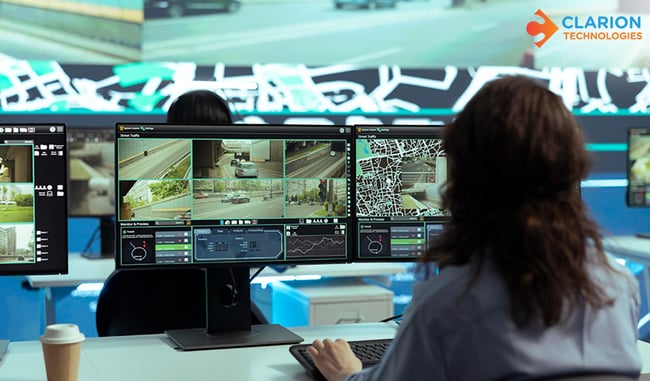
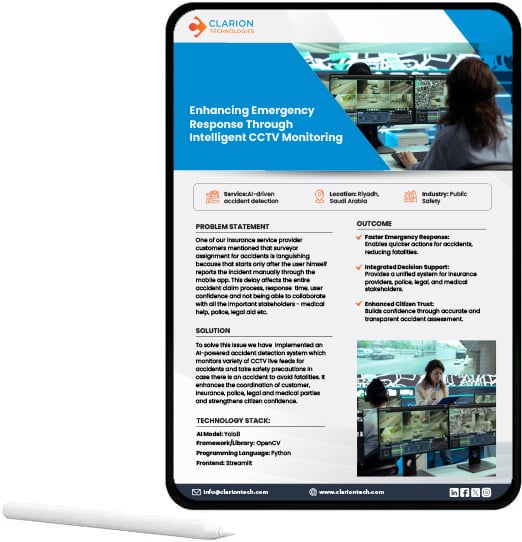
A public-sector insurance ecosystem in Riyadh, Saudi Arabia needed to improve accident response and claims processing. The existing process relied on users manually reporting road accidents, delaying surveyor assignment, emergency response, and coordination among insurance providers, police, medical teams, and legal authorities.
Long delays in assigning insurance surveyors while waiting for drivers to submit reports manually.
Delayed incident reporting slowed emergency response and the overall insurance claims process.
Poor coordination between insurance companies, police, medical teams, and legal aid.
Reduced customer confidence due to long claims processing and poor communication.
Clarion tech team developed an AI-powered accident detection solution using YOLOv8, OpenCV, Python, and Streamlit to monitor live CCTV feeds and automatically detect road accidents.
Enabled continuous monitoring of CCTV footage to identify accidents without relying on manual user reporting.
Automated early incident detection to trigger safety precautions and support faster emergency response.
Enables faster emergency response: Early warning system ensures quick response, decreasing death tolls.
Integrated Decision Support: Universal support for insurance, police, legal, and medical.
Increased Public Trust: Credible and timely evaluations help gain citizens' trust.
Running YOLOv8 (AI Model) on live CCTV feeds allows computer vision models to scan multiple video feeds at once and flag collisions as soon as they happen. Public safety agencies use YOLOv8 for accident detection because:
It processes high-resolution video streams instantly without system lag.
It detects vehicle collisions right away without waiting for manual incident reports.
It filters out false alarms by identifying specific impact patterns and sudden stops.
It sends immediate alerts to emergency responders and insurance teams.
Python paired with the OpenCV computer vision library provides a flexible foundation for running vision algorithms. Developers choose Python and OpenCV for video analytics because:
OpenCV includes tools for image processing, frame extraction, and motion tracking.
Python simplifies connecting machine learning models like YOLOv8 into live video feeds.
The stack scales easily across many camera feeds without overloading system memory.
It speeds up software development while keeping ongoing maintenance straightforward.
A centralized dashboard created via Streamlit (open-source python framework) brings everyone together on the same data platform. The shared platform can be beneficial for organizations involved in public safety in the following ways:
Alerts medical, police, and insurance teams at the same time an incident occurs.
Shares live visual evidence and precise locations to guide responders.
Starts surveyor assignments right away instead of waiting for manual claims.
Builds public trust through transparent, automated incident tracking.
Challenges: A major motor insurance company in the Emirates had issues with fragmented data across...
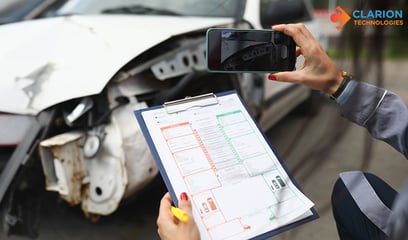
The Problem The traditional accident liability assessed mainly by manual video reviewing and...

A North America-based commercial insurance brokerage helps more than 1,200 small and medium-sized...