Thought Leadership to Decode Innovation & Accelerate Smart Business Decisions.

Choose Value with Competitive Costs through our IT Outsourcing ROI Calculator. Get Your Report
Hire Pre-Vetted Engineers with 2-weeks, Risk-Free Trial Get Started
Build your own Agentic AI. Book a Slot

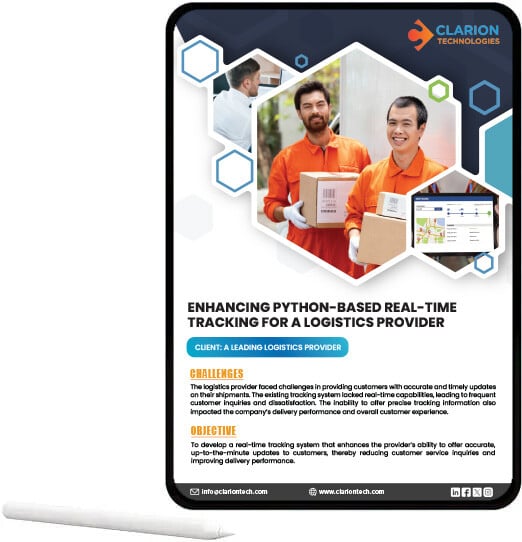
Case Study: Real-Time Shipment Tracking for Logistics Provider

Case Study: Real-Time Shipment Tracking for Logistics Provider
Optimizing Supply Chain Efficiency with Python-Based Real-Time Tracking - Case Study

A US-based logistics provider wanted to improve shipment visibility by offering customers accurate, real-time tracking updates. Its existing tracking system lacked real-time capabilities, resulting in frequent customer inquiries, delayed shipment visibility, and an inconsistent customer experience. The organization sought a scalable solution to improve operational efficiency and delivery performance.

The Challenges:

  • Limited real-time shipment visibility led to frequent customer inquiries and increased support workload.

  • Customers lacked timely and accurate delivery updates, impacting their overall experience.

  • The existing tracking system made it difficult to proactively identify and manage shipment delays.

  • The business needed a scalable tracking platform to improve delivery performance and operational efficiency.

The Solution:

  • Clarion`s developed a Python-based real-time shipment tracking solution using FastAPI, Socket.IO, Mapbox, and IoT integration to deliver live shipment updates with low latency.

  • Built an interactive customer portal that enabled users to track shipments in real time, view live locations on a map, and receive instant delivery notifications.

  • Integrated IoT-enabled tracking across vehicles and shipping containers for accurate, real-time shipment status and location data.

  • Enabled internal teams to proactively monitor shipments and respond quickly to potential delivery delays.

The Business Outcomes:

  • 40% Reduction in customer inquiries through self-service, real-time shipment tracking. 

  • 15% improvement in delivery performance, resulting in more on-time deliveries and fewer delays. 

  • Enhanced customer satisfaction with accurate, real-time shipment visibility. 

  • Improved operational efficiency through proactive shipment monitoring and real-time logistics management.

Frequenty Asked Questions

How does a real-time tracking system improve delivery performance in the logistics industry?

A robust real-time tracking solution continuously updates shipment locations, helping organizations improve delivery performance and visibility. The major benefits are:

  • It helps in identifying transit bottlenecks early, something that static systems may overlook.

  • Real-time tracking incorporates multiple operational variables such as exact coordinates, route maps, and delay notifications while processing shipment status.

  • Live data streaming also allows the system to update customer portals instantly, hence improving visibility.

  • Supports responsive fleet management and streamlines route planning.

  • Helps organizations make accurate, and time bound customer updates easily.

Why is Python preferred for building real-time tracking systems?

Python is widely used for real-time tracking and low-latency APIs due to its scalability, flexibility, and rich ecosystem of high-performance libraries. The key advantages of using Python are:

  • Helps in development of highly customizable tracking modules tailored to specific fleet management needs.

  • Easily integrates with modern IoT gateways, mapping systems, and communication sockets across major enterprise networks.

  • Maintains support for a broad ecosystem of open-source libraries for data parsing, map rendering, and backend automation and also scales easily with increasing active connections across growing business needs.

How does combining tracking devices with geolocation services improves logistic operations?

By combining tracking devices and geolocation services, real-time tracking systems provide accurate shipment updates and improved visibility throughout the logistics operations. The key benefits are:

  • Collecting real-time data directly from vehicles and shipping containers.

  • Providing customers with detailed information regarding their shipment on an interactive map.

  • Enabling internal monitoring of shipments and proactive management of potential delays.

  • Pushing instant updates to customers regarding their delivery status with low latency.