Thought Leadership to Decode Innovation & Accelerate Smart Business Decisions.
Choose Value with Competitive Costs through our IT Outsourcing ROI Calculator. Get Your Report
Hire Pre-Vetted Engineers with 2-weeks, Risk-Free Trial Get Started
Build your own Agentic AI. Book a Slot

Case Study: Python-Based Demand Forecasting Solution for FMCG

Case Study: Python-Based Demand Forecasting Solution for FMCG
Python-based demand forecasting solution for FMCG - Clarion Case Study

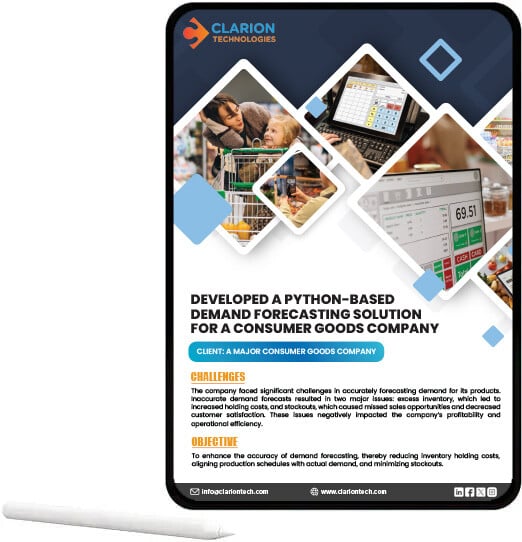
A major consumer goods company wanted to improve demand forecasting to better align inventory and production with market demand. Inaccurate forecasts resulted in excess inventory, stock shortages, increased holding costs, and missed sales opportunities, impacting profitability and operational efficiency.

The Challenge

  • Inaccurate demand forecasts resulted in excess inventory and stockouts.

  • High inventory holding costs reduced operational efficiency.

  • Poor demand visibility impacted production planning and customer satisfaction.

The Solution

  • Developed a Python-based demand forecasting solution using Scikit-Learn and TensorFlow to improve forecasting accuracy through machine learning. 

  • Built machine learning models using historical sales data, market trends, economic indicators, and seasonality to generate more accurate demand forecasts.

  • Integrated the solution into the client's existing demand planning process, enabling continuous learning and progressively improving forecast accuracy.

  • Enabled inventory and production planning to better align with changing market conditions through AI-driven demand forecasting.

The Business Outcome

  • Improved demand forecast accuracy by 30%, reducing the risk of overproduction and stockouts.

  • Reduced inventory holding costs by 20% through more accurate demand planning.

  • Optimized production schedules by aligning manufacturing with actual market demand.

  • Improved operational efficiency and profitability through better resource utilization.

Frequenty Asked Questions

How does machine learning improve demand forecasting in the consumer goods companies?

Machine learning improves demand forecasting for FMCG industry by analyzing historical sales data alongside market trends and seasonality, enabling more accurate predictions and better inventory planning.

  • Helps in identifying hidden demand patterns, something that traditional methods may overlook.

  • Incorporates multiple external variables such as market trends, promotions, economic conditions, etc. while processing data.

  • Allows the system to learn from new data, hence improving forecast accuracy.

  • Supports responsive production and streamlines inventory planning.

  • Helps organizations make accurate, and time bound decisions with ease.

 Why is Python used for demand forecasting in supply chain operations? 

Python offers powerful machine learning libraries, scalability, and flexibility to build accurate, data-driven forecasting models. Organizations across the globe choose Python these days because:

  • It aids in the development of highly customizable forecasting models tailored to specific business needs.
  • It integrates with modern AI systems, analytics solutions across major enterprise platforms.
  • It maintains support for a broad ecosystem of open source libraries for machine learning, visualization, and automation and also scales easily with increasing data volumes across growing business needs.

What is the role of deep learning tools like TensorFlow in predicting market demand?

Tensorflow helps organizations in building advanced predictive models that are capable of highlighting complex relationships within large datasets, something that traditional forecasting methods may miss. Such a model helps organizations with:

  • Complex pattern detection across multiple variables.

  • Structured and unstructured data processing.

  • Seasonality, customer behavior, and market fluctuation analysis.

  • Improving prediction accuracy for ever-changing demand environments.