



Enterprise applications are no longer back-office systems – they are revenue engines, compliance anchors, and board-level risk exposures. That also makes them high-value targets for increasingly sophisticated and financially motivated cyberattacks.
“As per IBM, a single breach can cost organizations an average of $4.45 million with non-compliance fines and irreversible damage leading to more financial loss. This security failure results in reduced customer trust and company credibility with long-term disruption.”
To avoid such scenarios and strengthen mission-critical applications, business and technology leaders need to collaborate with a proven, high-performance .NET software development company. This decision is not a technology selection — it is a risk management and business continuity decision.
This blog post outlines what enterprise leaders should expect from a trusted company delivering .NET development services when security, scalability, and regulatory exposure are on the line.
What is Enterprise-Grade Application Security in .NET
Enterprise apps, such as financial tools, customer-facing portals, ERP systems, and compliance platforms, handle confidential data that powers crucial business workflows. This software requires top-notch security to safeguard sensitive information, maintain digital integrity, and maximize interoperability across company-wide processes.
With .NET software development services, you will not just build a fully-functional app but engineer it to withstand sophisticated attacks and data leakages while maintaining customer trust, regulatory compliance, and uptime. This enables a shift from reactive incident response to ‘Security by Design’ — where threats are anticipated during architecture decisions, not discovered in production.
For instance, an experienced .NET software development company helps you protect your enterprise-grade applications by introducing security patterns built on top of DOT NET.
-
Building a data safety net to avoid insider threats, malicious activities, and unauthorized access.
-
Ensuring 360-degree compliance with HIPAA, GDPR, SOC 2, and other key industry standards.
-
Eliminating instances of permanent damage, financial overburden, and regulatory penalties.
For business and technology leaders, this security approach provides a stronger competitive stance with predictable risk exposure and minimal disruption.
How a .NET Software Development Company Designs Secure Architecture
In enterprise environments, architecture decisions determine whether security becomes a competitive advantage — or a recurring liability. A trusted .NET software development company doesn’t prioritize app security post-deployment. Rather, it embeds multiple fortification layers into every architectural decision, delivering tangible business results.
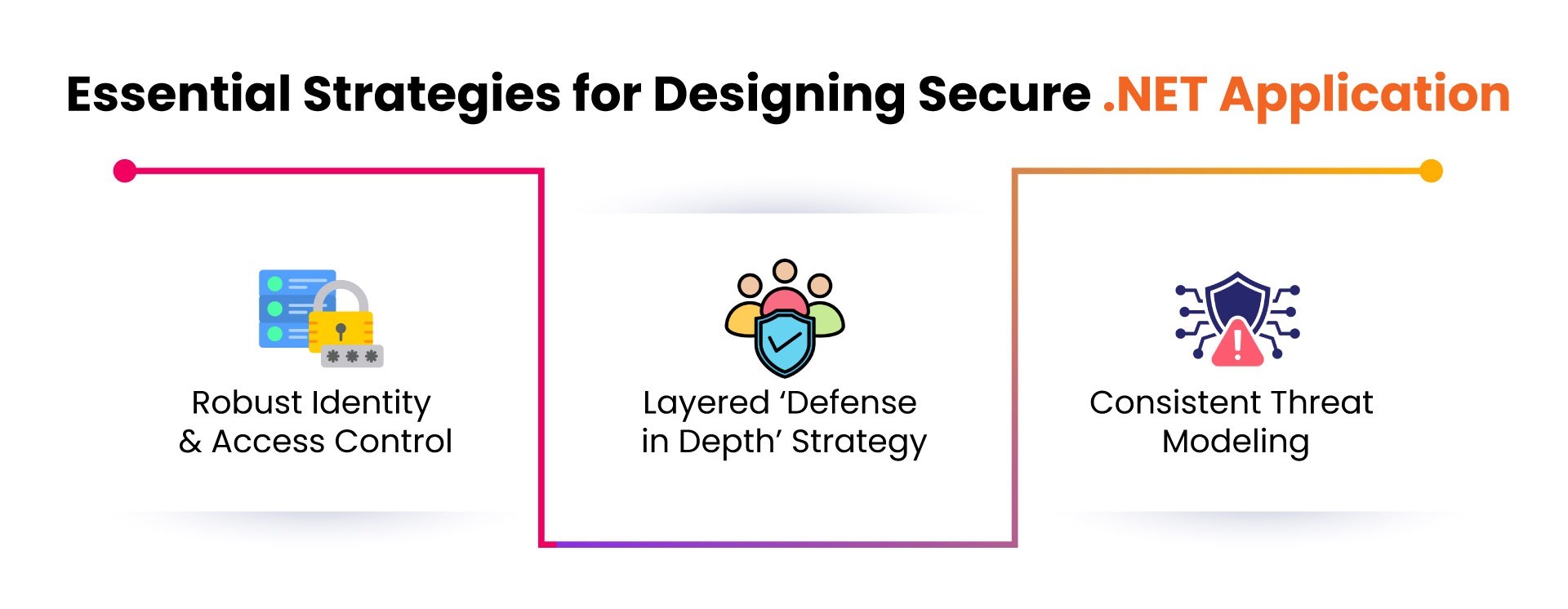
Robust Identity & Access Control
At enterprise scale, identity mismanagement is one of the most common and costly causes of security breaches. An agile and skilled DOT NET development company safeguards your application throughout the SDLC. It maximizes all-around protection with:
-
Authorization – Enables context, role, and policy-based user access.
-
Authentication – Grants system entry only to verified/legitimate users.
With assistance from a reliable development company specializing in .NET, you can eliminate potential risks by implementing modern architecture backed by controlled access (least privilege, claims, RBAC). Technology leaders can ensure seamless integration with corporate identity platforms, such as OAuth providers and Azure Active Directory.
Layered ‘Defense in Depth’ Strategy
Expert-led DOT NET development from a dedicated company operates with a clear understanding – enterprise systems are multi-layered. That’s why they help global businesses enable perimeter defenses and network firewalls along with:
-
Highly secure and stringent middleware/API gateways
-
End-to-end encrypted data workflows and database
-
Thorough segmentation of business-focused services
-
Microservices driven by well-defined trust boundaries
This approach limits breach impact, accelerates containment, and prevents localized incidents from becoming company-wide disruptions.
| In an enterprise modernization engagement for a financial services client, our architecture-first security approach reduced critical vulnerability exposure by 42% within the first audit cycle and shortened compliance remediation timelines by 30%. The result – faster regulatory clearance and zero production security incidents during migration. |
Consistent Threat Modeling
A mature .NET company institutionalizes threat modeling from day one — not as a compliance exercise, but as a core architectural discipline. Unlike discovering risky scenarios late in the software cycle, DOT NET professionals introduce attack vectors from the start. This mechanism avoids cost-heavy rework and significantly exploitable openings.
In regulated enterprise environments, security failures occur not because of weak code, but because identity governance, deployment pipelines, and cloud permissions were never aligned architecturally. In a SaaS company handling financial transactions, fragmented access policies across microservices created lateral movement risk — a vulnerability that would not have been visible without early threat modeling and architectural review.
Designing .NET Enterprise Applications: Security Best Practices to Consider
Enterprise security fails when it is treated as a one-time implementation instead of an ongoing governance discipline. It demands a combination of consecutive, auditable practices that reduce risk surface and exposure every day as your .NET software evolves over time.
Collaborating with a trusted DOT NET development company will help you create long-term business value by prioritizing the following best practices.
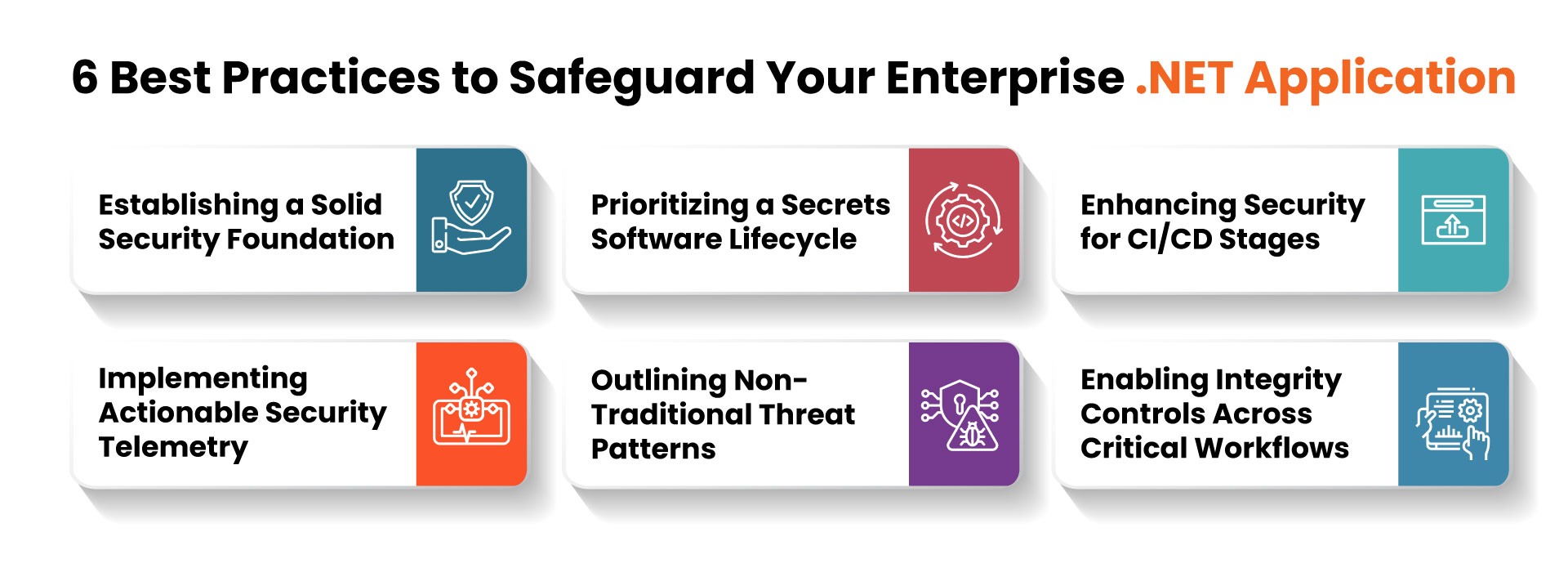
#1 Establishing a Solid Security Foundation
Securing your .NET software begins with stringent defaults – where features, runtime setup, and services are configured in a way that they only expose required aspects. This practice shrinks the ‘sudden attack surface’ and reduces breach instances.
Outcome
-
Reduced unexpected outages during production
-
Fewer unplanned/last-minute change interventions
#2 Prioritizing a Secrets Software Lifecycle
Sophisticated modern-day cyberattacks don’t just disrupt code; they target credentials and access control. With a secure DOT NET software, business leaders can enforce a comprehensive secrets lifecycle. This provides a centralized, safe storage for credentials, least-visibility access, and automated rotation, along with the elimination of secrets in build outputs, repos, and logs.
Outcome
-
Improved breach discovery & suppression
-
Reduced failure scenarios for credential reuse.
#3 Enhancing Security for CI/CD Stages
Enterprise applications rely on build agents, packages, and containers. In such environments, the deployment pipeline itself must be hardened — with automated vulnerability scanning, supply-chain transparency, and controlled artifact promotion across environments.
Outcome
-
Accelerated audit readiness for your company
-
Decreased exposure to third-party compromise
#4 Implementing Actionable Security Telemetry
Another best practice to be taken into consideration for securing software and applications of your company is instrumenting security telemetry using .NET. This includes anomaly indicators, privilege changes, authentication events, and high-risk transactions aligned with security information and event management (SIEM) workflow.
Outcome
-
Swift discrepancy detection and containment
-
Quick response mechanism for disruption
#5 Outlining Non-Traditional Threat Patterns
With guidance from a DOT NET-based development company, you can easily safeguard your enterprise apps and software against non-traditional threats like manipulative automation, gray failure, and web scraping. You will be able to identify unusual behavior patterns through proactive threat handling and a vulnerability scoring system.
Outcome
-
Better control over support, incident, and cloud costs
-
Minimized downtime and risk profile
#6 Enabling Integrity Controls Across Critical Workflows
Cyberattacks related to claims, finance, and procurement often hamper core business workflows. With .NET, technology leaders of your company can implement integrity controls to protect high-risk events. These include step-up validation, replay defense, fraud-resistant records, and idempotency for major activities.
Outcome
-
Trust-driven outcomes for business workflows
-
Eliminated the risk of potential fraud and breaches
Your Go-To Gamut of Tools for Secure .NET Software Development
A credible .NET development company does not rely on tools alone — it selects and governs them within a security architecture aligned to your risk profile. This fusion of technologies helps you amplify outcomes and ensure future readiness.
Built-In DOT NET Features for Enhanced Security
An intelligent DOT NET software development company offers:
-
Strong multi-factor support and authentication using ASP.NET Core Identity.
-
Secured storage for sensitive keys and tokens with data protection APIs.
-
Granular access to essential systems with policy-based authorization.
Seamless Integration of Cloud Capabilities
Today, business leaders are focusing more on building .NET applications with cloud native capabilities. They can take advantage of Azure security platforms, such as Azure Defender and Azure Key Vault, for securing secrets and protecting storage & compute against potential threats.
Well-Structured DevOps Automation
DevOps tools play a vital role in embedding security into CI/CD pipeline automation. These include SAST platforms like SonarQube, containerization tools like Kubernetes & Docker, and IaC models like Terraform.
High-Governance and Compliance Tooling
Tooling choices should be based on business accountability. This is only possible when you monitor, report, and comply with regulatory standards, such as HIPAA, GDPR, SOC 2, and CCPA. Business leaders can leverage platforms like SAP GRC, OneTrust, and ServiceNow GRC to avoid non-compliance fines.
How Clarion Technologies Ensures Security in Enterprise .NET Applications
Clarion designs enterprise DOT NET systems for organizations where uptime, compliance exposure, and scalability cannot be compromised. Our software engineers help global organizations maximize system security through outcome-driven development, high-level governance (HIPAA, GDPR), modular architecture, and risk profile mapping.
Every .NET engagement at Clarion is driven by a ‘maximum security minimal risk’ approach to ensure operational resilience, predictable uptime, and decreased total cost of ownership. With experience across 1,500+ engagements, our focus remains consistent: reduce operational risk, tech-next partnership, accelerate secure delivery, and align engineering outcomes to measurable SLAs.
Our stand-up agile product-oriented deliveries (PODs) blend the vEmployee model (where engineers work as an extension of your internal team – easy ramp-up/down) with lead engineers to help leadership teams with data security, software modernization, third-party integration, and ethical AI adoption.
Request a 30-minute .NET security architecture consultation and receive a high-level risk assessment tailored to your enterprise environment.

Author

Dilip Kachot - Technical Architect Delivery
Dilip Kachot, a seasoned Technical Architect with over 7 years of experience in the Mobility domain, excels in driving successful delivery of cutting-edge solutions. His expertise lies in architecting and implementing innovative mobility solutions that align with the evolving technological landscape.