



Blog Overview
Today, many companies are under pressure to release software quickly while maintaining high product quality. Business leaders struggle to balance speed and reliability in their development processes. The questions they’re juggling with:
-
Are hidden defects impacting performance and customer experience?
-
Can the current QA approach support faster releases?
-
Are quality issues increasing development costs and risks?
According to the Consortium for Information & Software Quality (CISQ), poor software quality costs US businesses $2.41 trillion. It highlights the massive financial impact of solution failures.
That’s why software quality assurance testing services have become a crucial part of modern delivery. Companies can invest in structured QA strategies to make sure their apps are safe, reliable, and scalable.
To understand more about this, read our blog, which explains why you should choose quality assurance services for your business success.
How Software QA Testing Services Improve Business Outcomes
Businesses rely on software to manage operations, deliver services, and support customer experiences. As these systems grow and evolve, making sure these systems perform reliably becomes crucial.
In such situations, software quality assurance testing services are important to help maintain stability and reduce the risk of unexpected issues. Below are key reasons on how quality assurance services help companies in improving results:
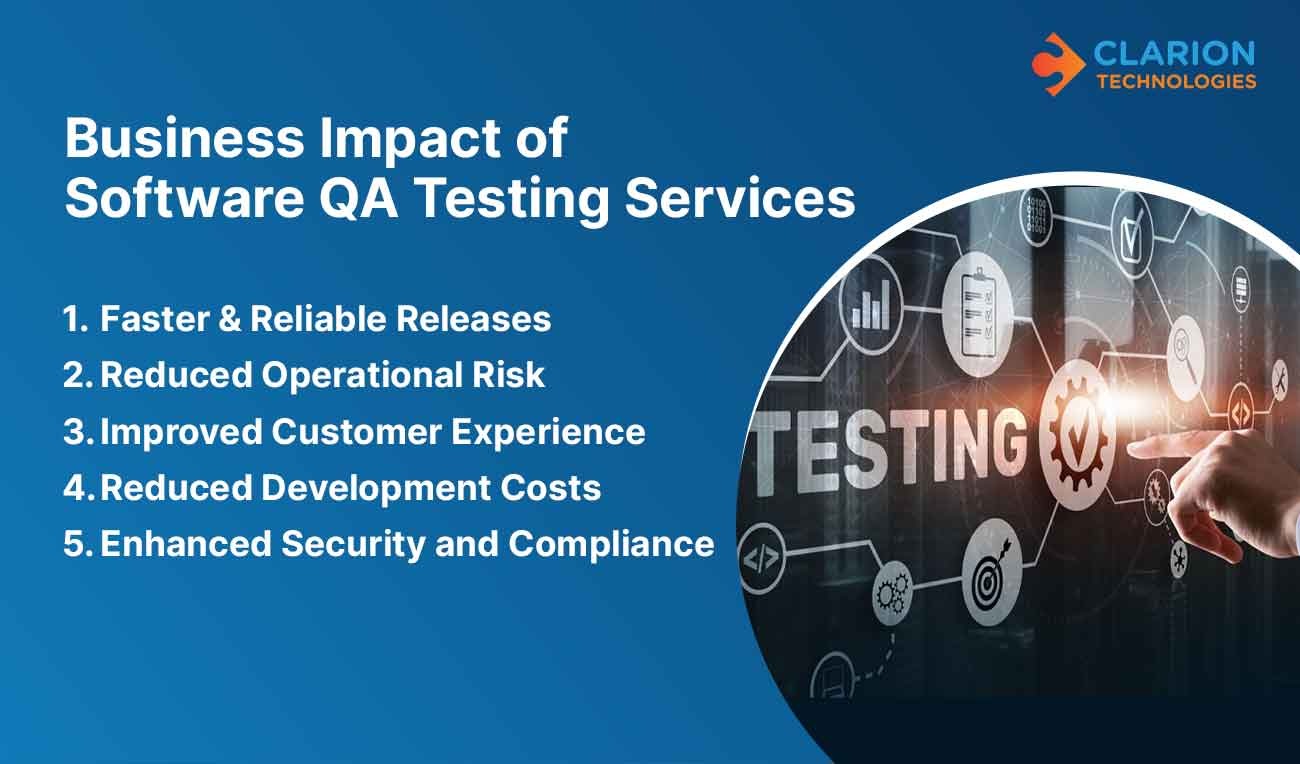
1. Faster & Reliable Releases
As teams adopt Agile and DevOps methodologies, release cycles have become shorter. Software quality assurance services help your business in maintaining release speed without affecting stability. These application testing services help organizations:
-
Detect defects early in the development cycle
-
Support automated regression testing
-
Reduce last-minute fixes before releases
-
Enable smoother CI/CD pipelines
2. Reduced Operational Risk
Business software failures can impact customer service, internal operations, and business continuity. With quality assurance services, these issues can be minimized by verifying system behavior before deployment. These services help to:
-
Identify critical defects before launch
-
Prevent system downtime and disruptions
-
Validate application stability across environments
-
Ensure systems perform under real-world conditions
3. Improved Customer Experience
Customers anticipate digital products to work smoothly. Application testing services make sure apps deliver consistent performance across platforms, devices, and usage scenarios. Here’s how it helps:
-
Minimize crashes and usability issues
-
Improve application speed and responsiveness
-
Ensure cross-platform compatibility
-
Deliver stable and reliable user experiences
4. Reduced Development Costs
Defects discovered after the development process are more expensive to fix. That’s why inspecting the software during the development lifecycle can help in identifying issues earlier to save cost and time in the long run. Here’s how quality assurance services benefit you:
-
Detect defects early in development
-
Reduce post-release fixes and patches
-
Minimize rework and development delays
-
Improve overall development efficiency
5. Enhanced Security and Compliance
Security and compliance are non-negotiable when applications handle sensitive data and operate in regulated industries. Here’s how quality assurance services help when you want to locate weaknesses and ensure systems meet the requirements:
-
Identify security vulnerabilities early
-
Protect sensitive customer data
-
Support regulatory compliance requirements
-
Improve overall system trust and reliability
When Businesses Should Consider QA Testing Services
Many businesses begin with basic internal testing. But, as the system grows and release cycles accelerate, there are clear signals that an organized quality assurance strategy or external support is required.
Here are some common business scenarios when you should opt for quality assurance services:
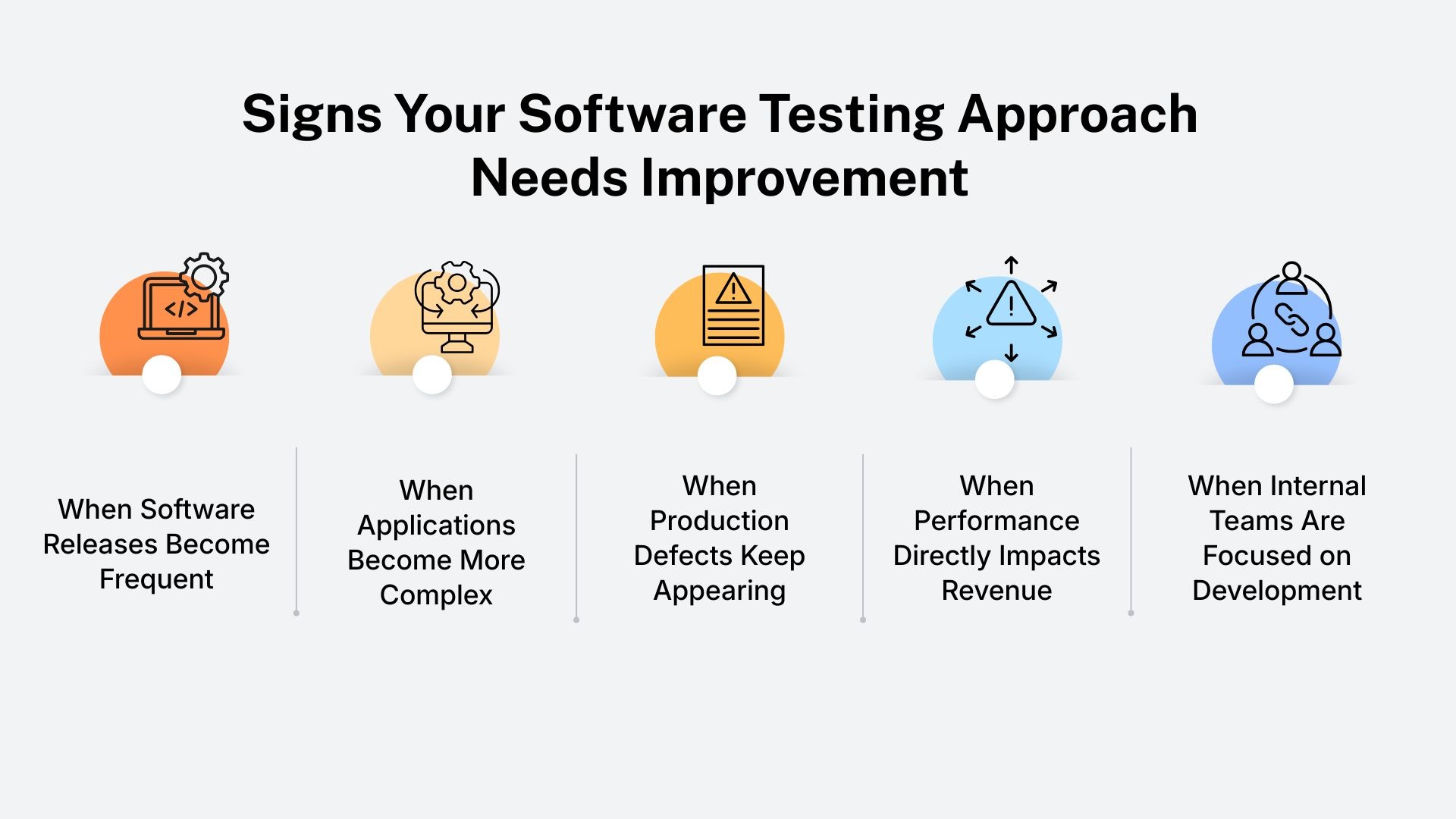
1. When Software Releases Become Frequent
Companies implementing Agile and DevOps often release updates daily, weekly, or even multiple times per day. Without automated and structured testing procedures, faster releases can easily bring new issues.
For example, a global outage of Facebook was caused by a configuration change during a standard system update. The outage disrupted services for billions of users on Facebook, WhatsApp, and Instagram for various hours.
The incident highlights how even a small change can result in major disruptions if proper testing and validation procedures are missing. Quality assurance assists in implementing automated regression testing and release validation to ensure frequent updates do not affect the product stability.
2. When Applications Become More Complex
Modern software systems rarely function alone. They usually incorporate multiple APIs, databases, cloud environments, and third-party integrations. It takes specialized tools and expertise to test these interconnected systems.
A well-known example is Knight Capital Group, where a software deployment error caused unintended stock trades. The defective software executed millions of transactions within minutes, which resulted in a loss of $440 million in less than an hour.
This incident shows how defects in complex systems can have serious financial outcomes. However, with QA services, organizations can implement integration testing, environment validation, and performance testing to avoid such incidents.
3. When Production Defects Keep Appearing
If users frequently experience crashes, bugs, or broken features after product releases, it usually means that testing coverage is inadequate. Finding defects in production is costly and disruptive.
Research by the IBM Systems Sciences Institute states that repairing a defect after release can cost up to 30 times more than fixing it during the development process.
This can be avoided with quality assurance services by using continuous testing practices and automated validation throughout the development lifecycle.
4. When Performance Directly Impacts Revenue
Application performance is closely linked to revenue and customer satisfaction for many digital businesses. Even minor performance problems can impact user behavior.
According to Google research, 53% of mobile users give up on a website if it takes longer than 3 seconds to load.
In such scenarios, quality assurance helps in load and performance testing to ensure applications stay stable under high traffic.
5. When Internal Teams Are Focused on Development
Development teams usually focus on delivering new features and enhancing existing products. So, when the same teams are responsible for testing and quality supervision, some areas may get neglected.
Nearly 70% of companies say their development teams spend a significant amount of time managing testing activities, which often limits the time available for building new features and innovation.
This can be prevented by having a dedicated QA team focused on quality validation. It allows development teams to concentrate on innovation while maintaining software reliability.
Tips to Choose the Right QA Testing Partner
Choosing the right QA partner helps companies deliver reliable software. Having a solid partner improves your testing strategy and assists development teams. Consider the following tips when evaluating a quality assurance partner:
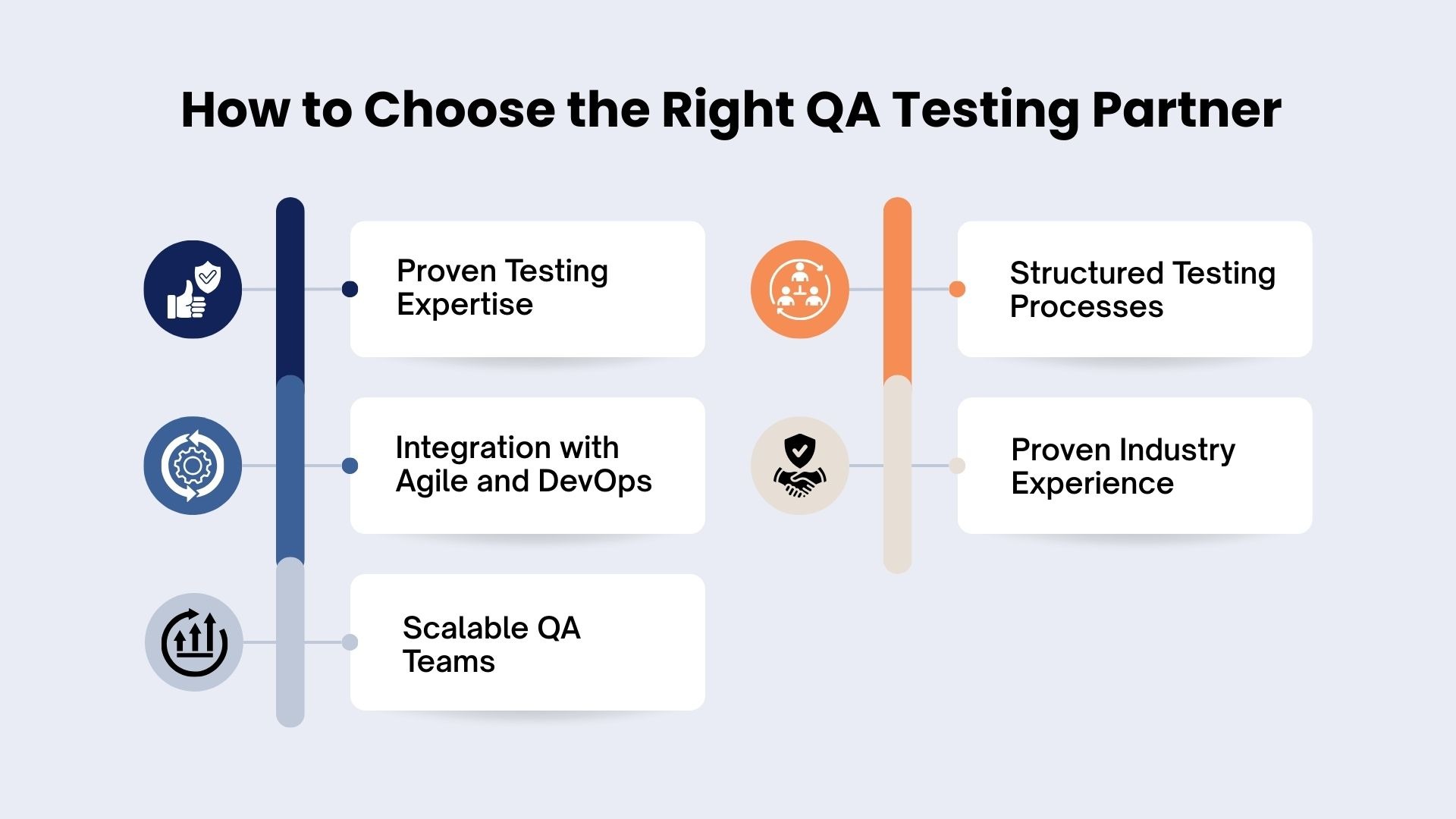
1. Proven Testing Expertise
Choose a partner with experience across multiple testing types to ensure complete quality coverage. Check their expertise across:
-
Functional and regression testing
-
Test automation
-
Performance and load testing
-
Security and compliance testing
2. Integration with Agile and DevOps
Modern teams release software frequently, so testing must support continuous delivery. Look for partners who can:
-
Integrate testing into CI/CD pipelines
-
Support automated regression testing
-
Collaborate closely with development teams
3. Scalable QA Teams
Testing needs often grow as products evolve. A reliable partner should scale resources when required. They should have experience in:
-
Flexible team scaling
-
Dedicated QA engineers
-
Support for complex projects
4. Structured Testing Processes
Consistent testing requires clear frameworks and reporting practices, such as:
-
Test planning and documentation
-
Defect tracking and reporting
-
Transparent communication
5. Proven Industry Experience
Experience across industries helps QA partners understand real-world challenges. Here’s what to look for:
-
Case studies and project outcomes
-
Industry expertise
-
Strong client satisfaction record
Strengthen Your Software QA Testing Strategy with Clarion
Now, you are well aware of the importance of quality assurance testing. But another important question for companies is: who can help you in putting a testing strategy that truly supports your business goals?

Clarion brings 25+ years of expertise in delivering reliable solutions for organizations across different industries. We’ve partnered with expanding SMB and global enterprises that needed assistance beyond testing. Our quality assurance specialists work closely with development teams and stakeholders to create structured testing frameworks that improve product quality, speed up releases, and ensure long-term system stability.
Here’s what sets us apart:
-
1,500+ global clients
-
98% customer satisfaction
-
2-week risk-free trial
-
Top 1% QA engineers
We follow a proof-over-promise strategy where we don’t just talk about software quality but demonstrate it through reliable testing techniques, transparent delivery procedures, and automated frameworks.
So, if you’re looking to strengthen your software quality strategy, connect with Clarion and get access to our quality assurance experts who understand both business priorities and modern development practices.
Author

Dilip Kachot - Technical Architect Delivery
Dilip Kachot, a seasoned Technical Architect with over 7 years of experience in the Mobility domain, excels in driving successful delivery of cutting-edge solutions. His expertise lies in architecting and implementing innovative mobility solutions that align with the evolving technological landscape.