

In deep change mode, the emergence of predictive health analytics based on the synergy between AI and python is reshaping health care through ai in predictive healthcare analytics and python in healthcare initiatives. This synergy is transforming patient care, diagnosis, and treatment — creating a more accurately efficient healthcare ecosystem. Read on to learn how this collaboration is transforming the future of healthcare — and why it’s revolutionary for ai in predictive healthcare analytics.
Why AI Matters in Healthcare
Modern Healthcare: Data-Driven AI Is the Future of Healthcare Innovation powered by AI in predictive healthcare analytics. By analyzing large volumes of data, AI can help identify trends and patterns under the radar of the human eye. AI offers solutions that augment decision-making and improve health outcomes, from predicting disease outbreaks to personalizing treatment plans using Python in healthcare systems.
AI is impacting several key areas, including:
- Early Diagnosis: Algorithms powered by artificial intelligence examine medical images, pricing data, as well as patient history to discover conditions in their initial stages with the support of AI in predictive healthcare analytics and Python app development.
- Treatment Personalization: Through predicting holistic treatment responses in individual patients at an unprecedented scale, machine learning models allow for the personalization of care developed by an AI app development company leveraging Python in healthcare.
- Operational Efficiency: AI streamlines hospital processes, minimizing patient wait times and maximizing resource allocation using scalable Python app development frameworks.
- Predictive Analytics: Healthcare predictions will be able to identify the at-risk patients, allowing healthcare providers to handle their health concerns before they develop, leading to a decrease of hospital readmissions and an improvement of population health through advanced AI in predictive healthcare analytics and Python in healthcare solutions.
- Supply Chain Management: Supply Chain Management in Healthcare to predict inventory needs, ensure the timely availability of medications and equipment, and minimize wastage with the help of Python app development and AI app development company solutions.
- Chatbots: Patient Engagement and Education with chatbots and virtual assistants provide patients with information about symptoms, medications, and lifestyle changes to manage chronic conditions, powered by AI in predictive healthcare analytics.
- Insurance & Fraud Detection: Health Insurance and Fraud Detection, identifies anomalies in billing and claims processes, reducing fraud and optimizing insurance reimbursements through python in healthcare platforms built via python app development.
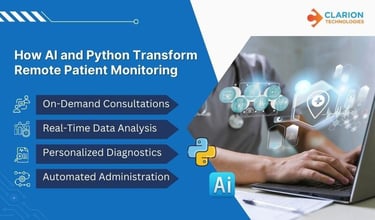
- Remote Patient Monitoring: Remote Patient Monitoring and Telemedicine,AI-powered devices and platforms monitor patient health in real-time, providing alerts for abnormal readings, and facilitating virtual consultations enabled by ai app development company expertise and python in healthcare ecosystems.
The Role of Python in Healthcare AI
The popularity of Python for AI applications in healthcare can be attributed to its simplicity, flexibility and enormous ecosystem of libraries, making python in healthcare a a preferred choice for modern systems. In predictive analytics, it is a perfect toolkit since applications are unique, covering data preprocessing to building complex machine learning models within ai in predictive healthcare analytics environments.
Key Python libraries used in healthcare AI include:
- Pandas and NumPy: For efficient data manipulation and analysis in Python app development projects.
- Scikit-learn and TensorFlow: For building and training machine learning models used in AI in predictive healthcare analytics.
- Matplotlib and Seaborn: For visualizing healthcare data trends and outcomes within Python in healthcare dashboards.
- PyTorch: For deep learning tasks like image processing or natural language processing, supported by AI app development company teams.
Real-World Applications of AI and Python in Predictive Analytics
- Disease Risk Prediction
AI and Python-powered predictive models are aiding in detecting the risk of people developing chronic ailments such as diabetes, heart disease, and cancer through AI in predictive healthcare analytics and Python in healthcare platforms. By employing predictive models that analyze patient records, genetic data, and lifestyle factors developed via Python app development, healthcare providers can intervene early, improving outcomes and savings costs.
- Patient Monitoring
Python AI algorithms process the information from wearable devices in remote patient monitoring systems supported by Python in healthcare solutions. These systems can predict and warn medical staff in real time about potential health issues, from heart attacks to strokes, leveraging AI in predictive healthcare analytics.
- Drug Discovery
Artificial intelligence speeds up drug discovery by sorting through large datasets to find potential drug candidates through AI app development company innovations. Researchers utilize Python’s extensive libraries, frameworks, and mathematical model in Python app development to simplify this process, solving the problems of time and costs to bring new therapies to market.
- Hospital Resource Management
For instance, hospitals can take advantage of predictive analytics to predict patient admission rates, staffing needs, and equipment requirements through ai in predictive healthcare analytics powered by python in healthcare systems. Enabling optimal utilisation of resources without crowds and maximizing patient experience and operational throughput using scalable python app development.
Challenges and Ethical Considerations
While the integration of AI and Python in healthcare is promising, especially with the growing demand for AI app development company solutions and Python in healthcare platforms. It’s not without challenges:
-
Data Privacy: Patient Data Act/Data Protection Act (HIPAA, GDPR) impacting ai in predictive healthcare analytics implementations.
-
Bias in AI Models: Ensuring that AI models are trained on diverse datasets is crucial to avoid biased predictions in Python app development environments.
-
Interpretability: AI systems that generate interpretable results are critical for building trust and accountability in healthcare settings powered by python in healthcare.
-
Integration: Integrating AI solutions developed by an AI app development company into current healthcare systems can be a complex and resource-intensive process.
The Road Ahead
The future of healthcare lies in the seamless integration of AI and predictive analytics, with Python leading the charge as the go-to language for Python in healthcare and AI in predictive healthcare analytics. As advancements in machine learning, data processing, and cloud computing continue, through Python app development and AI app development company innovations, we can expect:
-
More accurate disease predictions using AI in predictive healthcare analytics.
-
Increased adoption of AI-driven diagnostics supported by Python in healthcare systems.
-
Enhanced patient engagement through personalized health insights built with Python app development.
-
A global push toward preventative care over reactive treatments enabled by ai app development company's expertise.
The combination of AI and Python in healthcare is a giant step toward better patient outcomes and a more equitable and efficient healthcare system driven by AI in predictive healthcare analytics and Python in healthcare innovation. Never have the potential to save lives, lower costs and democratize access to care been more within reach.
Transform healthcare with AI and Python. Start improving outcomes today!

Author

Dilip Kachot - Technical Architect Delivery
Dilip Kachot, a seasoned Technical Architect with over 7 years of experience in the Mobility domain, excels in driving successful delivery of cutting-edge solutions. His expertise lies in architecting and implementing innovative mobility solutions that align with the evolving technological landscape.