



Blog Overview
A leadership guide to cost, risk, and modernization decisions for CEOs, CFOs, and CTOs.
Technical debt refers to the long-term expenses that arise when businesses take shortcuts in their software development to achieve short-term goals. These shortcuts may initially speed up time to market, but eventually lead to inefficiencies, unpredictable delivery schedules, and increased operational costs.
By the time the board understands the buzzword "delivery problem," it's too late. Thousands in avoidable, compounded interest have already rendered the company bankrupt. This compounded interest occurs in three places most treasured by the executive team: controllability of operating expense, delivery predictability and agility against market or compliance change without compromising operational integrity.
Across mid-market and enterprise companies, technical debt is not created through bad development. It's created through rationalized, executive decision-making for growth; systems integrations from acquisitions occur before systems are in place; compliance expectations are set before architectural wellness is defined; expectations of ROI materialize in mere quarters while expenditures increase for decades.
Modernizing applications is the key solution to address technical debt for growing businesses. It involves updating and restructuring legacy systems to make sure they are effective, scalable, and align with current business objectives. Legacy application modernization is not cloud migration or rewriting an application. It's a case study in capital expenditure prioritization. It's the distinction between technology being a revenue-generating facilitator or an infrastructural overhead to the organization.
Executive Summary
-
Technical debt is future costs involved in relying on quick shortcuts and making suboptimal decisions, as trade-offs for shipping business software and applications faster.
-
Technical debt carries an accumulated interest, increases maintenance costs, and slows down innovation. It compounds naturally as technology evolves and as MVPs shift fast to validate markets.
-
Tech debt reaching the boardroom is seen as a red alert. It's a critical business risk that belongs on the business agenda. Boards are legally responsible for digital resilience, IT risk management, and scaling AI strategies.
The Pattern We See Across Growing Enterprises
Technical debt rarely accumulates in a uniform, fair manner. It appears that where the most distracted leadership attention pays off: homegrown systems that “do the job well enough,” integrations no one takes ownership of, and processes inherited from teams that no longer exist.
In these cases, what's meant to be a straightforward effort on the roadmap becomes excessively expensive in real-life application. Pricing adjustment affects legacy billing logic. Compliance query integrates undocumented means of data sourcing. Client portal enhancement requires supportive participation from multiple departments, gates to approval, and tenuous integrations.
But those organizations that suffer this drag are not the runners. They're high-growth organizations. They scaled up efficiently with an eye toward speed, acquisition, and merger efforts or with an eye toward regulatory compliance, and intentionally accrued debt along the way. But that's where management mistakes lie: debt is not static. Debt accrues. Each quarter of deferment complicates future effort, adds operational risk, and increases the difficulty of strategic optionality.
Why Most Boards Misdiagnose Technical Debt
Most boards misdiagnose tech debt because they view it as an engineering failure instead of a negative consequence of their failing business strategy. There's a fundamental misunderstanding and misalignment of business with technology, which leads to wasted investment and being stuck on the wrong priorities.
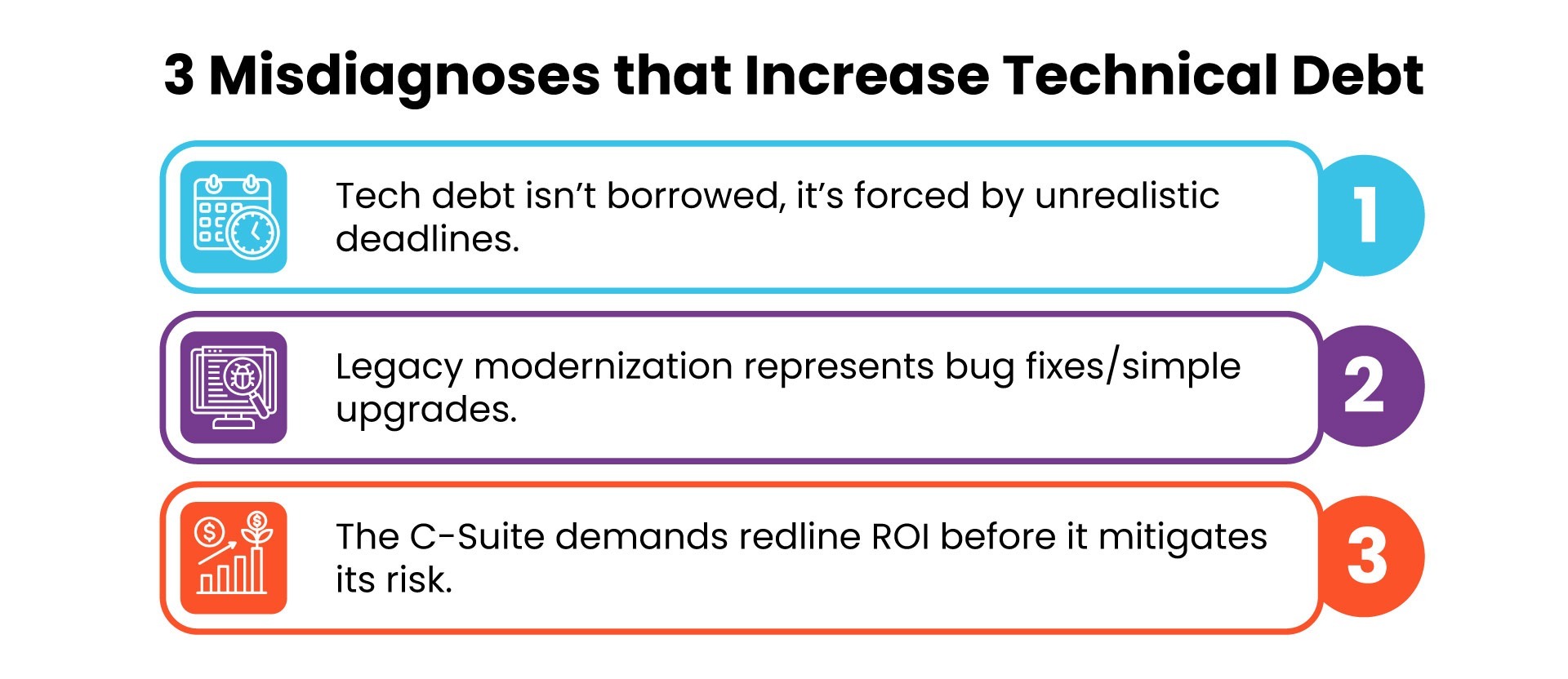
These three misdiagnoses happen regularly:
-
Tech debt isn’t borrowed; it’s forced by unrealistic deadlines. Boards blame negligence instead of software entropy and miss the actual issue.
-
Legacy modernization is seen as just making bug fixes or simple upgrades. Tech debt misses architectural debt, where actual systemic flaws lie. These require senior-level strategic re-engineering.
- The C-Suite wants redline ROI before it mitigates its risk (all the while the other option is triggering incrementally with quantifiable, unintended, undeclared compounded costs).
The reality is far simpler: the cost of inaction is already being absorbed, it just occurs in operating expense, risk exposure, and opportunity cost to equity without visibility.
An Enterprise Scenario: What Delay Actually Costs
A North American Logistics and Services company ($500M–700M annual revenue) experienced a multi-year growth period stemming from acquisition and regional expansion. Over time, the application footprint grew to include 120+ systems for billing, customer portals, compliance reporting, and partner integrations.
None of the systems was "broken". They became broken. Every new customer-facing enhancement required cross-team collaboration. Release cycles took weeks; if not quarters. Audit readiness was a semi-annual raised issue from non-existent data lineage and oversight of systems. Senior engineers found themselves knee-deep in integration stabilization, as opposed to checking features off the roadmap.
For executive management, modernization was postponed, not because the issue was not acknowledged, but because the risk of disruption was less undesirable than the visible costs of inaction. 18 months later, however, business as usual had changed; incidents were more common, cloud spend increased without performance improvements, compliance teams intensified audit exposure without need, and velocity and features stunted against competitors.
When legacy application modernization began, the first gut punch came from the portfolio assessment, where 30% of the portfolio was redundant, under-utilized or functionally obsolete. The lesson learned was not an urgency to act but the importance of value. Leadership did not possess a financial/risk-based rationale to assess what projects they could afford to not do during modernization and which ones they should do first, including what application modernization strategy to adopt.
When Not to Modernize (And Why That Matters)
There is no faster way to lose your credibility in an executive room than to announce that we must modernize everything. The reality is that sometimes modernization is not appropriate, and knowing when to hold back demonstrates your expertise.
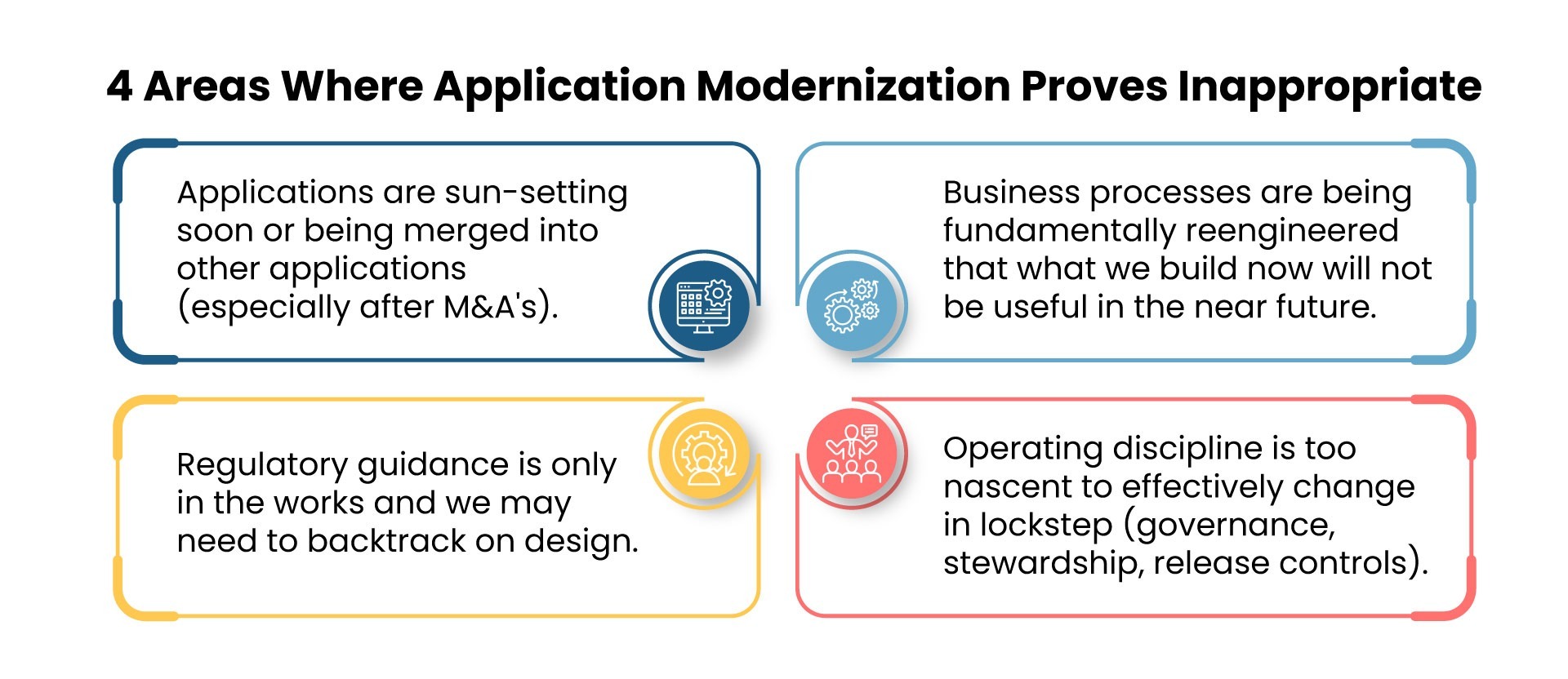
In this case, it's better to contain: contain the risk, reduce the blast zone, make dependencies known, create stewardship, and contain the budget until the situation improves. Those who modernize restraint and can effectively communicate why certain applications are legacy applications far exceed anyone who thinks the transformational tale of doing it all is worthwhile.
The Financial Reality CFOs Commonly Miss
Many application modernization business cases underestimate benefits due to over-indexing infrastructure savings. Infrastructure is real and quantifiable, but it's not usually the value that drives it.
The quantifiable financial equivalent comes through second-level benefits that snowball from the proverbial devil's advocate: fewer problems and escalations (unplanned man-hours), smaller sprints (time to revenue), audit predictable preparedness (less compliance babying) and more retention of senior technical personnel (less turnover and rebuilding costs).
From an enterprise perspective, such things are rarely present in year one. They are present in the 12-36 month range, and that's why they are underweighted. Therefore, it's a shame that the necessary modernization is deferred without the anticipated ROI, but the pay grid is still significantly higher and more unmanageable at the time of request.
AI, Compliance, and the New Debt Multiplier
AI redefines the technical debt equation. The longer a system's in place, the more AI vulnerabilities there are: uncertain data flows, legacy schemas, and easier integrations complicate lineage, controls, and accountability, something that greatly regulated environments demand.
Companies layering AI capabilities over technical debt not yet resolved frequently find they get what they didn't ask for: increased compliance risk, increased validation requirements, and reduced time to value. If models are running as they should from the start, the variation upstream will tank performance over time. Therefore, technology modernization should be viewed as a prerequisite to responsible automation - not a “nice to have”.
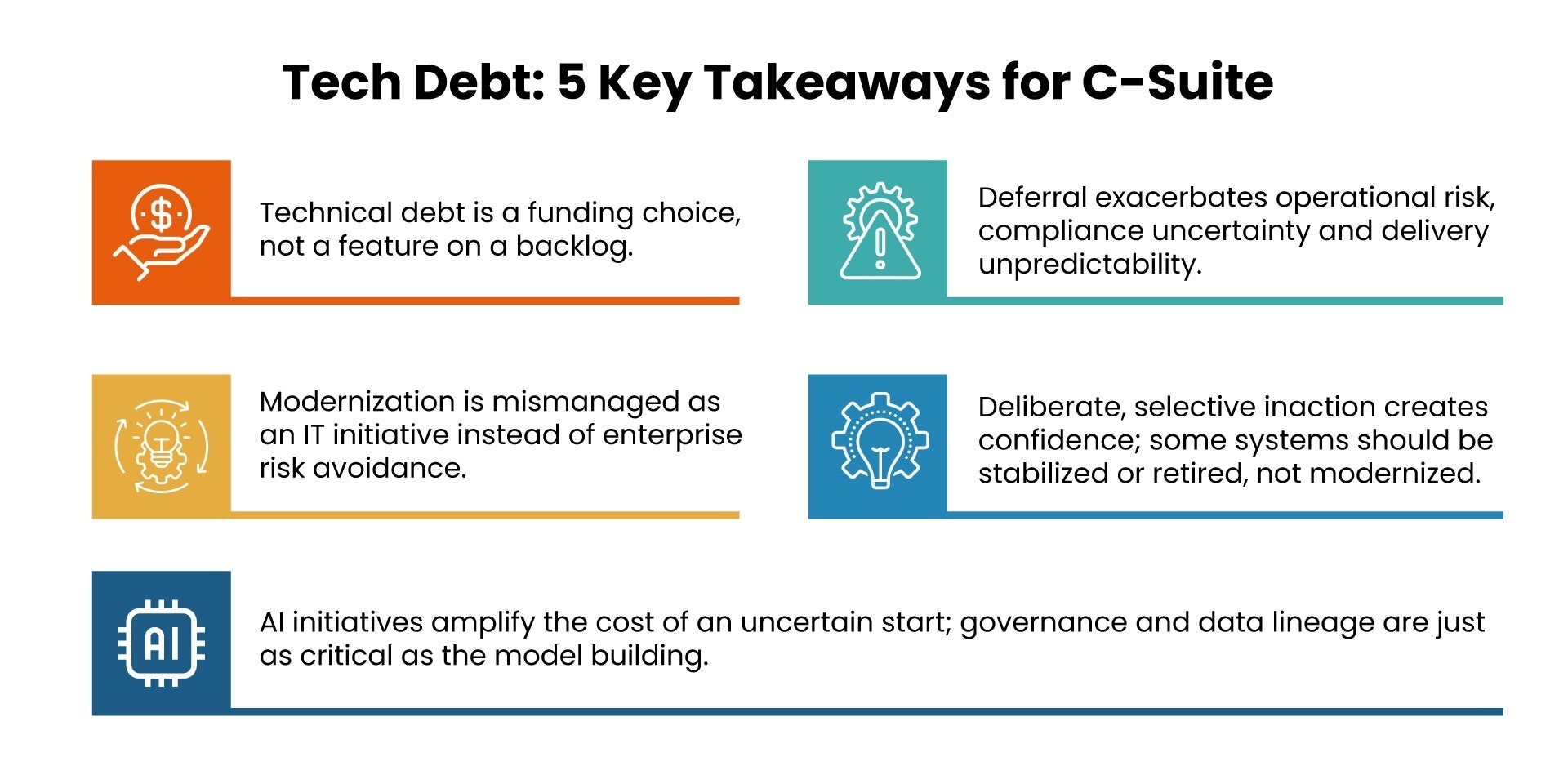
Executive Takeaways (CEO / CFO / CTO)
Advisory Checkpoint: A Practical Next Step
Within two weeks of assessment, most enterprise assessments reveal $800K to $2.5M in annual avoidable costs. Not from waste in the infrastructure but from operational drag and insufficient risk. The opportunity is not to create another map, but to assess which applications are just too good at making money with no one talking to them and which solutions can alleviate risk with the least direction and impact.
When you require a portfolio snapshot to determine what should sunset, be stabilized and modernized first, assessments provide easy avenues for resourcing such determinations, but not recommendations you've seen elsewhere. This is the same with application modernization services.
What a Sensible Modernization Decision Looks Like
A good application modernization strategy will empower your digital transformation efforts. Application modernization services can align your architecture with business goals and realize your investment value. Sensible application modernization can reveal to you what your organization requires and successfully implement the best roadmaps with a phased approach. Over time, the results of your assessments will also evolve, however your strategy evolves.
Executive business leaders won’t be locked into month-long journeys that way, as results accrue. They will appreciate intra-execution decisions that permit risk to be eliminated early and lessons to be learned with capital redeployment without brand equity risk.
They measure outputs, not technological milestones. The most successful modernization efforts are measured by rates of reduced incidents and quarterly releases approved, audit friction reduced, and confidence in delivery increased, not the percentage of workload transitioned to the cloud or the purity of the architecture.
Conclusion
At Clarion Technologies, we can help you figure out your organization's technical debt. Our team can give you insight on which apps to retire immediately, which to rehost for quick wins, and which ones to refactor for long-term ROI. We'll also help you do break-even projects and do financial impact analysis so you get the complete picture on how it costs to maintain systems, address compliance risks, and not miss business opportunities.
Schedule your assessment now. Get your detailed report within 2 weeks showing exactly where technical debt is hitting your budget hardest and what to fix first.
Final Advisory Next Step
A legacy modernization strategy should answer three questions quickly and credibly:
-
Which applications should be retired or unified immediately?
-
Which systems can reduce costs or increase risks with minimal disruptions to the business involved?
-
Which platforms are worth deeper investments, and what metrics and actions produce the best and most measurable outcomes?
It’s hard enough finding developers who speak both legacy COBOL and cloud-native architecture. Application modernization services are the answer. That's also where structured application modernization strategies and roadmaps come in. They are built by teams who've done this.
If you want a decision-ready view of technical debt’s financial impact and a pragmatic modernization sequence, Clarion Technologies can deliver a concise report within two weeks, built to support executive decision-making, not just IT planning.
Author

Dilip Kachot - Technical Architect Delivery
Dilip Kachot, a seasoned Technical Architect with over 7 years of experience in the Mobility domain, excels in driving successful delivery of cutting-edge solutions. His expertise lies in architecting and implementing innovative mobility solutions that align with the evolving technological landscape.