Thought Leadership to Decode Innovation & Accelerate Smart Business Decisions.

Choose Value with Competitive Costs through our IT Outsourcing ROI Calculator. Get Your Report
Hire Pre-Vetted Engineers with 2-weeks, Risk-Free Trial Get Started
Build your own Agentic AI. Book a Slot

Case Study - Modernizing Legacy IT Infrastructure for an Oil & Gas Company

Case Study - Modernizing Legacy IT Infrastructure for an Oil & Gas Company
Driving Operational Efficiency with Legacy System Modernization in Oil & Gas Company - Clarion Case Study

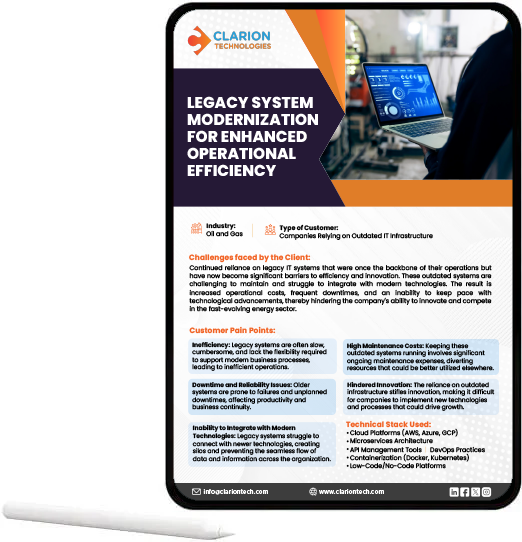
A US-based oil and gas company relied on legacy IT infrastructure that had become increasingly difficult to maintain, limiting operational efficiency and innovation. As business demands evolved, outdated systems created integration challenges, increased maintenance costs, and reduced system reliability. Clarion partnered with the organization to modernize its IT landscape through a phased cloud transformation strategy.

The Challenges:

  • Legacy IT systems became costly to maintain, increasing operational expenses and limiting business agility.

  • Frequent downtime and reliability issues disrupted business continuity and reduced operational efficiency.

  • Outdated infrastructure made it difficult to integrate modern technologies and prevented seamless data exchange across the organization.

  • Inability to connect existing software applications with modern cloud technology.

The Solution:

  • Clarion modernized legacy applications by migrating them to cloud platforms including AWS, Azure, and Google Cloud Platform (GCP), improving scalability, flexibility, and cost efficiency.

  • Implemented a microservices architecture with API management tools to improve application scalability and enable seamless integration with modern technologies.

  • Adopted DevOps practices, CI/CD pipelines, Docker, and Kubernetes to automate deployments, improve reliability, and accelerate software delivery.

  • Executed a phased modernization strategy using low-code/no-code platforms to minimize business disruption while accelerating application modernization.

The Business Outcomes:

  • Reduced legacy system maintenance costs by up to 50%.

  • Improved system reliability by 40%, reducing downtime and enhancing operational efficiency.

  • Build a more agile, scalable, and responsive IT infrastructure that responds quickly to market demands.

  • Accelerated innovation by enabling integration with modern cloud technologies and APIs.

Frequenty Asked Questions

How do microservices help oil and gas companies update old systems?

Many energy companies still rely on outdated software, leading to inefficient processes. Breaking large applications into smaller microservices using Docker and Kubernetes enables safer, faster updates and improved system agility. A microservices architecture helps energy companies by

  • Breaking large applications into smaller, independently manageable services.

  • Enabling seamless deployment across cloud platforms such as AWS, Azure, and Google Cloud.

  • Improving system resilience by isolating failures and reducing the risk of organization-wide outages. 

  • Accelerating software releases, allowing new features and updates to be delivered more quickly.

Why are APIs essential for connecting legacy systems with the Cloud?

Many energy companies rely on legacy systems that struggle to integrate with modern cloud platforms, creating data silos and limiting accessibility. API management solutions bridge this gap by enabling secure, seamless data exchange between legacy and cloud-based applications. APIs support modernization by:

  • Facilitating seamless data exchange between on-premises systems and cloud applications.

  • Allowing business operations to continue uninterrupted during modernization phase.

  • Eliminating data silos and improving information accessibility across teams.

  • Faster integration with low-code and modern applications without major redevelopment.

How do CI/CD pipelines reduce downtime and deployment risks?

Manual software updates can lead to errors, downtime, and slow releases. CI/CD pipelines automate testing and deployments, enabling faster, more reliable software updates. CI/CD pipelines help energy companies by:

  • Finding defects early through automated testing.

  • Implementing new features and enhancements faster with minimal disruption.

  • Reducing manual effort and lowering operational costs.

  • Ensuring consistent, predictable, and smooth software releases.