Thought Leadership to Decode Innovation & Accelerate Smart Business Decisions.

Choose Value with Competitive Costs through our IT Outsourcing ROI Calculator. Get Your Report
Hire Pre-Vetted Engineers with 2-weeks, Risk-Free Trial Get Started
Build your own Agentic AI. Book a Slot

Building a Flutter-Based Energy Consumer Management App for Android and iOS

Building a Flutter-Based Energy Consumer Management App for Android and iOS
Building a Flutter-Based Energy Consumer Management App for Android and iOS - Clarion Case Study

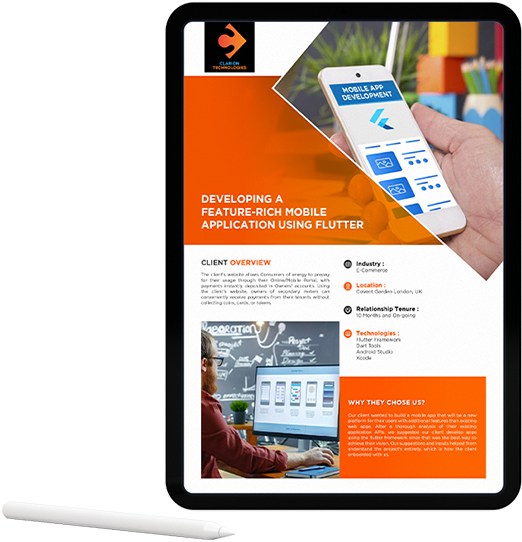
The client operates an online and mobile energy payment platform that enables consumers to prepay for energy usage and allows property owners to receive payments from tenants. The platform supports prepaid meters and digital payments, providing an alternative to traditional coin, card, or token-based payment methods. The client partnered with Clarion to expand its existing web capabilities through a feature-rich mobile application.

The Challenges:

  • The current web platform did not provide mobile access for the users. 

  • The business wanted to simplify prepaid energy payments.

  • The platform needed a consistent experience across mobile systems.

  • The company required a scalable application for future updates.

The Solution:

  • Developed a cross-platform mobile application using Flutter and Dart for iOS and Android.

  • Added auto-recharge, Fast Add Credit, bill payments, payment-source management, and recharge history.

  • Integrated energy usage charts, bill downloads, delivery tracking, and prepaid meter management.

  • Added EV charger search, credit top-up, and automatic refund functionality for unused charging balances.

  • Created UI wireframes and developed the application for iOS and Android based on the approved designs.

The Business Outcomes:

  • Built a feature-rich mobile app featuring auto-recharge, EV charger discovery, and one-step fast credit.

  • Delivered substantial cost savings through flexible resource scaling and affordable development teams.

  • Established a streamlined, well-documented process flow for clear tracking and predictable development cycles.

  • Provided 24/7 technical support and direct, transparent access to dedicated developers.

  • Enhanced customer experience by giving end-users full visibility into energy usage charts and bill histories.

Frequenty Asked Questions

Why do energy companies invest in Flutter mobile app development?

Flutter enables businesses to build applications using a single codebase. It easily compatible with both Android and iOS platforms, enabling critical functionalities for users. Key benefits include:

  • Single-codebase engineering eliminates the need for separate native development teams.

  • Reduced codebase complexity lowers ongoing software maintenance budgets.

  • Standardized UI components maintain visual consistency across all customer devices.

  • Direct compilation into native code accelerates deployment timelines significantly.

  • Flexible framework architecture simplifies future system integrations and updates.

What are the benefits of a mobile app for prepaid energy management?

A mobile application simplifies routine account management for everyday users. Key benefits are:

  • Users recharge prepaid meters anytime through a mobile device.

  • Customers monitor electricity consumption through regularly updated usage data.

  • Consumers save payment methods for faster future transactions.

  • Users view recharge and billing history in one place.

  • People access account information without manual processes.

What benefits do customers get with a streamlined UI built on Flutter Open-source Framework?

A streamlined user interface built on Flutter framework delivers smooth, fast, and highly responsive mobile experiences across devices. Key customer benefits include:

  • Flutter renders its own UI components, ensuring identical visual layouts and behavior on both iOS and Android.

  • Custom, flexible widgets enable clean layouts that make navigation simple and intuitive.

  • Streamlined interfaces reduce menu clutter, allowing users to complete key tasks in fewer taps.

  • Direct native hardware access minimizes visual glitches, input delays, and app crashing.