Thought Leadership to Decode Innovation & Accelerate Smart Business Decisions.

Choose Value with Competitive Costs through our IT Outsourcing ROI Calculator. Get Your Report
Hire Pre-Vetted Engineers with 2-weeks, Risk-Free Trial Get Started
Build your own Agentic AI. Book a Slot

Optimizing Retail Inventory with AI-Driven Demand Forecasting

Optimizing Retail Inventory with AI-Driven Demand Forecasting
Improving Retail Inventory Management with AI-Driven Inventory Optimization Solution - Clarion Case Study

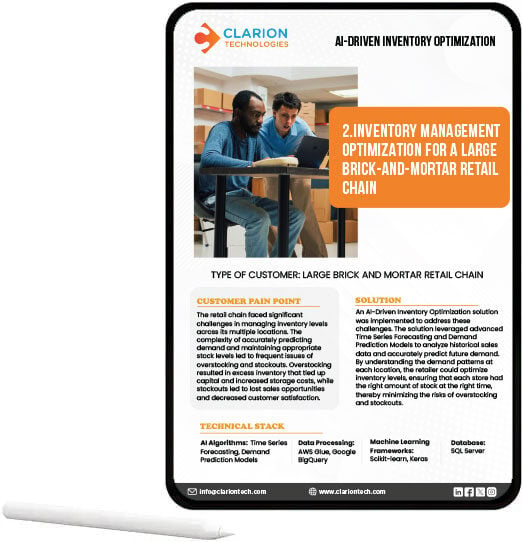
A large brick-and-mortar retail chain was managing inventory across multiple locations and struggled to accurately predict demand and maintain optimal stock levels. Overstocking tied up capital and increased storage costs, while stockouts resulted in lost sales opportunities and lower customer satisfaction. The retailer needed a more data-driven solution to manage inventory with changing demand across locations.

The Challenges:

  • Excess overstock tied up operational capital and inflated store storage costs.

  • Frequent stockouts created missed sales opportunities across key locations.

  • Inaccurate demand predictions led to unbalanced product distribution.

  • High holding expenses reduced total operating profit margins.

  • Poor inventory control lowered overall customer shopping satisfaction.

The Solution:

  • Implemented an AI-driven inventory optimization solution using time-series forecasting and demand prediction models.

  • Analyzed historical sales data to identify demand patterns and forecast future inventory requirements for each location.

  • Used AWS Glue, Google BigQuery, SQL Server, Scikit-learn, and Keras to process data and build the machine learning solution.

  • Optimized inventory levels based on location-specific demand, helping reduce both overstocking and stockouts.

The Business Outcomes:

  • Reduced overall overstock levels by 25% across all store outlets.

  • Improved product stock availability by 20% in physical locations.

  • Increased total net profit margins by 10% through reduced overhead.

  • Integrated custom prediction models into existing supply chain platforms.

  • Maximized working capital by eliminating unnecessary inventory accumulation.

Frequenty Asked Questions

How does AI inventory optimization improve retail operations?

AI-powered optimization systems accurately calculate the demand and supply needs through dynamic sales forecasts in real time. Key benefits include:

  • Predicting customer demand accurately across individual store locations.

  • Lowering excess storage expenses and holding costs.

  • Eliminating stockouts to capture every available sales opportunity.

  • Streamlining daily store replenishments to improve worker productivity.

  • Protecting operating profit margins through reduced product markdowns.

Why do brick-and-mortar retailers use machine learning for demand forecasting?

Machine learning algorithms identify complex sales patterns to predict localized demand accurately. Main advantages are:

  • Processing historical sales datasets to find precise seasonal trends.

  • Generating location-specific stock recommendations for every outlet.

  • Adjusting reorder points automatically when market purchasing behavior shifts.

  • Preventing human calculation errors during peak shopping periods.

  • Giving supply chain managers real-time visibility across all stores.

What are the operational benefits of real-time inventory monitoring?

Live tracking gives operations managers full visibility into stock levels of high-demand items, enabling businesses to benefit from:

  • Identifying declining inventory counts before total stockouts happen.

  • Reducing unnecessary transfer movements between regional distribution hubs.

  • Maintaining consistent shelf availability for top-selling product lines.

  • Improving overall supplier coordination through predictable ordering cycles.

  • Enhancing customer loyalty through dependable product availability.